







Oil & gas industry supporters rally at Colorado state Capitol against proposal to end new drilling

Chad Calvert listens to speakers during an opposition rally to Colorado Senate Bill 24-159, which would limit oil and gas exploration in the state, outside the Colorado State Capitol on Wednesday, March 13, 2024.
Tom Hellauer [email protected]
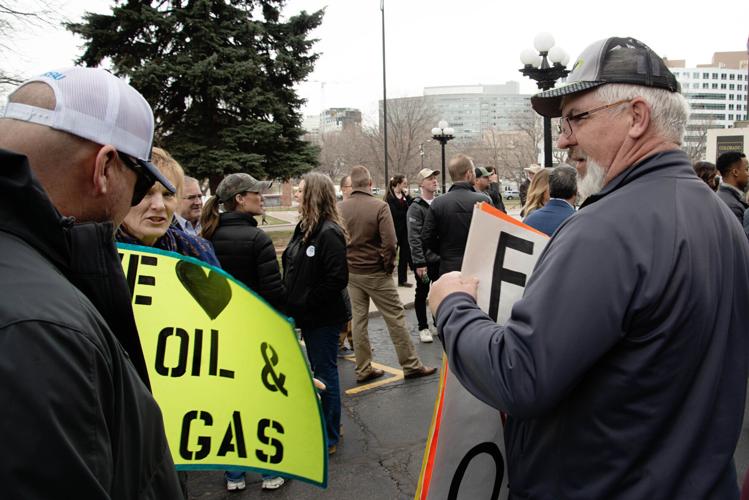
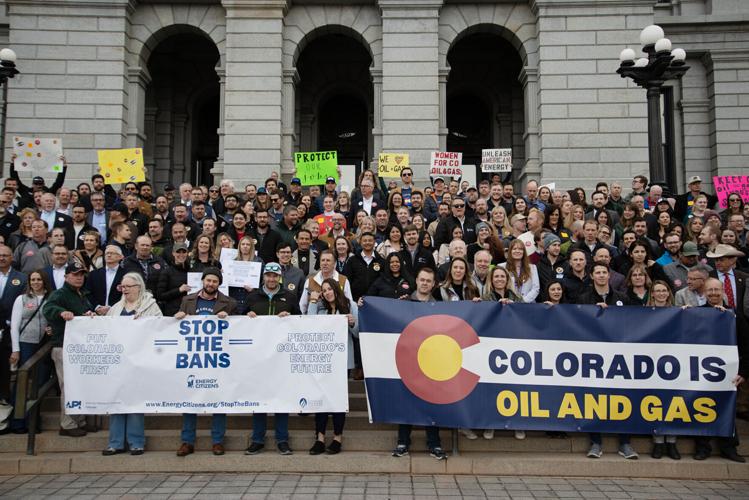
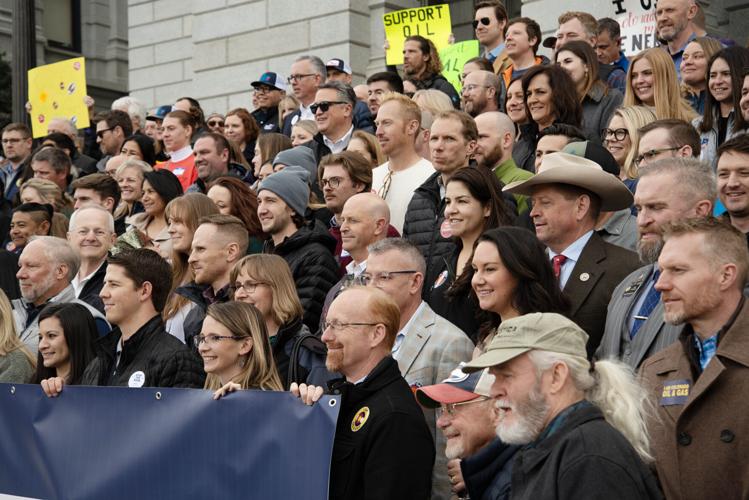
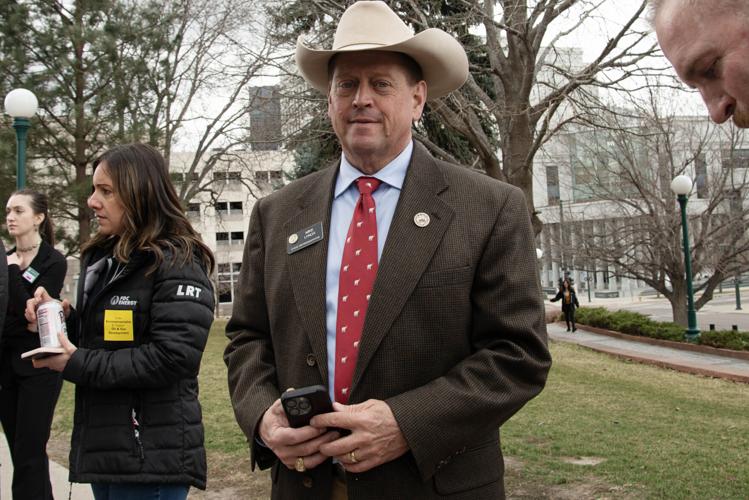
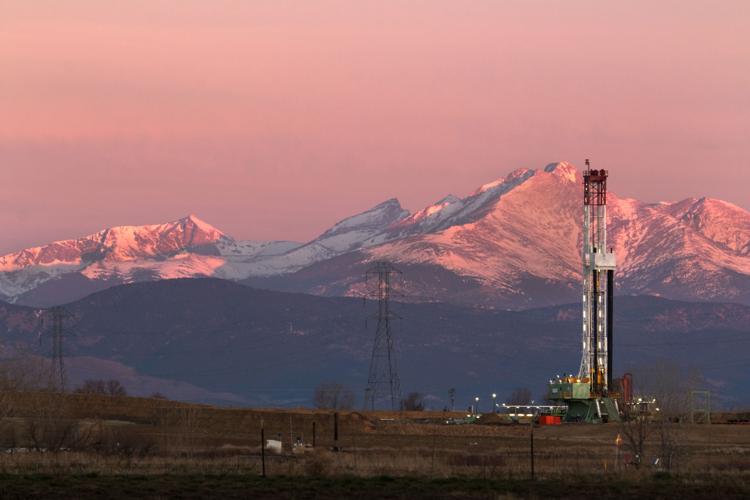
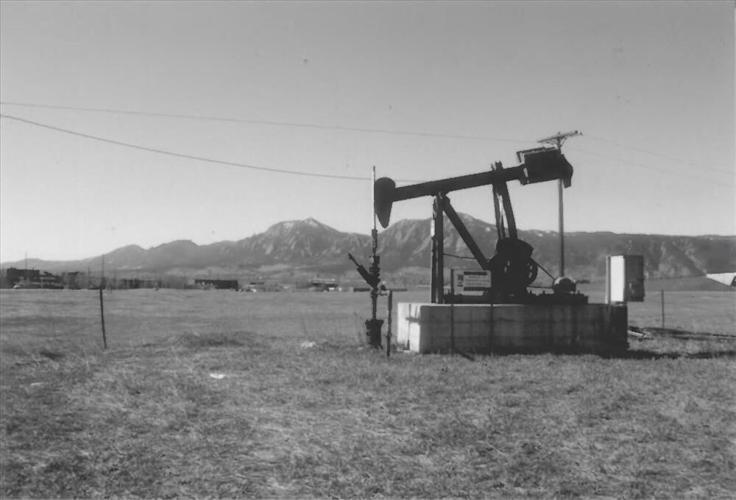
Representatives of Colorado’s oil and gas industry, along with hundreds of supporters, gathered on the west steps of the state Capitol on Wednesday for a rally opposing a proposal to ban all new oil and gas drilling by 2030.
Senate Bill 24-159 is scheduled to be heard on Thursday in the Agriculture and Natural Resources Committee.
Dan Haley, Colorado Oil and Gas Association president and CEO, Kim McHugh, COGA board chair and vice president of the Chevron Corp. Rockies Business Unit, and Kait Schwartz, the American Petroleum Institute Colorado director said they’re fighting for jobs and their industry.
“Look, we are in a fight for our industry, this is a tough place right now in Colorado,” McHugh said. “Our jobs, our communities, the economy of the state, we’re a vital part of that in this state. What we do is a noble cause. The world needs what we provide and it makes lives better. We need affordable, reliable, ever-cleaner energy.”
The bill — sponsored by Sen. Sonya Jaquez Lewis, D-Boulder, Sen. Kevin Priola, D-Henderson, Rep. Andrew Boesenecker, D-Ft. Collins, and Rep. Julia Marvin, D-Thornton — claims that Colorado’s economy is “ready for the clean energy transition” and adds the industry produces “roughly four times more natural gas, and two times more oil than Coloradans use.”
Oil and gas production in Colorado is among the state’s top industries.
A study from the American Petroleum Institute said that, in 2021, oil and gas activities contributed more than $48 billion to Colorado’s gross domestic product — $19.8 billion in direct benefits and $20.8 billion in indirect benefits, which constituted 11.2% of the state’s total GDP.
The study, prepared by PricewaterhouseCoopers, shows the industry supports more than 300,000 jobs, both direct and indirect, comprises 7.7% of Colorado’s total employment and provides $34.1 billion in labor income.
“Was anyone here five years ago when we rallied for our jobs,” Haley said. “Why do we have to keep coming back here? It’s going to snow tomorrow, and I guarantee you everybody in that building is going to turn up the heat just a little bit. Some of them are probably going to have their gas fireplaces on to keep their families warm and protected.”
Haley added: “Why on earth are we going to ban a resource that we need every single day that we’re going to depend on tomorrow to keep us warm and safe?”
This measure has a clause that the state will retrain employees.
Haley asked what oil and gas workers are going to be retrained to do — and by whom.
“Where are those jobs going to come from? The regulations that we’ve set up in the state are not conducive to bringing in jobs, bringing in employers,” Haley said. “So, how are we going to retrain a hundred thousand plus oil and gas employees?”
Sponsors said the move is necessary to counteract climate change and address “adverse health impacts.”
In an interview with The Denver Gazette in February, bill sponsor Jaquez Lewis said that, while oil and gas production is important to Colorado, it’s a “finite resource” and that “we can’t keep drilling forever.”
She also said that people and families living near oil and gas wells are developing adverse health conditions, such as asthma, “at an alarming rate,” and that the bill is “a land, air, water, and public health legislation.”
“Most Coloradans agree with us that we can’t keep drilling forever. This is an energy source that is finite,” she said.
Jaquez Lewis added that Colorado “needs to be a participant in what many other countries have pledged to do” to reduce fossil fuel production in order to decrease greenhouse gas emissions, such as via the Paris Accord of 2015.
“We have lawmakers who have introduced a ban on our industry,” Haley told The Denver Gazette. “If they get their way, thousands of Coloradans will lose their jobs. Costs will go up. Several other bills aim to walk us down the path of California, where there are rolling brownouts and blackouts, where they tell you what you can drive and when you can drive, (where) they tell you to plug in your EV, but don’t plug it in at this time because the grid’s going to collapse.”
“We don’t want to be California and we don’t have to be California,” Haley added.
When pressed in a prior interview about the constitutional issue of just compensation being required when the government takes private property for public use, Jacquez Lewis insisted that, because there are existing wells that won’t be closed by the legislation, banning new drilling won’t deprive mineral owners of their property.
“We are saying that they have thousands and thousands of wells that they have permits for. There is no takings,” said Jacquez Lewis. “They will be able to continue to produce. There’s nothing in the bill that says that they cannot keep producing from the wells that they have. It’s over 50,000 wells in the state.”
Disagreeing with Jacquez Lewis, Haley said that, while there are producing wells that won’t be closed, there are billions of dollars worth of untapped oil and gas reserves that would be rendered worthless by the bill and that could leave taxpayers on the hook to pay the owners for the value of those underground minerals.
“If the state were to go through with something like this, you could see billions of dollars being at risk through lawsuits.” said Haley.