







Five tons of equipment: How the Rockies prepared for trip to Mexico City | Sunday Special

Colorado Senior Director of Major League Operations Paul Egins watches the team warmup ahead of a 2023 game against the Washington Nationals at Coors Field.
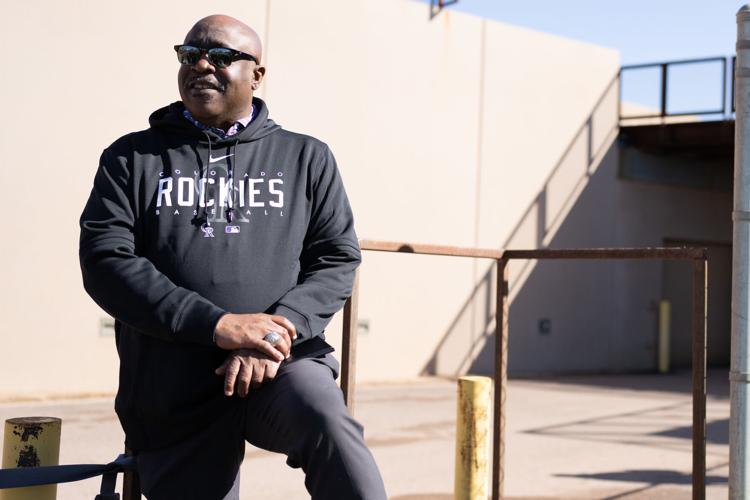

Paul Egins had the power of preparation on his side ahead of the Rockies’ trip to Mexico City, and he’s happy to have the hindsight of others as a guide.
The organization’s senior director of major league operations started his planning for the team’s two-game series at Alfredo Harp Helú Stadium two years ago and attended last year’s inaugural series at the park between San Diego and San Francisco for insight.
It was one of multiple scouting trips Egins made to Mexico City to scope out hotels and attractions for the team when it arrived Friday.
Egins and Colorado clubhouse manager Mike Pontarelli are in charge of numerous details unique to traveling abroad. The club had the added challenge of doing so twice in April if you add their Canada trip to Toronto. They are the third team in league history to play a game in three countries in one month.
A running log of details, from the team’s manifest to all of its travel plans leading up to leaving, is its guide for three-plus days.
The Rockies’ manifest is a list taken on each road trip and is never more important than when they travel abroad. It’s the club’s lifeline to easily pass through customs without being subject to additional wait times. Pontarelli and company have the list down to a science developed each trip throughout his years on the job.
Each bin holds bats, baseballs, jerseys, equipment and other necessities for the trip. If players want to bring golf clubs for off days, even for the club’s subsequent trip to Miami, that’s accounted for too.
It will add 10,000 pounds of equipment and 4,500 pounds of luggage to the Boeing 757’s passenger weight — which includes 79 people for the trip, up from a typical 58-60 — and each must be accounted for. Each bin gets an individual number and a corresponding description on the manifest.
If a bin must be removed, Pontarelli can bring up his Excel sheet, call them up by number, and have them removed before being trucked to the awaiting charter. A final list is due to customs 72 hours before the flight.
“Every inch of that plane is accounted for,” Pontarelli added.
And it must be correct — except in a different way than the club’s previous trip across a border. Egins made a scouting trip in January to go over rules with customs agents at the airport.
“Going through Canada, they had security dogs who were checking on things,” Pontarelli said. “But going through Mexico, they’re a little more stringent on making sure they know what’s in each bin. They want to know, internally in each truck, what brands, name brands, stuff like that.”
And the bins have multiplied from the previous trip.
Colorado was on a traditional road trip when the club went to Toronto. This trip is different and requires over double the amount of jersey preparation. The grey jerseys that normally accompany the Rockies on the road need home counterparts since they were deemed the home team in Mexico City.
So purple and pinstripes were added to the load. Each player needs multiple jerseys in case one gets damaged, so double the previous amount again — all with a tight seamstress deadline.
MLB didn’t originally notify Colorado of a sponsored jersey patch, so Pontarelli made a quick call down the street when it did.
“My uniform order for Mexico City arrived, and then they sold the patch,” Pontarelli said. “So I called our seamstress and said ‘Hey, I’ve got about 250 jerseys that need patches on them.’ She came right in this week and patched all of them — jerseys for the active guys, the coaches, and all their backup jerseys.”
The team and front office work hand-in-hand when deciding which jerseys and equipment are needed.
Injuries on or right before the trip could necessitate roster moves. Egins, Pontarelli and the rest of the staff put together a list of what names could join the club, and what extra luggage may be joining the manifest to account for it.
Egins and the league collaborate to plan security measures to protect the eventual list of travelers.
The team is always accompanied by a traveling security professional (TSP) but will have a four-person team for the Mexico City trip. The league also provides a resident security agent (RSA) to join in the team’s hotel and throughout the trip.
Egins’ scouting trips find where the team can be safest outside its hotel, too.
His process included finding accommodations in Polanco, an affluent neighborhood of Mexico City, to allow players freedom when they roam. Any players venturing outside of the area have been briefed on what to expect in adjoining towns and have the hotel’s transportation system available to help, too, an extended part of Egins’ hotel checklist.
That same checklist was used to find a hotel where it wouldn’t be necessary to leave. Saturday’s starting pitcher, Cal Quantrill, needs a relaxed day before his outing to conserve energy. Quantrill and others who choose to stay nearby have restaurants and attractions inside the hotel to save the trouble of a commute. In his search through three hotel options, Egins used it as a tiebreaker.
Come Sunday, the same manifest that got the Rockies across customs must be rechecked. Each piece of luggage’s content will have to be verified, weighed and attached to a number once again for easy maneuvering.
Years of work went into the two-day event, and its value extends to a foreign country being once again exposed to Major League Baseball.
Pontarelli goes by the nickname “Tiny.”
His and Egins’ task to get the Rockies to Mexico was anything but.