







Air Force wants new ‘Doomsday’ planes and this Englewood campus will play key part
Courtesy photo, Air Force / Sgt. Jerry Morrison
The U.S. Air Force wants a new generation of its planes built to survive a nuclear war — and some of that work will be done out of a south Denver suburb.
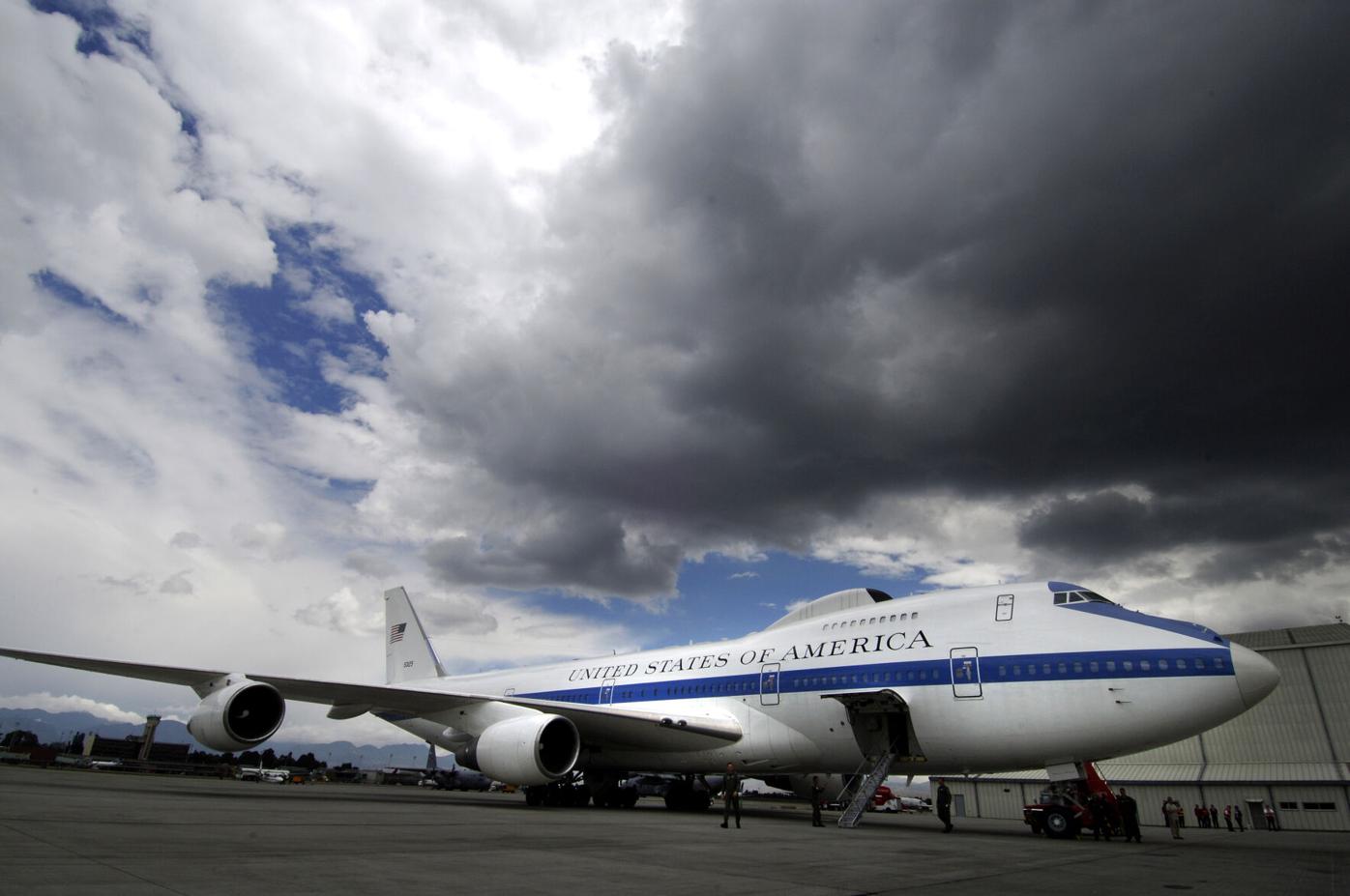
The E-4B “Nightwatch” — nicknamed the “Doomsday” plane and the “Flying Pentagon” — is designed to withstand nuclear attacks and serve as an airborne headquarters to command the U.S. military if ground command centers are destroyed. It’s also the Secretary of Defense’s travel plane, much like the president’s Air Force One, during peacetime.
The current fleet began service in the 1980s and is expected to reach the end of its life in the next decade.
The next generation will be built by defense company Sierra Nevada Corp., the Air Force announced last week.
The company — who’s aviation and military division is headquartered out of its Rocky Mountain Campus in Englewood, south of Centennial Airport – won the coveted $13 billion fixed-price contract after Boeing dropped out last year.
The contract is a big win for Sierra Nevada, a mid-sized defense company that trade publication Aviation Weekly called an “underdog.” It’s the 57th-largest defense contractor in the world and is estimated to have made $1.6 billion in revenue last year, according to Defense News annual ranking.
The new fleet will be called the “Survivable Airborne Operations Center.” It’s expected to be completed by 2036. Work on the project will be done out of the company’s Colorado base in Englewood, the Air Force said, as well as in Nevada and Ohio.
Sierra Nevada confirmed the contract and would not comment further, but communications director Ayse Caglar added that the Denver area is a “key location” and the company will be hiring.
The company will post “hundreds” of jobs related to the program this week, according to its website.
The company already posted 18 job positions based in the Denver area and 20 in Dayton, Ohio to build the “airborne command post of the future.”
Current open positions include aerospace and security systems engineers with estimated salaries starting at $80,000 to nearly $220,000 a year.
While some work on the new fleet will be done in the Denver area, Sierra Nevada also made a big investment in Dayton, Ohio by building the Aviation Innovation and Technology Center, a 90,000-square-foot aircraft modification hangar that opened in 2023. The company is also building another hangar of the same size and said it expects to develop more in the future.
It was running against defense giant Boeing, which built the current operating “Doomsday” fleet made up by militarized Boeing 747-200 jumbo jets.
Boeing is facing financial turbulence after an exit door blew off an Alaskan Airline plane mid-flight earlier this year, sparking federal investigations and intense scrutiny over its engineering.
But even before that incident, Boeing executives have told investors the company’s defense unit is losing money on fixed-price contracts, locking Boeing to complete a project and to a fixed payment, even if costs ended up higher.
Late last year, the Air Force eliminated Boeing, despite its experience with the “Doomsday” planes after the two parties couldn’t agree on contract terms and data rights, Reuters reported.
“We are approaching all new contract opportunities with added discipline to ensure we can meet our commitments and support the long-term health of our business,” a Boeing spokesperson told The Denver Gazette in an email. “We remain confident our SAOC approach was the most comprehensive, technically mature and lowest-risk solution for the customer and Boeing.”

The Air Force's flying nuclear bunker was developed during the Cold War. The 1970s fleet is expected to retire in the 2030s and Sierra Nevada's Rocky Mountain Campus in Englewood was selected to build the next generation of "Doomsday" planes.
Courtesy photo, Air Force


The Air Force’s flying nuclear bunker was developed during the Cold War. The 1970s fleet is expected to retire in the 2030s and Sierra Nevada’s Rocky Mountain Campus in Englewood was selected to build the next generation of “Doomsday” planes.
Sierra Nevada is not the only Colorado operation updating the U.S. militaries Cold War technologies.
America’s nuclear warheads are aging and each component of the nuclear triad — land, air and sea — needs upgrades, but none so much as the land weapon systems.
Colorado’s Hensel Phelps Construction Co., a construction firm headquartered in Greeley, an hour north of Denver, won its third and largest contract in January for the new weapon system replacing the 50-year-old Minuteman III intercontinental ballistic missiles.
The job is to build a command center at the Francis E. Warren Air Force Base in Wyoming. The Greeley-based firm was awarded a nearly $103 million contract for the project.
The Doomsday plane first went into service in 1974 with the earlier model E-4A. The Air Force got its first E-4B aircraft in 1980, and, by 1985, all of the service planes were B models.
The planes have high maintenance costs, and repair is expensive because of obsolete parts.
The aircraft can fly for up to 12 hours without refueling but can stay in the air longer as it can refuel inflight, according to the Air Force. In addition to nuclear blasts, it’s also built to withstand electromagnetic effects. It’s basically a mobile bunker for U.S. leaders to command the military.
The planes can also be used to assist the Federal Emergency Management Agency during natural disasters, such as hurricanes and earthquakes.
Reuters contributed to this report.