







The Department of Energy’s Atlas rail car is ready to move expended nuclear fuel safely
Railcar can carry 480,000 pounds of spent nuclear power plant fuel
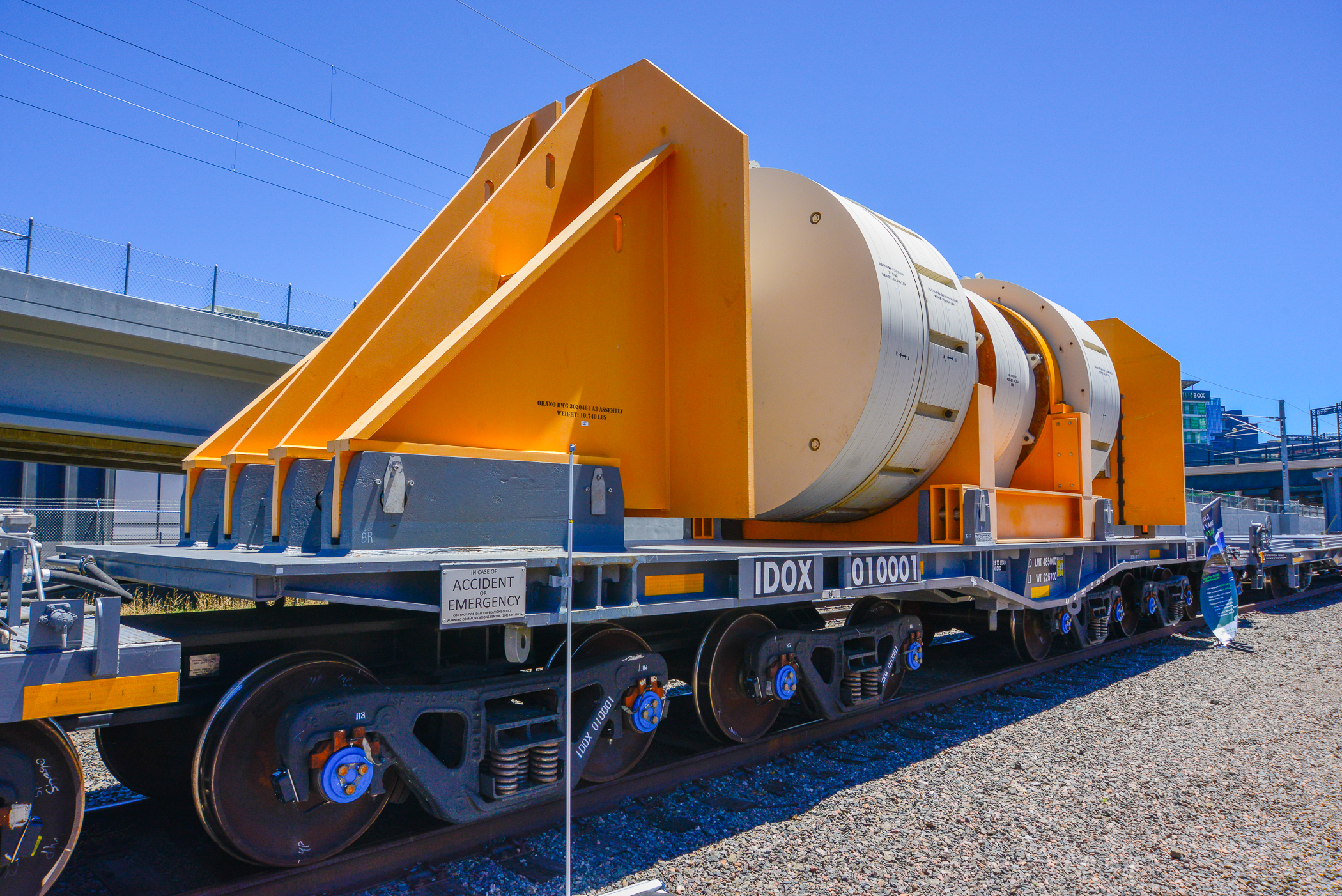
The U.S. Department of Energy’s new Atlas nuclear fuel transportation rail car made its debut in Denver this week at the Burlington Northern Santa Fe railroad yard north of Coors Field.
A product of 10 years of research and development, the Atlas rail car cost more than $33 million to build. But officials tout a safe, secure railroad transport system to move spent nuclear fuel.
Yes, the new transport emits low levels of radiation — no more than someone would get on a commercial airplane flight, experts said — but officials are confident the containers carrying the nuclear waste won’t be breached.
“Would (the public) like to see a package rammed, smashed into by a speeding train? Would they like to see it dropped from a great height? Would they like to see it retrieved from a body of water?” asked Erica Bickford, director of the DOE Office of Storage and Transportation in an interview with The Denver Gazette. “What kind of demonstrations could we perform that would give them trust and confidence in the safety of these packages and the transport of this material?”
More than 180 people in Denver signed up for the tour to the rail yards on Wednesday to see the Atlas system, which was recently fully certified for operational use. Testing was performed at the MxV Rail test site in Pueblo.
A heavy load
Designed to carry as much as 480,000 pounds of used nuclear power plant fuel rods, or other high-level nuclear waste, Atlas was built to fulfill the department’s obligation to eventually move and permanently store the growing stockpile of some 92,000 metric tons of spent nuclear fuel produced by the 94 nuclear power plants in the U.S.
The total maximum gross weight of the rail car, including the weight of the car and the maximum load it can carry, is 710,000 pounds.
But Atlas has 12 axles, which reduces the axle load to about 59,000 pounds per axle — below the 65,750-pound axle loading of a typical “100 ton” rail car with four axles, said Steve Maheras, a nuclear engineer at Pacific Northwest Labs which participated in the design process,.
The fully-loaded system of two flatcars to separate the locomotive and security car from the cask car recently completed a successful 1,680 mile trip from Pueblo to Scoville, Idaho.
Minimal risk of radiation leaking
Today, spent fuel rods are kept on site at each power plant, where they are encased in concrete dry casks for security and radiation protection.
The DOE is working towards siting a consolidated interim storage facility that would be operated by the agency, pending approval of a permanent disposal site.
The Atlas rail car, and its companions, are designed to secure the payload and ensure that malfunctions or accidents don’t happen. Officials said that’s even in the event of a catastrophic rail accident.
The transportation casks containing the fuel rods that are loaded onto the car are so robustly designed that there is only a tiny risk of nuclear materials escaping, Bickford said.
Built to all federal nuclear and rail safety standards, the federal energy agency has gone beyond the standards that have been used for 75 years by the U.S. Navy to transport nuclear materials from the naval fleet without incident.
Each car in the “consist,” or lineup of rail cars, is completely instrumented with sensors to instantly relay any problems — such as an axle bearing overheating — that allow the security team in the last car in the consist to take action to stop or otherwise deal with any problems.
In operation, up to seven three-car Atlas systems will comprise a single train. Seven was determined to be the largest number of cars that can be seen and visually monitored by security personnel.
But while the system design is certified, the testing will not stop just yet.
Testing safety measures
Bickford said the DOE is going to open a request for information from the general public, industry and other testing facilities to see what kinds of tests would boost confidence in the transportation system.
Bickford stressed public safety is the No. 1 goal of the project.
“We’ll be putting out a request for information this summer, inviting input from members of the general public, cask vendors, testing facilities and others to tell us what they would like to see in a demonstration,” said Bickford.
Because the transport containers are limited in size so the train will fit through rail infrastructure like tunnels, there are some small emissions of radiation from the containers. But the dose a person might receive is very small and is within federal exposure limits, even within about six feet, Maheras, the nuclear engineer, said.
Background radiation exists pretty much everywhere, including from the sun, but doesn’t cause any harm, according to Maheras.
“The (dose standard) that is the most important is measured from two meters from the edge of the conveyance,” Maheras said. “So, step off two meters, to about right here. That’s 10 millirems per hour. That’s the standard for the radiation dose rate from the cask.
“Now, for perspective, if you flew cross-country in an airplane, you would be getting somewhere around four millirems per hour. So, you can imagine the railcar going by you — you would be getting a small fraction of the dose because the car is moving.”
By comparison, according to the U.S. Nuclear Regulatory Commission, studies of occupational workers who are chronically exposed to low levels of radiation above normal background (below 10,000 millirems) have shown no adverse biological effects. It requires a dose of about 500 rem (1,000 millirems = 1 rem) all at once to be fatal without medical treatment, according to the NRC.
Maheras said moving 10 meters away from the railcar would decrease the exposure by a factor of five.
“As we get further away, it drops off as the square of the distance, so it decreases even faster as you get further away from the cask,” Maheras said.

