







Aurora council moves forward with plans to stop prosecuting domestic violence, challenge state law
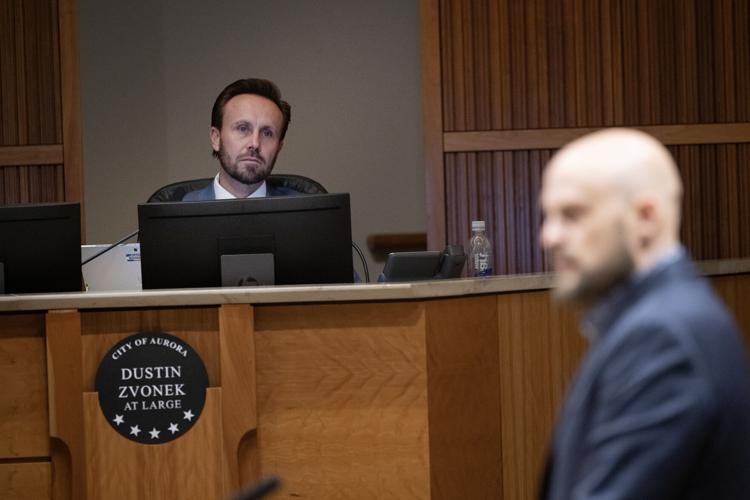
Timothy Hurst/Denver Gazette
Aurora lawmakers on Monday night moved forward with items that deal with the city’s handling of domestic violence cases and potentially explore a lawsuit against the state over a new law on indigent defense.
The first of the two is a resolution that directs “the City Manager, City Attorney, Court Administrator, and Presiding Judge to collaborate with key stakeholders” to create a plan to move domestic violence cases out of the city’s municipal court and into county courts instead.
The resolution says a plan — created with the input and assistance of various stakeholders — will be presented to the city council during a study session on Aug. 12. It must include a detailed timeframe for the transition and an analysis of the pros and cons of such transition, according to council documents.
At the last study session, Zvonek brought forth an ordinance directing the city to outright stop the transition, and the council decided to put the decision off after questions about how the transition would be handled.
Zvonek said Monday’s resolution is a way to “take a step back” and write up a plan before putting forward an ordinance, rather than the other way around, to make sure questions are answered and a plan is feasible.
“I would want to see what the true fiscal impact would be for us,” Zvonek said. “What this resolution does is direct our four appointees to come back and show us what a plan would look like. At that point, assuming there’s a plan (that) I believe is feasible, I would bring forward the ordinance.”
His resolution passed without opposition.
Zvonek also brought forth another resolution directing the city attorney to pursue legal action challenging Colorado House Bill 24-1437, which prohibits flat fee contracts for defending indigent clients.
Gov. Jared Polis signed the bill into law earlier this month.
The resolution alleges the law “violates the Colorado Constitution including home rule authority.”
“Forget the public defender’s part of it, I think the bigger question is whether or not this violates local control and home rule,” Zvonek said. “The state, by passing this bill into law, is essentially dictating to local governments like us how we can and can’t spend our resources.”
A request for proposals sent out by the city of Aurora in January to determine the potential costs of contracting out for indigent defense attorneys came back empty in March after months of tense discussion about the future of the city’s public defender’s office.
The City Council originally voted to send out the RFP — which was intended to figure out if court-appointed defense counsel using private attorneys on contract would be more cost effective than maintaining the city’s public defenders office — in October.
“That’s fine,” Zvonek said Monday of the request not attracting any submissions. “But I don’t think we should ever find ourselves in a position where the state is mandating this type of language on us and we just take it essentially.”
The city is also looking into partnering with the city of Lakewood in the lawsuit, Zvonek said. Lakewood and Aurora are two of three cities in the state that handle domestic violence cases in municipal court.
Pete Schulte, Aurora’s public safety client manager, said the resolution would allow them to talk to other city councils of other cities affected by the state legislation and assess how they view it.
“What this resolution would do is allow us to reach out to those other cities to see if their councils are having the same issues, if they feel like the state has come in and taken away some local control and then to look at whether or not a lawsuit is necessary,” Schulte said.
Councilmember Alison Coombs argued that the legislation doesn’t affect the city of Aurora, since it doesn’t contract out for indigent defense.
“It certainly doesn’t impact us right now except that we have to pay our contract attorneys adequately. We actually pay them much more than what the state requires right now,” Coombs said. “It’s equal pay for equal work, which we are bound by, and I don’t think we should be saying that we shouldn’t be bound by that either.”
Mayor Mike Coffman said he talked to senator state Rep. Mike Weissman, who sponsored the bill, and asked him why it only included cities that prosecute domestic violence cases and not all cities.
“He said he was already treading on local control and he didn’t want to go any further, so he certainly acknowledged to me that he was already treading on home rule authority,” Coffman said.
The resolution passed through city council’s study session without any opposition.