







Central City Opera comes bouncing back

A rendering of the set of "Pirates of Penzance" opening at the Central City Opera House Saturday. The set is made completely of paper by Papermoon Opera Productions. "Supertitles" will be projected on side walls.
Courtesy photo, Papermoon Opera Productions



Last season, Central City Opera was a mess.
Troubles with the union, a threatened walk-out by stage directors, a mid-season departure by the executive director. A mess. But the three productions made it through.
The news is good this year, said Scott Finlay, president and CEO. And he has the numbers to prove it, as the company opens its summer season on Saturday in the cozy Opera House, 45 minutes west of Denver.
“Everybody loves a good comeback story,” he said. “Ticket sales are the strongest since 2010. Pirates is almost sold out.”
That’s a reference to the opener, Gilbert & Sullivan’s comic operetta “Pirates of Penzance.” On succeeding Saturdays, the season’s two other productions will launch: Puccini’s “Girl of the Golden West” (July 6) and Kurt Weill’s “Street Scene” (July 13). Those are selling briskly, as well.
Finlay admitted that he could have lured supporters into taking pity on Central City Opera.
”We didn’t reach out with that,” he said. “We offered our reputation, we asked for trust.”
In response, the endowment has grown to $27 million. Five years ago, it stood at $9 million.
Last summer’s chaos was followed by a period of self-examination, Finlay said.
“We realized how we had been losing our way. So we began re-imaging ourselves, to discover where we wanted to go.”
That new direction involved new-audience development and working more diligently with diversity, equity and inclusion strategies. Plus, building long-term plans such as turning the Opera House into a year-round performance venue.
Those are big goals. But sometimes, little ideas can help a troubled organization heal and raise morale.
Artistic director Alison Moritz — who came aboard in February — spoke about “changing the ethos.” She mentioned a picnic.
“Yes,” she chuckled, “a company picnic. The people involved in all three productions getting together and meeting each other — which they never do, since they’re at work on their own shows. It helps everyone gain solidarity when you’re back from the brink.”
Moritz clarified that last remark: “I meant the entire opera industry after the pandemic. Everyone is re-evaluating. (Vocal) artists out there are watching us from afar. They ask how we’re doing. Here, we’re re-evaluating everything.”
Change is happening, beginning onstage.
Audiences arriving for Pirates and “Girl of the Golden West” will see that change. That’s because both shows are employing sets from Papermoon Opera Productions. The sets are indeed made of paper. It’s part of the magic of theater, says Fenlon Lamb, Papermoon’s co-creator, and artistic director (she’ll also be directing the Puccini).
“We use cut-out cardboard, creating trees and rocks,” she said. “We’ll use a lot of craft paper, too. This is a brand-new production for us. We’ve used projections on sets before with other operas, but not with Pirates – we’ll be doing that with Fanciulla (Puccini’s Italian title for Girl of the Golden West).”
The renderings for Pirates suggest a cartoonish atmosphere. Lamb reports that audience reactions to her stagings have ranged from delighted to astonished.
“One patron told me after seeing our Hansel and Gretel, ‘I cannot believe this is paper’,” Lamb said. “But everything was in fact paper – there were paper trees, paper woods.”
The company has staged a dozen or so operas around the country.
Lamb promised some surprises when the Puccini production is unveiled. Though the opera was originally set in a California mining camp, this version takes place in Central City. Cleverly chosen projections will reveal some familiar local images, we’re told.
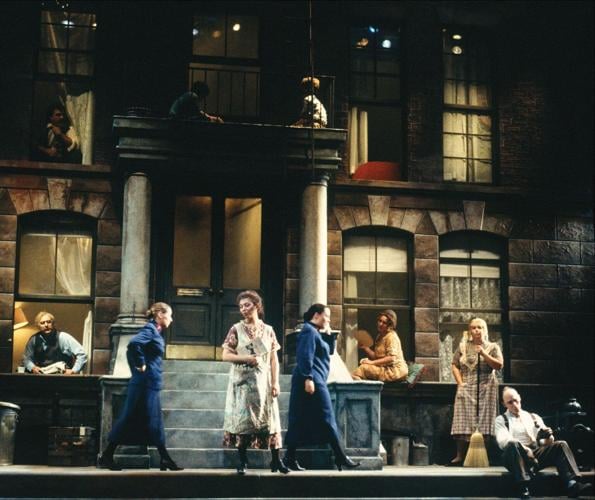
The new-look Papermoon shows will be balanced by the revival of Central City’s 1999 production of Street Scene, featuring the re-creation of a 1946 tenement on Manhattan’s East Side.
Managing the switch from paper to wooden stairs and walls is part of the job of production director Paul Horpedahl, who’ll be guiding the backstage maneuverings all season. And he won’t do it alone. He reminded that he’ll work with members of the IATSE Local 7 union — and that’s important to mention, considering all the labor troubles Central City Opera encountered in 2023.
“All the scheduling of manpower, hiring the union workers, taking care of the trouble-shooting — all that lands on me,” Horpedahl said.
A new wrinkle this summer is the projecting of supertitles, he noted. Instead of flashing them above the audience, the texts will appear on the side walls.
“This new concept has been used around the country,” he said. “I think people will like it.”
Change has come to a company that desperately needed it.
CEO Finlay put it simply with a modest plea: “Give us another chance.”