







Canine Companions: How a service dog makes life a little easier for Colorado Springs Paralympian
Parker Seibold, The Gazette
Amanda McGrory hadn’t even left handler training when she realized how much her service dog would affect her life.
The retired Paralympian was packing her bags to return home from a two-week training program, where she learned how handle to Calvin, a 2-year-old, blond Lab-golden retriever mix.
While getting ready to leave, she spilled her makeup bag. The toiletries fell onto the bathroom floor, jars rolling underneath the vanity and bottles sneaking behind the toilet. As a full-time wheelchair user who was used to living independently, she sighed and thought about what a pain it was going to be to collect everything.

Calvin demonstrates his ability to pick up items dropped by his owner, retired Paralympian Amanda McGrory, at their home in Colorado Springs on Thursday, June 27. McGrory got the 7-year-old Lab-golden retriever mix five years ago from Canine Companions.
photos by Parker Seibold, The Gazette


Calvin demonstrates his ability to pick up items dropped by his owner, retired Paralympian Amanda McGrory, at their home in Colorado Springs on Thursday, June 27. McGrory got the 7-year-old Lab-golden retriever mix five years ago from Canine Companions.
“The only way for me to do it is to get down on the ground and grab everything,” she said.
But then, it hit her.
“I was like, ‘Oh my God, I have a dog who can do this,’” she said. “Calvin retrieved all of my small items from under the vanity and behind the toilet in the bathroom as we were checking out, which was amazing … That was the first time that I was like, ‘Oh, this is great.’”
McGrory and Calvin have been navigating life together now for five years. A graduate of Canine Companions, 7-year-old Calvin helps McGrory with her day-to-day tasks — picking up dropped items, retrieving things and, of course, providing companionship.
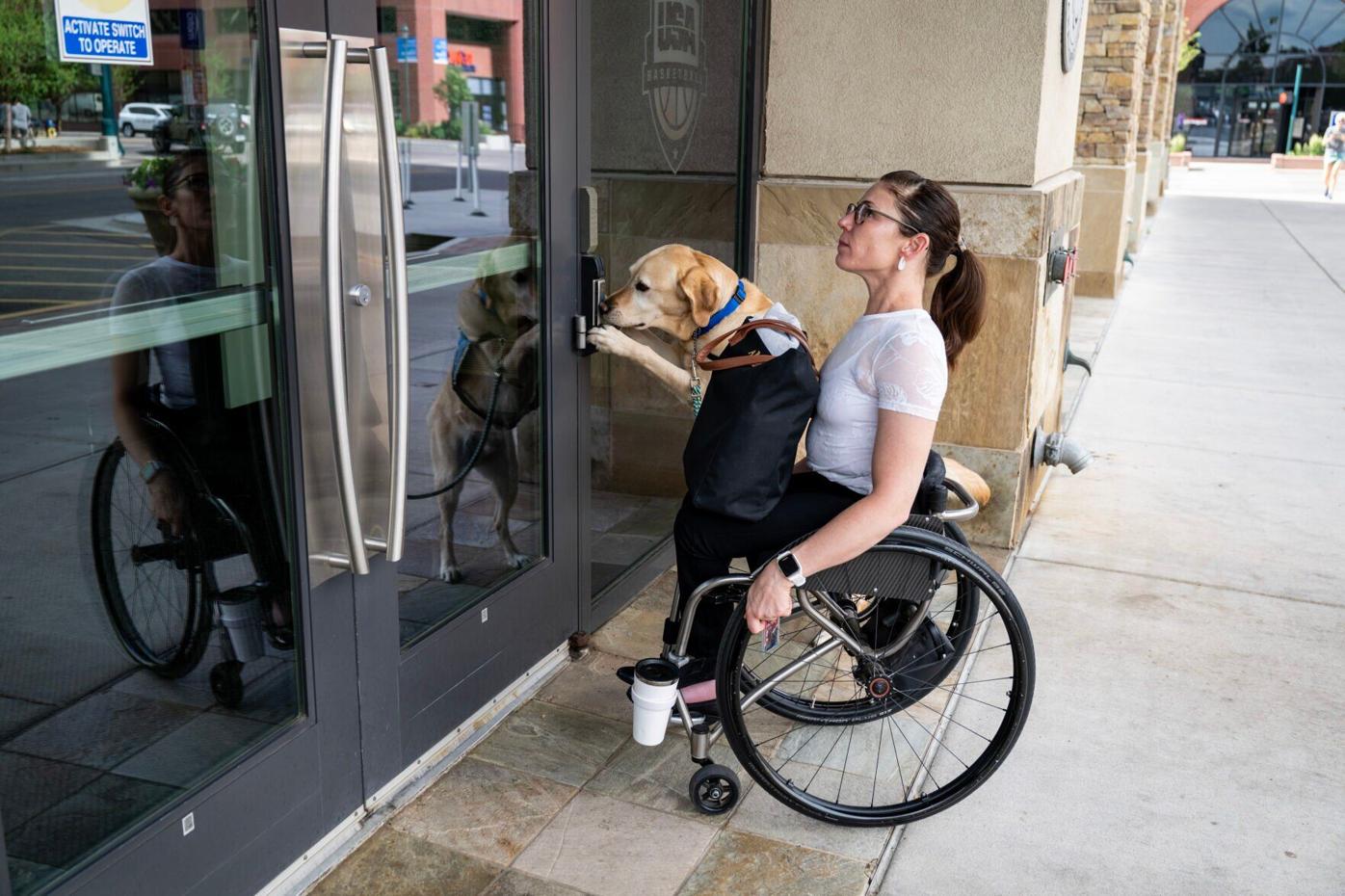
Calvin pushes the button to activate an automatic door at the entrance of the U.S. Olympic and Paralympic Committee Headquarters, where Amanda McGrory works as an archivist , on Thursday, June 27, 2024 .
Parker Seibold, The Gazette


Calvin pushes the button to activate an automatic door at the entrance of the U.S. Olympic and Paralympic Committee Headquarters, where Amanda McGrory works as an archivist, on Thursday, June 27, 2024.
McGrory knows about a half-dozen, if not more, Paralympians who also have a service dog through Canine Companions. As an accomplished athlete, McGrory faced an internal debate before applying at Canine Companions, worried she would be taking away resources from others. But, after meeting the service animals of other athletes and looking at the program, she decided to take the leap.
When McGrory was 5, she woke up to find herself unable to walk. McGrory and her family would soon discover she had contracted a rare neuroimmune disease, transverse myelitis, which resulted in paralysis.
At 10, she came across a newspaper article about the Atlanta Paralympic Games. That’s when she decided she was going to become a Paralympian, “without having any experience with sports whatsoever,” she joked.
At the same time, her local parks and recreation department in the suburbs of Philadelphia had received funding to start a youth adaptive sports program. She soon joined the program and started playing wheelchair basketball and participating in track and field.
“It was great because I was super active. I had a lot of energy, as many 11-year-olds do, and it was also the first time that I had a real group of friends and a real community of other young and active people who use wheelchairs,” she said.
McGrory would continue playing sports through high school, eventually being recruited by the University of Illinois on a wheelchair basketball scholarship.
So, how’d she end up a Paralympic track athlete? McGrory said she was bribed to compete in a marathon her sophomore year of college, and from there, everything just kind of fell into place.
“It turned out that the reason why I wasn’t having the success I wanted to as a track and field athlete was because I was doing the wrong events,” she said. “I was not meant to be a sprinter. But I was a long-distance athlete.”
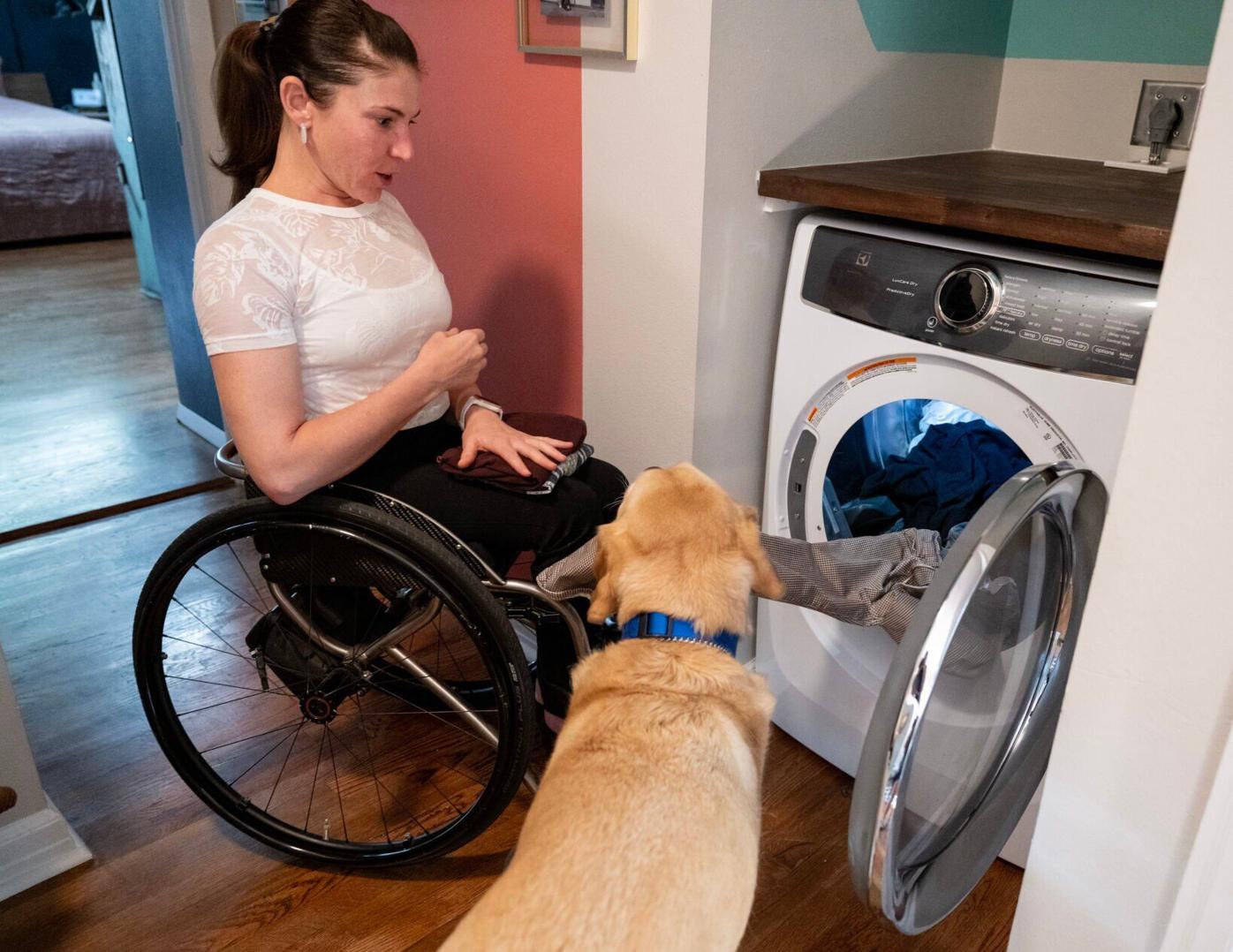
Calvin demonstrates how he helps Amanda McGrory with laundry by unloading clothing from the dryer on Thursday, June 27 , 2024 . The nonprofit Canine Companions trains dogs and then matches them with applicants based on their needs.
photos by Parker Seibold, The Gazette


Calvin demonstrates how he helps Amanda McGrory with laundry by unloading clothing from the dryer on Thursday, June 27, 2024. The nonprofit Canine Companions trains dogs and then matches them with applicants based on their needs.
Two years later, she competed at the 2008 Beijing Paralympic Games, bringing home gold (5,000 meters), silver (marathon) and two bronze medals (800 meters, 100-meter relay). She graduated with her bachelor’s degree in 2010 and went on to compete at the 2012, 2016 and 2020 Paralympics, and earn a total of seven medals (one gold, two silvers, four bronzes). And if that’s not enough, she also earned her master’s in information science in 2018.
Before applying for a service dog at Canine Companions, McGrory struggled with the idea of taking away a resource from others — a feeling compounded by being an accomplished Paralympian.
“As athletes, we tend to minimize the effects of our disabilities on who we are and our day-to-day lives, because we are focused on being stronger and faster and really competitive,” she said. “But that doesn’t change the fact that I, like all Paralympians, have a permanent disability, and one that does affect my day-to-day life, and affects the way that I am able to function in a world that very honestly was not created for someone like me.”
Having grown up with huskies, she had always really wanted a dog of her own. But she knew she would need a well-trained pup who wouldn’t be spooked easily and run off.

Calvin rests his head on Amanda McGrory’s lap on Thursday, June 27, 2024 . McGrory emphasizes that even though Calvon works as a service dog doing practical tasks, ultimately he also provides companionship, which she was particularly grateful for during the COVID-19 pandemic.
Parker Seibold, The Gazette


Calvin rests his head on Amanda McGrory’s lap on Thursday, June 27, 2024. McGrory emphasizes that even though Calvon works as a service dog doing practical tasks, ultimately he also provides companionship, which she was particularly grateful for during the COVID-19 pandemic.
“One of the challenges as a full-time wheelchair user is training and controlling a big dog,” she said. If the pup could assist her day-to-day, that would be a bonus, she said.
McGrory was finally inspired to apply for a service dog with Canine Companions from a fellow Paralympian and friend who was matched with a dog a few years prior. After meeting her friend’s service dog, a black Lab and golden retriever mix named Colton, she became warmer to the idea.
So, in 2018, she began the application process. She had decided to let the organization decide if she was a good fit, sharing her fears with them through the rigorous application process.
“They were very, very reassuring that the purpose of a service animal — of a service dog — is to make your life better,” McGrory said. “As someone who used a wheelchair all the time, whether or not I was able to live on my own and hold down a job and drive a car, there are still things that having a dog could make easier.”
The organization Calvin graduated from, Canine Companions, was founded in 1975 in Santa Rosa, Calif. The nonprofit is the oldest and first service dog organization to exist in the U.S., said spokeswoman Sarah Zetlmeisl.
Canine Companions originally trained dogs to serve individuals with physical disabilities but has since expanded its reach to provide service dogs for those with hearing loss, veterans with PTSD and children with autism, Zetlmeisl said. Canine Companions provides these service dogs free of charge.
Training these pups is no easy task — the process starts the day they’re born, Zetlmeisl said.

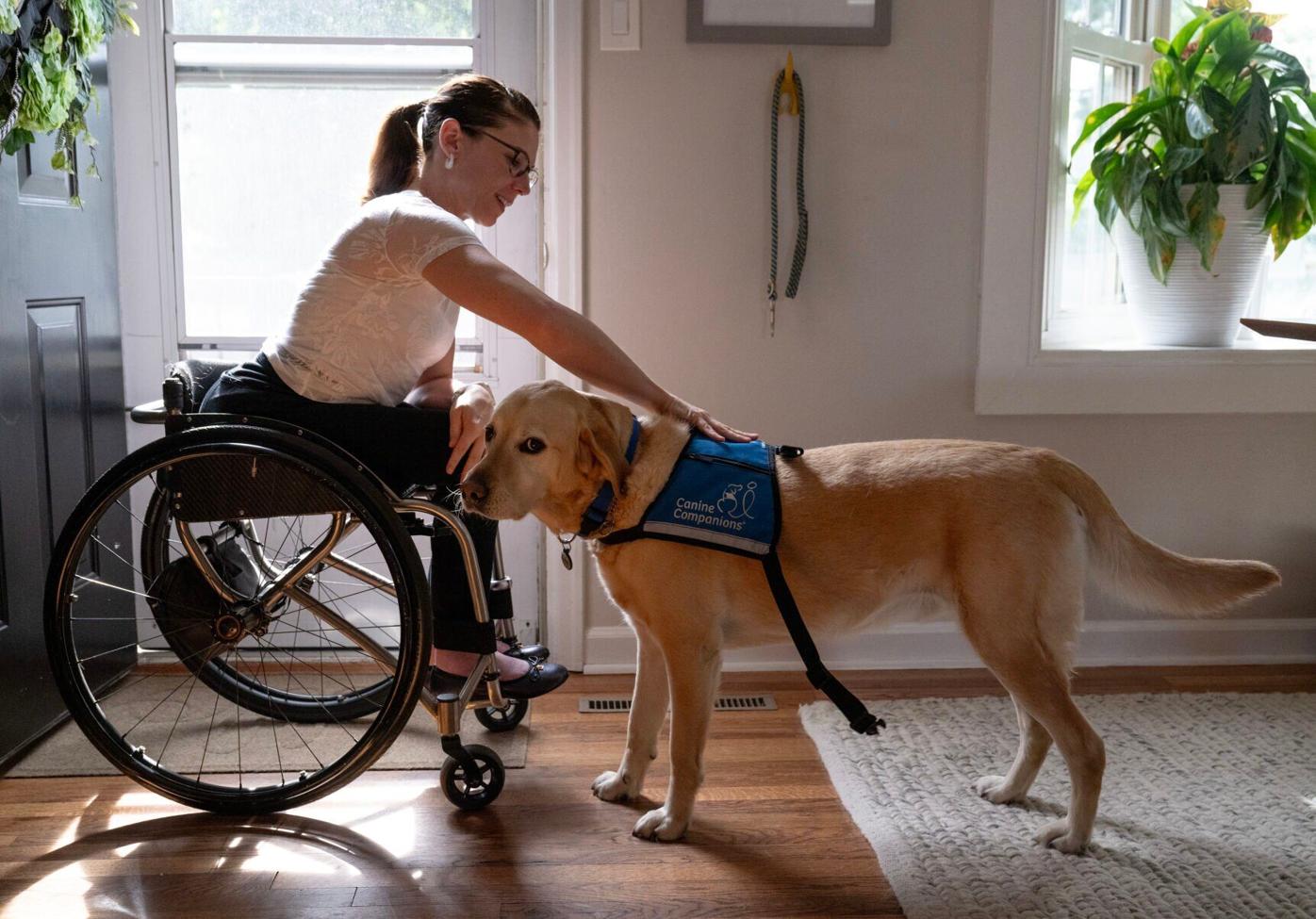
Calvin stands next to Amanda McGrory as she gets ready to leave for work on Thursday , June 27, 2024 .
photos by Parker Seibold, The Gazette


Calvin stands next to Amanda McGrory as she gets ready to leave for work on Thursday, June 27, 2024.
The organization manages its own breeding program, and pups are born in the homes of volunteer caretakers, who nurture them for eight weeks. Then, around the eight-week mark, the puppies go to a volunteer puppy raiser who will guide the dogs through their first year and a half of life. The organization has thousands of volunteer puppy raisers around the country.
“Our volunteer puppy raisers are tasked with potty training, socialization, behavioral things,” Zetlmeisl said. “They also start to teach the puppies up to 30 different tasks. Simple things that could be like sit and down, but also practicing being out in public settings, around people and behaving in public, exposing them to new surfaces, environments; making sure that the dog is confident and does well around different dogs, people, animals.”
Once they reach about 18 months, the now well-mannered pups are turned over to one of the organization’s seven campuses for their professional training. Each campus has 10 to 12 instructors, who teach specialized skills to the service dogs for the next six months.
These service dogs are trained to complete up to 45 tasks, including skills like opening doors, turning off lights, picking up items, running items to their handler, hitting a crosswalk button, interrupting nightmares and alerting to sound.
“It really just helps a lot of our clients feel more comfortable and kind of keep their independence too, so they don’t have to rely on family and friends or a partner to really just have to be there for them at every step,” Zetlmeisl said.
Each year across the country the program graduates about 400 dogs. Individuals who are matched with a service dog come to the campus for a two-week team training. But the program doesn’t stop after graduation — the organization provides follow-up services throughout the lifetime of the partnership, Zetlmeisl said.
After applications and interviews, it came time for McGrory to head to a campus to meet her potential matches and start training as a handler.
“Those two weeks are to train you, not to train the dog,” McGrory joked. “The dog already knows; you need to learn the commands.”
When she met Calvin, who at the time was 2 and ready to graduate, the connection was almost instant.
“It was really funny, because we got there, and the first couple of days they have you work with different dogs, just to see how you work together, how they respond to you,” she said. “By maybe day two, other people were still kind of trying out different dogs working on bonds, and it kind of became a joke right away, like, ‘Here’s Calvin,’ ‘Surprise, you’re gonna be with Calvin again.’ So it was pretty instant from the start that we were going to be a pair.”
Despite that instant bond, it still took some time to create the strong relationship they have now.
“Dogs take a little while to get comfortable with you,” she said. “It wasn’t until a couple months after that, when we were at home and had really like settled in together that I started feeling like we had a really strong bond.”
One of the reasons Calvin was selected to match with McGrory was his comfort with traveling. His puppy raiser had frequently exposed him to flying, and since McGrory travels often for work and to visit family, it made for a good match.
And while Calvin does help with those daily tasks, like hitting crosswalk buttons, he also provides companionship — something that McGrory was grateful for during the pandemic.
“It is cheesy, but I think there’s just a companionship you get from having an animal and even talking about like moving out here not knowing anyone during COVID and just him always being there. There’s something very comforting in that and I definitely miss him when he is not around,” she said.
Margaret Jones, who works as an attending physician at Craig Hospital in metro Denver, is a close friend of McGrory. The two met through a mutual Paralympic friend a few years back. Jones, an owner of two Labradoodles Penny and Copper, often watches Calvin while McGrory is away. Jones and McGrory jokingly refer to Calvin’s stays as a trip to “Camp Dood,” for doodles.
“Calvin and Amanda have just a very unique bond, and he is very clearly her ‘person,’” Jones said of the duo. “Calvin’s greatest joy in life is doing what is asked of him and picking things up off the floor. The command for that is called ‘get’ and he loves a good get, and just get so excited to be able to pick things up for her, or open up doors, or to do other tasks. They just work quite well together.”
While Calvin gets to play like a normal dog during his stays, he also has to adhere to the same rules he normally does, like no eating food off the ground, Jones said.
Seeing the support Canine Companions has offered two of her friends, both Paralympians, Jones actually became a puppy raiser for the organization. There’s a large and active puppy raising community in the Springs and in Denver, Jones said.
“One of the nicest things as someone who helps raise puppies for this organization is meeting the graduates and seeing the graduate teams,” Jones said. “Everyone would say, ‘How can you give up a puppy? That’s so hard,’ and it’s like, you know how much help you’re providing to someone, and it’s just a joy.”
Now, as an archivist for the U.S. Olympic and Paralympic Committee, McGrory can often be seen working at her desk with Calvin calmly cuddled up underneath. When a guest comes in her office, he’ll greet them by showing off his favorite stuffed animal or plop down to be doted on.
McGrory jokes that he’s the favorite co-worker of the office, even providing support to colleagues who may be having a bad day.
“I feel like he is definitely very receptive to changing levels of stress and can tell when people are anxious or upset, and is even more attached to me then,” McGrory said. “I feel like he is a calming presence just being in the office.”