







Identifying human bone found at local golf course could take months
The Colorado Springs Police Department received a call in late May regarding the discovery of a human bone at the local Patty Jewett Golf course.
According to the department, it remains unclear if the bone is connected to a suspicious death, or just whose death is being investigated in the first place.
“To my knowledge, this is the first time we have discovered a single bone in some time,” said Lt. Owen Scott with CSPD’s Homicide Unit.
Police department spokesperson Ira Cronin described the investigation as a “very unique set of circumstances,” to have a single human bone at the center point of a death investigation.
Human remains found at Colorado Springs golf course
According to department officials, the bone discovered at Patty Jewett has been sent to a forensic anthropologist to see if any viable DNA can be extracted, a process that could take months.
So, what can be learned about a person and their death from just one of their bones?
According to Forensic Anthropologist Diane France, who has consulted for the with the El Paso County Coroner’s Office since 2010, potentially a good deal.
“Any bone, pretty much, will give me clues about how large an individual is and possible sex,” France said.
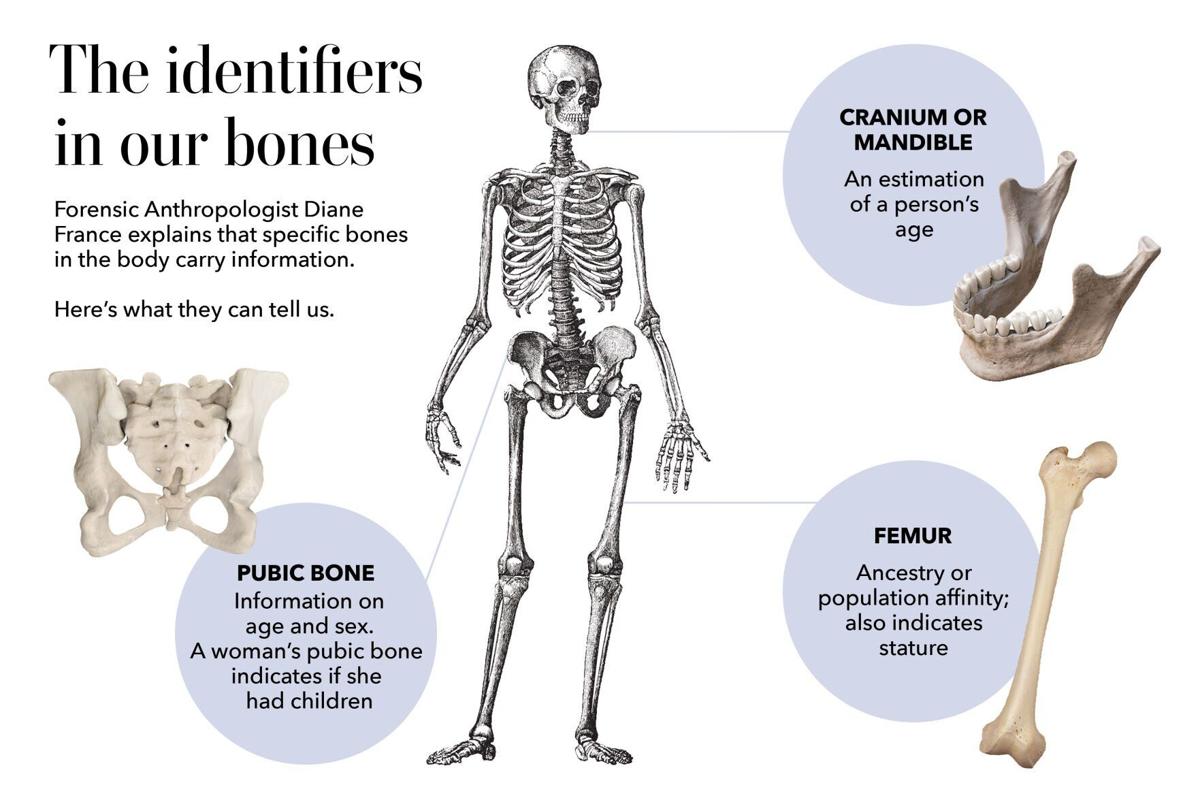
She went onto explain that specific bones in the body carry more or less information compared to others.
For example, if a cranium and mandible are discovered, France said she can estimate a person’s age, however imprecisely.
If a pubic bone is discovered, it can unveil more information including a person’s age, sex, and if it’s a woman if she’s had children.
Over 200 fentanyl pills discovered during booking at El Paso County jail
If a femur is found, France said, she will be able to find out the person’s ancestry or population affinity.
“A person with African population affinity will often have a straighter femur, while someone of Native American population affinity has a polymeric femur proximally,” France explained.
“Also, it is an indication of someone’s stature,” she continued.
While information regarding which human bone was specifically discovered at the golf course in Colorado Springs is not available, El Paso Deputy Chief Coroner Dr. Emily Russell-Kinsley said another way the coroner’s office can work to identify an incomplete set of skeletal remains is through extracting DNA.
“We can keep moving forward for DNA. If we have an idea of who it is, we can match it. If we don’t have an idea of who it is, we can see if it’s a match for some missing person in the database,” Russell-Kinsley said.
“We’re going to take these steps, and it’s probably going to take a long time. Hopefully, we can get some good DNA with what we have, and maybe we can get a match through familial DNA.”
The nameless dead
According to Rob Lowe with the Colorado Bureau of Investigation, there are currently 1,194 cold cases active in the agency’s database.
Of the 1,194 cases, 74 of which deal with unidentified remains. Currently, there are three sets of unidentified remains in El Paso County.
“The traditional method of making these identifications, especially when they are skeletal, is through a DNA sample,” Lowe said.
“The DNA sample typically could come from a single bone, a tissue sample, a blood sample, or whatever is available given the condition of the remains.”
Lowe says CBI assists local agencies, like the Colorado Springs Police Department, with DNA testing to upload the profile to the Combined DNA Index System (CODIS).
Delays continue in the El Paso County courthouse shooting case
“Through this system, you can compare (a) DNA profiles from the unidentified human remains cases against DNA profiles that exist in the database, specifically to those that have been collected and uploaded related to an open missing persons case,” Lowe said.
According to Lowe, testing DNA is an expensive process. Depending on a variety of factors and processes used, the cost to run one sample can run between $1,500 and $9,000.
“We have had grants over the years to aid with Colorado cold cases, especially prior to the legislation that created a comprehensive cold case team within the CBI,” Lowe said.
“The CBI regularly assists coroners and others in the public safety community with their cold case work, including unidentified human remains. There has been tremendous success with this effort over the past years, including human remains identified in Jackson and Mineral counties, and others being currently reviewed.”
Lowe estimates CBI has been a collaborative partner in over 30 unidentified remains cases since 2018.
Waiting for answers
While the human remains were discovered in May, Russell-Kinsley said it will likely be months before any answers come to the surface regarding the identification of the bone.
“A common misconception that is often carried is that everything is solved in like, 47 minutes,” Russell-Kinsley said.
“Also, that one person does it all. The back is like a weird dance. Everyone has a role; every role is important.”
She estimated eight to 10 groups of people will work on a single unidentified remains case.
The case of the unidentified remains found in Colorado Springs comes months after the gruesome discovery of nearly 200 decomposing bodies at the Return to Nature Funeral home in Penrose. The El Paso County Coroner’s Office assisted Fremont County in the identification efforts.
Although a long and emotional process, she continued saying that bringing identification to a set of remains and closure within a case is her favorite part of the job.
“Getting answers for people, whatever it is, whether it is a cause of death or an ID, it’s incredibly satisfying, it’s everything,” Russell-Kinsley said.
“The work that we do is incredibly special. It is an honor to get to do what I do, and I don’t take it lightly.”