







RTD’s Colfax Avenue BRT project gets $23M in federal funding
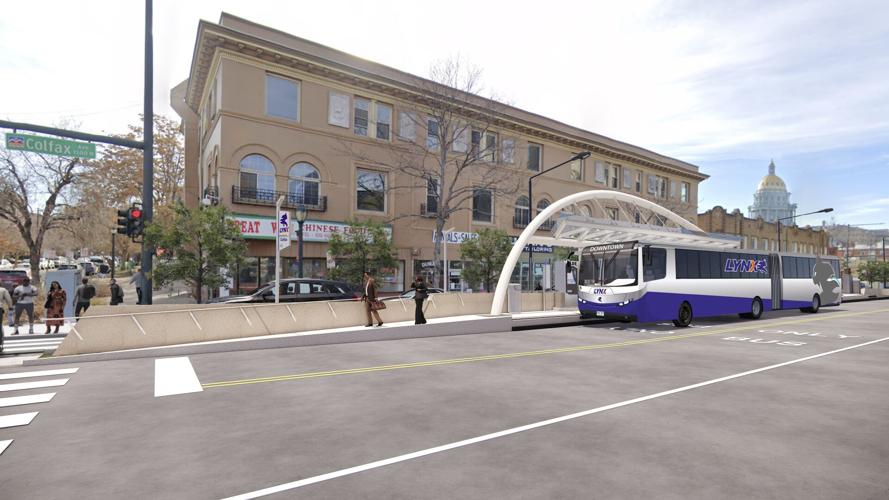
A rendering of an east Colfax Avenue bus rapid transit station. The project is progressing and construction may begin as early as this year.
Courtesy photo, Regional Transportation District
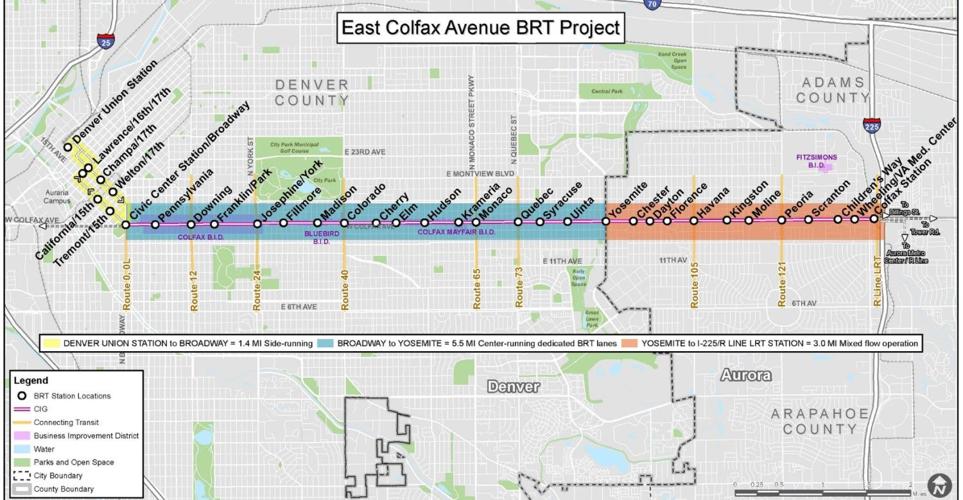
The Regional Transportation District’s re-imagining of Colfax Avenue — sometimes called the longest commercial road in America and home to the city’s busiest bus route — is $23 million closer to becoming a reality. Colfax will soon be home to a new bus rapid transit line (BRT), halving the available lanes for car traffic, and is part of the Colorado Department of Transportation’s 10-year plan improving sustainability.
The Federal Transit Administration notified RTD it had received the additional grant money last week, according to a Wednesday news release. The project has been given $150 million in grants, which is the maximum amount allowed in the discretionary grant category, according to the release.
Colfax’s BRT line will cost roughly $280 million, with $88 million coming from the City and County of Denver, $28.4 million from the Denver Regional Council of Governments and $14 million from Aurora.
This latest haul of grant money is cause for celebration for government stakeholders in the project and advances major efforts to bring BRT to Colfax, the RTD release said.
“In allocating the maximum funding allowed for this grant opportunity, our federal partners are signaling their confidence in our ability to deliver Denver’s first bus rapid transit line,” Amy Ford, the executive director of the Denver Department of Transportation and Infrastructure, said. “We’re ready to make travel by bus along East Colfax safer, faster and more convenient and further our city’s climate protection goals by offering an attractive option to single occupancy vehicle use.”
Colfax Avenue is currently a four lane arterial with center turn lanes and parking on both sides in most stretches. It serves as a major connection between Denver and Aurora and is home to bus line 15 and the 15L, and express lines, which are consistently the most ridden buses in RTD’s network.
But cars also use the road. It serves Denver’s historic East High School, the Convention Center and countless businesses along the nearly 10 mile corridor. By halving the available lanes of traffic, city officials previously acknowledged there may be outsized impacts on surrounding streets like 13th, 14th and 17th Avenues.
Businesses along the corridor may look wearily to the massive reconstruction of the 16th Street Mall, which itself was ostensibly served by a BRT line. Yet as construction has dragged on beyond the original timeline — and is compounded by RTD maintenance work on several downtown light rail lines — some businesses worry continuing construction may put their survival in peril. That’s even as a section of the mall reopened and foot traffic increased.
But officials maintain the planned high frequency bus service will spur development on Colfax Avenue, rather than stifle it, according to the release.
“The Colfax corridor leads directly into the Anschutz Medical Campus and Fitzsimons Innovation Community, the backbone of Aurora’s – and Colorado’s – thriving bioscience industry employing nearly 30,000 people,” Aurora Mayor Mike Coffman said. “Increased mobility options for our residents and workers are critical to the area’s ongoing success.”
And Colfax Avenue will not be the only major arterial road in Denver to see a BRT line added. CDOT has already announced plans for similar lines on Federal and Colorado Boulevards, part of its 10-year plan to increase mobility and sustainability according to Shoshana Lew, CDOT’s executive director.
It’s also not the first time CDOT has implemented a BRT line. The Flatiron Flyer connects Denver with Boulder and other northwestern communities, though it stops short of going all the way to Fort Collins. It runs every 15 minutes, according to RTD.
Next steps for the project in the coming weeks include bringing a BRT construction contract through Denver City Council for approval and a groundbreaking event with project, business and community partners along Colfax Avenue this fall.
Contracts, resolutions and bills for the project will have to pass through multiple layers of bureaucracy, such as planning and development and committee meetings, before the City Council can take any action, however.
The project started in 2012, when planning and initial analysis began. Between 2020 and 2022, much of the preliminary design, engineering and environmental work started, according to a timeline on Denver’s website.
Construction is expected to start this year and last until 2027.