Regional Air Quality Council calls for more restrictions as the summer ozone season ends
Ozone levels in the Denver metro area violated EPA limits 40 times.

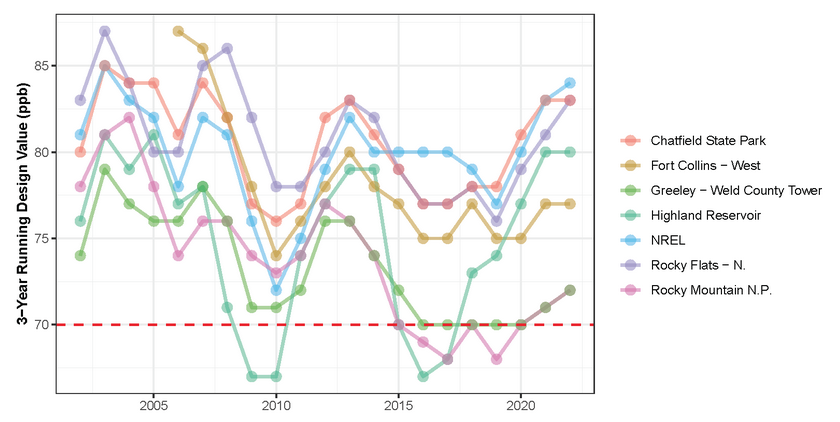
This year’s ozone season has come to an official end, but the Regional Air Quality Council is not happy with the results of ozone-causing emissions reductions, saying the nine-county Denver Metro/North Front Range ozone non-attainment region experienced more high ozone days than in eight of the past 10 years.
In a news release, the RAQC said “additional control strategies and immediate action” are required if the nine-county Denver Metro/North Front Range ozone nonattainment region is to meet federal ozone standards set by the Environmental Protection Agency by 2027.
There were 40 days of ozone levels in excess of either 70 or 75 parts per billion. There were 18 days of levels from 71-75 ppb, and 22 days with levels greater than 75 ppb at one or more of the monitoring stations.
According to a 2017 report from the National Center for Atmospheric Research, sources outside of the region contribute 40 to 50 ppb of “background” ozone to the region, leaving less than 30 ppb generated by local pollution that can be controlled.
One uncontrollable source of both particulates and ozone-causing chemicals is forest fires. A 2023 report by the National Oceanic and Atmospheric Administration analyzed the impacts of imported smoke from wildfires it says contributed 6-to-8 ppb higher daily averages in the region than in 2019, 2020, or 2022.
“Lidar measurements showed the extra ozone imported with the wildfire smoke to be as large as 12 ppb on some days,” said the report.
According to EPA regulations, extraordinary events like smoke from wildfires can be removed from pollution measurement data with the permission of the EPA.
In May 2023, heavy smoke from massive wildfires in Canada blanketed much of the Front Range.
In a September 29 2023 email, Kate Malloy, spokesperson for the Colorado Department of Public Health and Environment told The Denver Gazette: “The division is not at this time developing any potential exceptional events demonstrations for submission to EPA for any 2023 days. The division also did not submit any exceptional event demonstrations for any days since 2019.”
In a subsequent email on October 20, 2023, CDPHE spokesperson Leah Schleifer clarified why CDPHE did not request a wavier for that event, saying the EPA will only consider a waiver if doing so would make a difference in the region’s attainment status.
“The division determined that any potentially qualifying exceptional events in Colorado’s nonattainment area since 2019 would not have made a difference for this average,” said Schleifer. “In other words, even factoring in any or all potentially qualifying exceptional events, the nonattainment area would still not meet the 2015 federal standard of 70 parts per billion.”
Recommendations for further actions to reduce ozone include increasing emissions regulation for the oil & gas industry, which RAQC says emits 47% of nitrogen oxides and 36% of volatile organic compounds — both of which contribute to the formation of ozone when exposed to sunlight.
The release said that creation of “indirect source” emission reduction programs may be required, not by the EPA, but by the state. This could include regulation of activities that cause “increased pollution by nature of their operations such as warehouses, residential developments, recreational venues, and others that cause increased vehicle traffic and similar pollutants.”
“Indirect Source Rule development was originally called for in the 1970s via the Clean Air Act. EPA later removed it as a requirement under the Clean Air Act, but left it as a possible avenue for pollution reduction,” said the release.
Electrification of gas-powered lawn and garden equipment is on the list of strategies.
Another target for emissions reductions are motor vehicles. The RAQC release said options could include “removal of high polluting vehicles, increased emissions testing, and similar efforts.” The report goes on to say that it may “explore emissions budgets” for motor vehicles “to codify their reductions in their contribution to ozone pollution over time.”
“While natural ozone is needed in the upper atmosphere (the ozone layer) to protect the earth from the harmful rays of the sun, ground-level ozone is dangerous for humans, animals, and plants, causing breathing difficulties and other health problems, including long-term chronic health issues, plus crop and ecosystem damage,” according to the release.