







Parents in southwest Denver brace for school closures
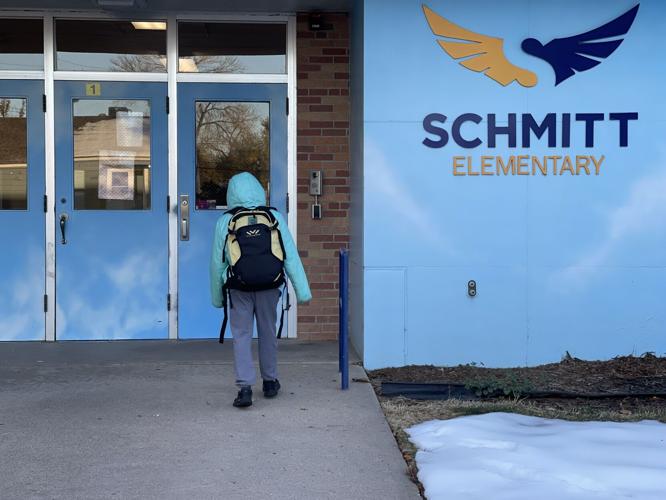
A student arrives before the start of school at Schmitt Elementary School on Nov. 12, 2024.
Nicole C. Brambila [email protected]
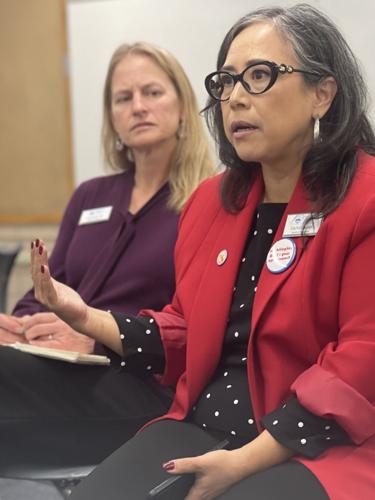
Seven out of every 10 school-age students who left or chose not to go to the Denver Public Schools over the past five years have lived in southwest Denver, a Denver Gazette analysis of district data shows.
It’s a data point Board of Education Director Xóchitl Gaytán knows full well.
Half of the schools proposed for closure or restructuring are in her district in southwest Denver, which is expected to continue experiencing a decline in school-age students.
Since 2019, Southwest Denver has lost roughly 20% of its students, the most profound decline in the district. The northwest region is down 9%, while in the central region, it’s down 7%.
Some have identified lower birth rates, skyrocketing home costs and gentrification are major forces driving enrollment declines.
Birth rates have been declining nationally since 2008, but the Denver metro region had been largely spared until now because domestic migration to Colorado.
Defined as a neighborhood transformation in which wealthier individuals move, in leading to increased property values and rent, gentrification has been happening in pockets across The Mile High City. Gentrification, though, in southwest Denver has meant the people moving into the neighborhood are not coming with children.
When Gaytán looks at the bleak enrollment landscape in southwest Denver, she also blames charter schools.
“They siphon students away from local public schools,” Gaytán said.
That claim is an established belief in progressive circles, which view charter schools as competition for public dollars.
Kristi Burton Brown, a Republican who won her race for a seat on the Colorado State Board of Education, said the bigger question is why parents choose to put their children in charters, instead of the traditional schools.
“Performance numbers and academic results are often part of the answer,” she said. “Also, some parents prefer their children to get a different kind of education — classical or one focused on science or the arts. Traditional schools would do well to ask what charters are doing so well that is convincing parents to make the move.
“Clearly, they’re meeting a need families have, and when 7 of the 10 highest performing high schools in the state are charters, you can see why.”
‘Too few students for the number of schools’
Southwest Denver has the second-most number of charter schools in the district.
Charters were designed to provide an alternative to traditional schools. In Colorado, charters are public school operated as a semi-autonomous school of choice.
Charter schools continue to grow. Between 2011-12 and 2022-23, the number of charter students spiked to 137,722 — an all-time high — from 83,478.
District data shows charters account for the majority of new campus openings.
Since 2017, charters have accounted for two out of three of the new schools in Denver. But charters also account for the majority of the school closures at 83.3%.
“The district has embraced charters and magnet schools, which means neighborhood schools in Denver aren’t really neighborhood schools,” said Shelby Balik, a history professor at Metropolitan State University of Denver.
Balik added: “In Denver there are simply far more choices.”
The decline in births means fewer students — regardless of where they attend school.
Denver has had roughly 2,400 fewer births since 2002, when the city hit a peak of 10,411 babies. Last year, Denver had just 8,016 births.
“There are too few students for the number of schools that we have,” said Andrew Huber, the district’s executive director for enrollment and campus planning.
Huber added: “We’re feeling it very acutely here in southwest Denver, but it’s happening everywhere.”
In the past six years, southwest has lost 3,457 school-age children.
No other region has lost more.
The northwest region, represented by Director Marlene De La Rosa, lost the second most number, with 906 fewer students.
The trend is not expected to improve.
Over the next four years, the southwest region is projected to lose another 2,000 children.
“It’s heartbreaking,” Gaytán said.
No other region is expected to lose more.
‘A long time coming’
Officials project a 5,000 enrollment decline districtwide over the next four years, despite a temporary reprieve from the influx of immigrant students whose families arrived in Denver after illegally crossing the U.S.-Mexico border.
In Colorado, funding follows students. That means fewer students means less funding.
The district has grappled with declining enrollment since 2019.
“It’s been a long time coming,” Board President Carrie Olson said.
In the intervening years, the district lost about $107 million in revenue. And officials anticipate losing another $70 million each year for the next four.
Last week, Superintendent Alex Marrero recommended closing seven schools and restructuring three others to address the district’s declining enrollment.
Marrero hopes the move will save the district $29.9 million.
The schools on the closure list are: Columbian Elementary, Castro Elementary, Schmitt Elementary, International Academy of Denver at Harrington, Palmer Elementary, West Middle School and Denver School of Innovation and Sustainable Design.
The board will vote on Thursday on the recommendation.
“This is going to be a very difficult vote,” Gaytán — and others — said.
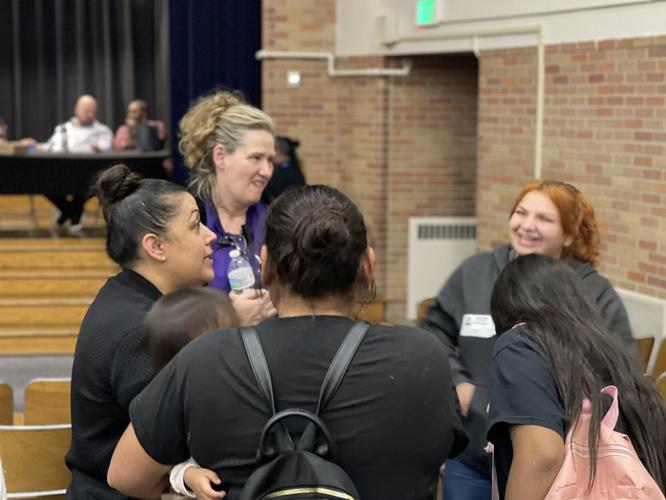
As difficult a decision as it may be, the impact on families was on full display this week, as board members bounced between meetings and schools with parents and staff.
It was a breakneck week, with multiple engagement meetings at two schools each day to give parents and staff an opportunity to ask board members questions.
Most, not all, conceded that school closures are likely necessary. Some scoffed or raised their voices at board members, while others cried silently. Some took board members to task about spending priorities. And still others questioned what they could do to influence the outcome.
“It’s not a done deal,” Olson assured parents at Kunsmiller Creative Arts Academy on Tuesday.
Kunsmiller is a kindergarten through 12th grade magnet school in southwest Denver where students can pursue creative and artistic careers.
Marrero has recommended Kunsmiller becoming a six through 12th grade campus, removing first through fifth grades.
Grade-level changes — district officials contend — can be made without a board approval.
‘A slap in the face’
While the response to the closure list may have varied, without exception, parents shared a common story about the big impact a small school had on their children who frequently did not fare as well on a larger campus.
Devon Trizio’s daughter struggled after the pandemic. The teachers at Castro Elementary in southwest Denver worked with her and now she’s thriving, Trizio said.
The way Trizio sees it, the teachers at Castro are more than just educators.
“They’re like family,” Trizio said.
For a single mom who depends on her sister and the community, the district isn’t just closing a school.
“The help I have right now is in the community,” Trizio said.
It was a sentiment — predominantly in Latino communities — echoed time and again.
Adriana Hernandez, a mother of three children who attend Schmitt Elementary, drives 25 minutes one-way for her school of choice. Having been on a list for closure two years ago, Hernandez dropped her fears of the school closing after the district made building improvements from the 2020 bond this past summer.
“It feels like a slap in the face,” Hernandez said.
A diverse Title I school near Section 8 housing in southwest Denver, more than half of the students at Schmitt are multilingual learners who speak one of a dozen languages.
Schmitt parents also raised the issue of after-school care, provided by the Boys and Girls Club, which is located across the street.
“There really are tradeoffs in this decision,” said Parker Baxter, director of the Center for Education Policy Analysis at the University of Colorado Denver.
School closures are personal to Denver parents who have pushed back against attempts to address declining enrollment by shrinking the district’s footprint. Until now, the majority of the campus closures have been charter schools.
Fifteen have been shuttered since 2018. Nine of these were in the southwest and northwest regions, five alone in southwest Denver.
“They are a community that sees this building as a beacon for the neighborhood,” Gaytán said.