







Change is coming to Denver’s Civic Center Park. Some worry it’ll ‘damage’ historic features
Courtesy photo, City and County of Denver
As downtown struggles with rising office vacancies and 16th Street Mall construction, Denver is planning to revitalize a key part of its urban core: Civic Center Park.
The park is a National Historic Landmark, the highest designation an historic site can get in the U.S. It is the only one within the city’s limits and it is subject to strict federal regulations.
Denver’s revitalization project, known as the “Civic Center Next 100” vision plan, includes renovating the Greek Theater, upgrading the Central Promenade and making Bannock Street more of a public plaza — all while promising to respect the national landmark.
There are also other initiatives, such as developing pickleball courts in the gravel pit across the street and Gov. Jared Polis’ announcement of a pedestrian bridge connecting the park to the State Capital to commemorate Colorado’s 150th birthday.
Some expressed serious doubts about the first phase of Civic Center’s revitalization.
A group consisting of architects, preservationists and the historians who helped put forth the park’s National Historic Landmark nomination in 2012 voiced concerns that changes proposed to the park’s Greek Theater could cause permanent damage.
Meanwhile, two notable historic preservationist advocacy groups, Historic Denver and Colorado Preservation, Inc., expressed support for the project —with a few caveats.

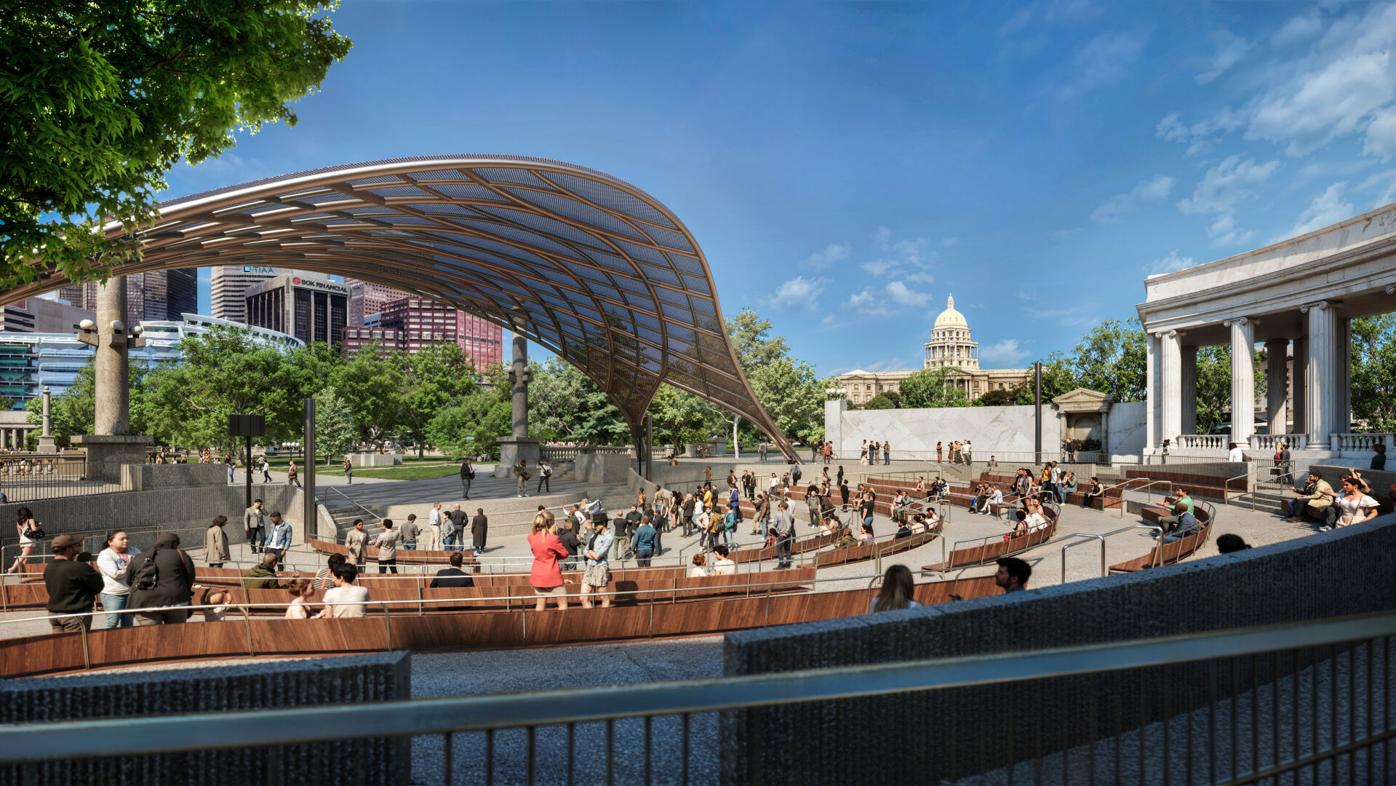
A rendering of the proposed changes to the Greek Theater in Denver's Civic Center Park designed by globally-renowned architectural firm Studio Gang.
Courtesy photo, City and County of Denver


A rendering of the proposed changes to the Greek Theater in Denver’s Civic Center Park designed by globally-renowned architectural firm Studio Gang.
The first phase is set to go before Denver’s Landmark Preservation Commission at an emergency meeting on Tuesday. The originally scheduled meeting on Nov. 19 to discuss the park proposal was canceled due to a lack of a quorum.
In letters submitted for public comment, the group against the project asked the commission to reject the city’s application to push the new designs forward.
“We have viewed the presentation and are convinced the plan will do irreparable damage to the historic integrity of Denver’s only National Historic Landmark,” Front Range Research Associates, the group of architectural historians who helped make the park a national landmark, said in its letter.
Meanwhile, Historic Denver and Colorado Preservation advocated moving the project forward with several modifications.

FILE PHOTO: A view of the Denver City & County Building from the top floor of the 13-story Populus Hotel on May 30, 2024. Studio Gang designed the hotel and is now working on a project with the city's Civic Center Park.
Bernadette Berdychowski / Denver Gazette


FILE PHOTO: A view of the Denver City & County Building from the top floor of the 13-story Populus Hotel on May 30, 2024. Studio Gang designed the hotel and is now working on a project with the city’s Civic Center Park.
What the changes entail
The area around Civic Center Park has changed dramatically since its creation in the early 1900s.
The area north of it has been filled with modern skyscrapers, and south of the park is now home to several modern cultural institutions, such as the Denver Art Museum and the Civic Center Cultural Complex.
Then there’s the Golden Triangle neighborhood, a growing residential hotspot.
The entire park has acted as a venue for large city events like championship rallies in Avalanche, Nuggets or Broncos title years, the Denver Christkindl Market, the new Outside Festival or as a gathering space for protesters.
But city officials say the Greek Theater is underutilized for daily use, and they are looking to attract smaller events and make it into a frequently-visited destination for nearby residents, commuters and tourists.

FILE PHOTO: Workers prepare for the Denver Christkindlmarket, an authentic, German-style holiday market, in Civic Center Park on Tuesday, Nov. 19, 2024. (Stephen Swofford, Denver Gazette)
Stephen Swofford/Denver Gazette


FILE PHOTO: Workers prepare for the Denver Christkindlmarket, an authentic, German-style holiday market, in Civic Center Park on Tuesday, Nov. 19, 2024. (Stephen Swofford, Denver Gazette)
Denver commissioned globally-renowned architecture firm Studio Gang — the same group behind the newly opened Populus hotel — to modernize the Greek Theater by west 14th Avenue and transform it into an “intimate” events venue.
The firm’s design plans publicly revealed late last month propose flipping the orientation of the amphitheater 180 degrees, building a canopy over a new stage and adding ramps to improve accessibility.
The design also proposes a tribute to the Gang of 19, protestors who threw themselves in front of Denver’s buses near the park to express frustration over wheelchair accessibility on public transit and helped pave a path for the Americans with Disabilities Act in 1990.
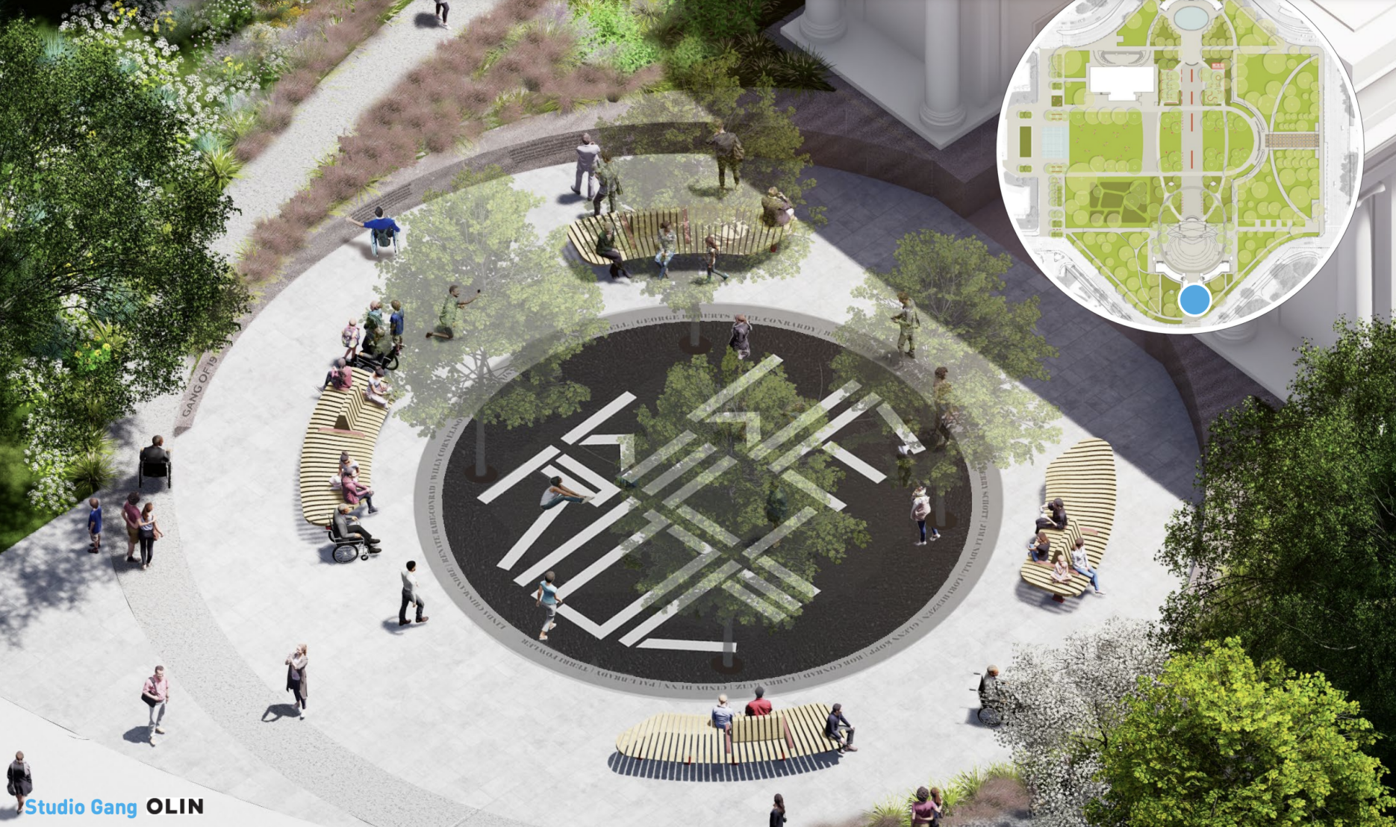
A rendering of Studio Gang's memorial commemorating Denver's Gang of 19 disability advocates for Civic Center Park.
Courtesy photo, City and County of Denver


A rendering of Studio Gang’s memorial commemorating Denver’s Gang of 19 disability advocates for Civic Center Park.
Flipping the stage was a “Eureka moment,” said Studio Gang Architect Juliane Wolf during a public presentation on Oct. 29.
In earlier design attempts, Studio Gang’s team faced several challenges limiting the amphitheater’s ability to host community events ranging from 10 to 1,000 people.
The seating for the amphitheater faces the sun all day and any canopy added onto the theater needed to block the sunlight would have touched the historic theater structure or distracted from its design. Its existing stairs created several dead ends or obstructions for people with disabilities, according to Studio Gang.
Another problem is its size. The Greek Amphitheater is nearly equivalent to Denver’s Mission Ballroom, which hosts large concerts and seats nearly 4,000 people.
“It feels a little bit out of scale for those kinds of smaller performances,” Wolf said.
Flipping the stage solved many of those problems, Wolf added.

A rendering of the Greek Theater's stage reversal from a city presentation. It was a "eureka moment," said Studio Gang designer Juliane Wolf.
Courtesy photo, City and County of Denver


A rendering of the Greek Theater’s stage reversal from a city presentation. It was a “eureka moment,” said Studio Gang designer Juliane Wolf.
Performers are used to spotlights and facing the sun and the audience would be closer to the stage. The Greek Theater building would then act as a “gateway” to invite the neighborhood into the park and its events.
But to flip the theater around and make it more accessible with ramps, Studio Gang proposes to remove parts of the Greek Theater with a “sensitive and surgical touch” to protect the landmark.
Much of the removal will be of materials not original to the Greek Theater due to a major restoration project in 2010, according to Studio Gang.
“While we want to make sure that we honor the historic fabric of the park,” Wolf said, “we also want to make sure that it is being transformed for today’s needs.”
When asked about the public letters following the presentation, representatives for Studio Gang did not comment.
How it became a National Historic Landmark
Civic Center Park is one of the most complete examples of civic center urban design from the City Beautiful movement, the most famous being Washington D.C.’s National Mall.
The City Beautiful movement sought to build cultural and political institutions close to the heart of the city with large parks and favored classical European architecture. It encouraged values of political and cultural engagement through urban planning.
But many American cities never fully brought their civic center plans inspired by the nation’s capital to fruition like Denver, San Francisco and Cleveland did.
Former Denver Mayor Robert Speer hired architect Edward H. Bennett to spearhead the creation of Civic Center Park. Bennett was instrumental in realigning Colfax and 14th avenues around the park, building the Greek Theater, Voorhies Memorial and the seal pond, according to the Civic Center Conservancy’s website.
The park was completed and opened in 1919.

FILE PHOTO: Todd Thurman stands for a photo during the rally in Civic Center Park after the Denver Nuggets 2023 Champions Parade on Thursday, June 15, 2023, in Denver. (Timothy Hurst/Denver Gazette)
Timothy Hurst/Denver Gazette


FILE PHOTO: Todd Thurman stands for a photo during the rally in Civic Center Park after the Denver Nuggets 2023 Champions Parade on Thursday, June 15, 2023, in Denver. (Timothy Hurst/Denver Gazette)
“Cities sought to make large, grand gestures for city beautification and to instill virtue and quality of life within the population. … It really is Denver’s front yard for gatherings, for civic movements and for outpourings of emotion,” John Deffenbaugh, CEO of Historic Denver, told The Denver Gazette.
Civic Center Park joined the National Register of Historic Places in 1974 and was later nominated as a National Historic Landmark in 2012, a program supervised by the National Park Service through the U.S. Department of the Interior.
The Greek Theater is considered a major contributing structure to the National Historic Landmark.

The Greek Theater as the city prepares for the Denver Christkindlmarket holiday market in Civic Center Park on Tuesday, Nov. 19, 2024. (Stephen Swofford, Denver Gazette)
Stephen Swofford/Denver Gazette


The Greek Theater as the city prepares for the Denver Christkindlmarket holiday market in Civic Center Park on Tuesday, Nov. 19, 2024. (Stephen Swofford, Denver Gazette)
Modernity vs. historic integrity
Making any changes to a National Historic Landmark requires an extra degree of care due to its national significance.
In 2021, an earlier plan for the Greek Theater suggested building a canopy over the Greek Theater to provide shade from the sun. The Landmark Preservation Commission was supportive at the time, when the park was temporarily shut down due to safety concerns from rising crime and substance abuse.
In the commission’s discussions, a key theme was brought up: The best way to preserve a landmark is if people use it.

A dropped proposal from 2021 for a canopy to be built over the Greek Theater.
Courtesy photo, City and County of Denver


A dropped proposal from 2021 for a canopy to be built over the Greek Theater.
But during further planning, the city pivoted over concerns the canopy was visually and physically overwhelming the theater’s classical architecture. So, Denver hired Studio Gang in 2023.
Denver Parks and Recreation is overseeing the park’s rehabilitation and has worked with architectural, preservation and cultural landscape organizations, as well as Historic Denver and History Colorado in line with the 2009 Civic Center Design Guidelines and the Park Master Plan, officials said in a statement to The Denver Gazette.
“The new design plans respect the integrity of the Greek Theater structure, and the landscape changes are inspired by the 1918 Bennett Plan,” the statement said.
The firm’s proposed canopy to accommodate the stage reversal would be a new permanent structure in the park and detached from the Greek Theater.
“It really allows the original historic fabric to shine, whilst also providing sufficient space for that new piece of architecture,” Deffenbaugh said.
Though it’s separate from the theater, Historic Denver and Colorado Preservation have both suggested moving the canopy further from the historic freestanding columns.

A rendering of the canopy for the Greek Theater in Denver's Civic Center Park designed by globally-renowned architectural firm Studio Gang. Historic preservationists supportive of the project suggest moving the canopy from the freestanding columns pictured behind.
Courtesy photo, City and County of Denver


A rendering of the canopy for the Greek Theater in Denver’s Civic Center Park designed by globally-renowned architectural firm Studio Gang. Historic preservationists supportive of the project suggest moving the canopy from the freestanding columns pictured behind.
Federal regulations around historic properties allow for new construction and new uses of a site, as long as it causes minimal changes and leaves the historic property “unimpaired” if removed.
Front Range Research Associates expressed in its letter that the stage reversal would eliminate historic curved seating areas in the theater bowl, raise the floor of the plaza and add large curving paths.
“The proposed changes would do great damage to the theater and other elements of the park,” the letter said.

A rendering shown in a city presentation of new seating for the Greek Theater in Civic Center Park. It would require removing the curved stairs in the bowl, which some experts said is a historical feature of the structure.
Courtesy photo, City and County of Denver


A rendering shown in a city presentation of new seating for the Greek Theater in Civic Center Park. It would require removing the curved stairs in the bowl, which some experts said is a historical feature of the structure.
Colorado Preservation also expressed concerns about removing the curved seating areas.
“Efforts should prioritize covering rather than demolishing original features, such as the historic seating area,” the organization’s letter said.
A group of 12 graduate students from the Dana Crawford Preservation Program at the University of Colorado Denver agreed with concerns over how the proposed changes may not be reversed and said they worried about the precedent it set over the treatment of a National Historic Landmark.
“If the current design is permitted without significant alterations, the ability to defend our treasured historic fabric in Denver is in serious jeopardy at the hands of negligently idiosyncratic and naïve design proposals,” the group’s letter said.
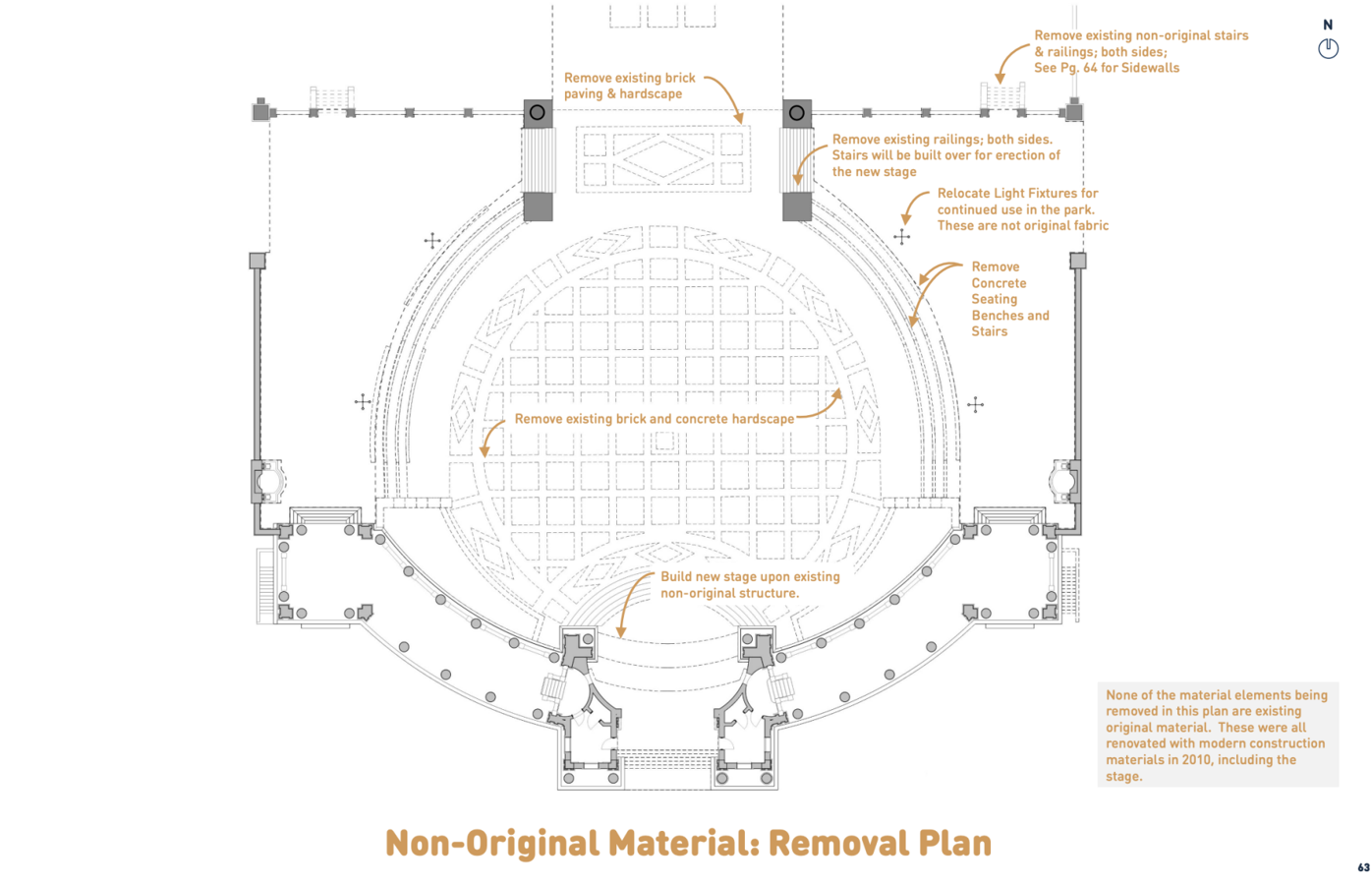
Studio Gang's removal plans for the Greek Theater rehabilitation project shown in a city presentation.
Courtesy photo, City and County of Denver


Studio Gang’s removal plans for the Greek Theater rehabilitation project shown in a city presentation.
After being asked about the comments, the Denver Parks and Recreation said in a statement that it is excited about the new opportunities the rehabilitation will provide while restoring Civic Center as the heart of the city’s cultural and civic life.
“We are grateful for the ongoing feedback from the public and preservationists alike, and we look forward to delivering a revitalized Greek Theater that both honors its past and adapts to the needs of the future,” the statement said.
With a slate of changes coming to Civic Center Park, Deffenbaugh said the Greek Theater is the one Historic Denver is currently paying closest attention to.
The design is still in development and Historic Denver called for more clarity on what materials would be used for the canopy, the process of maintaining areas exposed due to removals and switching to an “orthogonal layout” for accessibility features (to follow City Beautiful’s historical precedent of using a grid system).
If the Landmark Preservation Commission approves the city and Studio Gang’s application, the project is slated to begin construction late next year and would be mostly completed by spring of 2027.
As the design progresses, Deffenbaugh said Historic Denver will keep working to make sure it respects the original concept of Civic Center Park.
He cited prioritizing the views throughout the park, the composition and the ancient Greek and Roman architectural elements.
“The guidelines for Civic Center do support the concept of change and evolution,” he said. “And drawing more people there will allow more and more people to appreciate the historical assets of the park and its beauty.”