







‘Just explore’: One woman’s journey in Colorado high-altitude wildlife photography

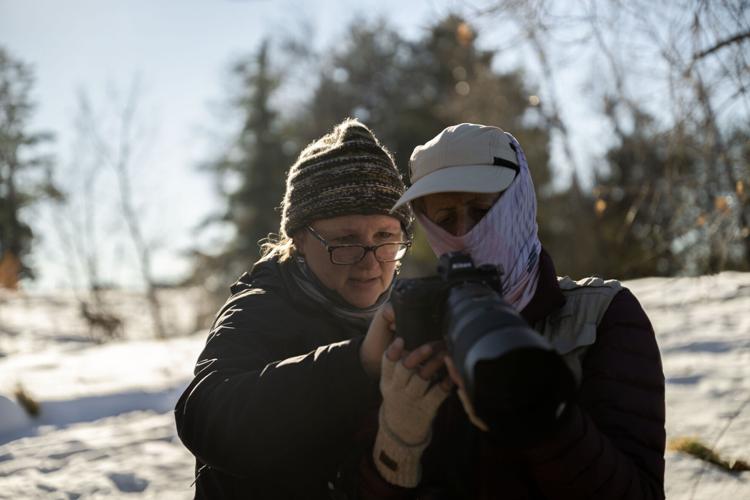
Dawn Wilson, owner of Creeks and Critters Nature Images, left, teaches Loving Driscoll how to use her camera as they photograph wildlife at Kountze Lake in Belmar Park in Lakewood on Nov. 12.
Stephen Swofford, the Gazette



At the start of November, Rocky Mountain National Park saw its first big snowfall.
The fluffy, white powder coated the meadows several inches deep and lakes turned to an icy slush.
Dawn Wilson, with her camera attached to her hip, woke up early on this cold morning to guide another photographer around the park.
Today, Wilson was on the prowl to capture a cow moose and her calf, which had been spotted recently near a lake. She waited in view of the water, which had not completely frozen solid, looking for those long, lanky legs to break through the fresh snow.
“We were the first ones at the lake,” Wilson said. “We broke trail around the lake, and sure enough, she was where I had seen her the day before, and her calf went out into the slush in this lake, and they were feeding. It was a scenario I had never seen before. It was really just beautiful.”
While she finds herself at the park often, the wildlife photographer is always seeing something new.
Wilson, who is based in Loveland, has been photographing wildlife for about two decades. She specializes in high-altitude photography, and her career has taken her to some of the most remote places on the planet, from the Alaskan tundra to the Galápagos Islands.
As a kid, Wilson remembers using a camera often, mainly capturing family and friends. A couple of years after graduating from Rowan University in New Jersey with a communications degree, she made the move to Colorado to work for an animation company around 2002.
It was around 2007 that Wilson recalls capturing her first “spark photo” — the one that inspired her to pursue photography more seriously. Perched on Lake Windsor in winter, she managed to shoot an eagle in flight. The photo, she said, was sharp, exposed just right, and really made her start to question her career in corporate.
However, it took some personal hardships for Wilson to make the complete leap into nature photography. About a decade ago, Wilson lost both her father and her partner unexpectedly, within months of each other. Ultimately, Wilson decided she couldn’t spend one more day in corporate; she needed to commit to her passion.
“That was what gave me the final push to pursue it as a full-time endeavor,” she said. “We don’t know what’s gonna happen tomorrow, and we need to be happy with what we’re doing and pursuing, what we spend a lot of our time in our lives doing each day.”
For Wilson, happiness is being out on the tundra, capturing moments seen by very few individuals.
Wilson’s specialization in high-altitude photography has allowed her to travel to some of the world’s most remote destinations. She’s drawn to these places because of their unique ecosystems, especially as someone who grew up in New Jersey, she said.
“There’s something to me about the tundra and those wide open spaces and the wildlife that live there in an area that a lot of people, on initial look, they think it’s very barren, and when you really spend some time there, it’s so diverse,” Wilson said. “You look at this landscape that seems extremely difficult to live on, yet you get moose and elk and mountain goats and big horn sheep and pikas and marmots, and they’re all thriving up there.”
Working in these areas has taught Wilson to slow down and take even the smallest details in. It goes beyond capturing a photo — to just exist in nature.
Patience is a common thread among the nature photographer community. As Wilson said, “We all have a similar acceptance of: We get up early, we stay out late.” When the alarm rings at 2 a.m., they’ll wake up and set out to capture the sunrise. Or they’ll stay out throughout the night to get a shot of the stars.
“We really do have a complete understanding and appreciation for what it takes to do some of those things that not everybody is understanding of,” she said.
While the nature photographer community is small and welcoming, it’s still a male-dominated field, Wilson said, even as more women enter the profession. Wilson recalls a recent landscape photo contest in which administrators calculated the number of entries from men and women. They found that only about 20% of entries were from women.
Wilson, who was president of the North American Nature Photography Association Board for two years, works for several photo tour companies in Rocky Mountain National Park. One group she works with, Women In Wildlife Photography, leads tours for women interested in learning the craft.
“It’s amazing how many women are really interested in pursuing this, but they don’t feel comfortable or safe out on their own,” Wilson said.
Photographing animals comes with its own set of safety precautions, but Wilson said she often feels safer among wildlife than with humans.
“I learned a lot about animal behavior over the years. I feel much more secure in those situations than I do walking through downtown Denver,” she said. “I feel like people are much less predictable. .. I can back off in those scenarios where sometimes I just feel like with people, I can’t necessarily predict that as well.”
Reaching people is one of Wilson’s motivations — hoping to inspire others to care about and appreciate the natural world.
“Capturing what’s out there and sharing the photographs and sharing the stories, I hope that I’m reaching people to say, ‘Hey, just take a moment and think about what’s out there. Think about the impact that we have each day on what our own actions do,’” she said. “That’s a big part of why nature photography, I think, speaks to me probably more so than any other type of photography.”
Wilson recalls one of her most memorable moments while photographing polar bears in Alaska during the fall, right before the water started to freeze for the winter. With her camera beside her, she watched from an island within the Arctic National Wildlife Refuge.
“These beautiful bears, and mom and cubs are playing together, or you get a couple of older ones that might be picking things up off the beach, and they’re just trying to they’re just kind of passing time until the water freezes so that they can go out and feed for the winter on the frozen ice,” she said. “My favorite thing is to just be outdoors and just explore, to learn about a new place, or discover a place that I’m familiar with in a new way.”