







In Boulder’s underground Media Archaeology Lab, a search for tech reckoning
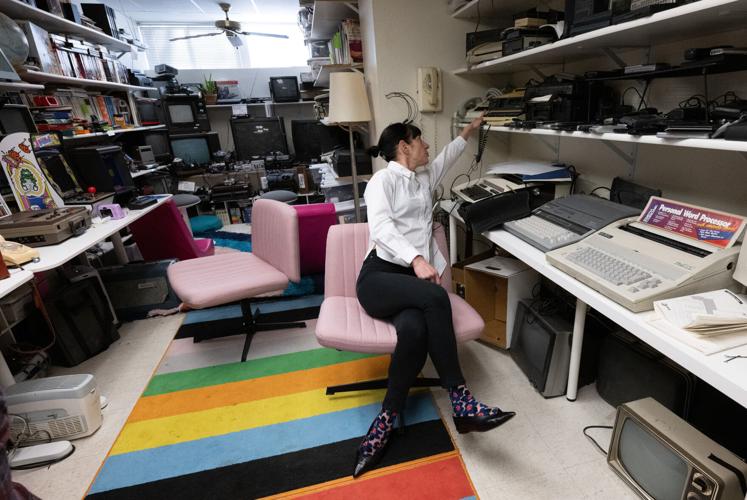
Lori Emerson, associated professor and founder of the Media Archaeology Lab, reaches for an old phone in a room full of historic media technology as she is interviewed Wednesday, Nov. 13, 2024, at the lab on the campus of the University of Colorado in Boulder.
photos by Christian Murdock, The Gazette





BOULDER • Before stepping down into the basement of a brick cottage on the University of Colorado campus, I had been thinking about a book.
It’s called “Amusing Ourselves to Death: Public Discourse in the Age of Show Business,” published in 1985. It was written by Neil Postman, who thought deeply on the consequences of television and the differences between thinkers before him: George Orwell and Aldous Huxley.
“Orwell feared those who would deprive us of information. Huxley feared those who would give us so much that we would be reduced to passivity and egoism,” Postman wrote. “Orwell feared that the truth would be concealed from us. Huxley feared the truth would be drowned in a sea of irrelevance.”
Many years before that sea swelled with the rise of the internet and iPhone and social media, Postman wrote: “People will come to adore the technologies that undo their capacities to think.”
The book probably made me a techno-pessimist. Which was a word I never knew before stepping down into this basement home of the Media Archaeology Lab.
The lab is overseen by a young, tattooed, dyed-haired scholar who does not like capital letters. It was libi rose striegl who made me aware of the terms “techno-pessimist and “techno-optimist.”
“The computer will save us or we’re totally doomed,” striegl said. “And somewhere in the middle is the reality.”
The manager of the Media Archaeology Lab (the MAL) lives in the middle. She calls herself “agnostic” when it comes to technology, while also confessing to screen time amounting to adoration.
“I’ve been online for way more time than probably is healthy,” striegl said. “But it’s always where I’ve found community, and also where I’ve found I maybe don’t need to be anymore.”
She is no longer active on X — formerly known as Twitter before the richest man in the world took ownership — but she maintains the MAL’s presence on Instagram. And this is where you might gain the greatest understanding of the difficult-to-define MAL without actually stepping down into it.
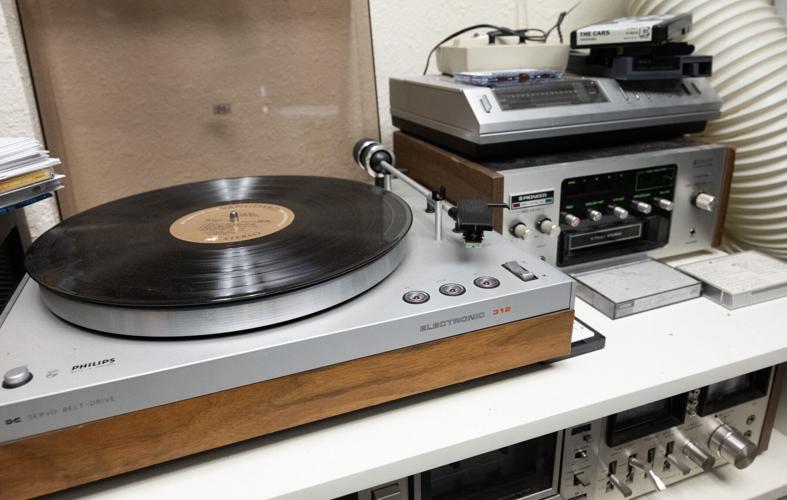
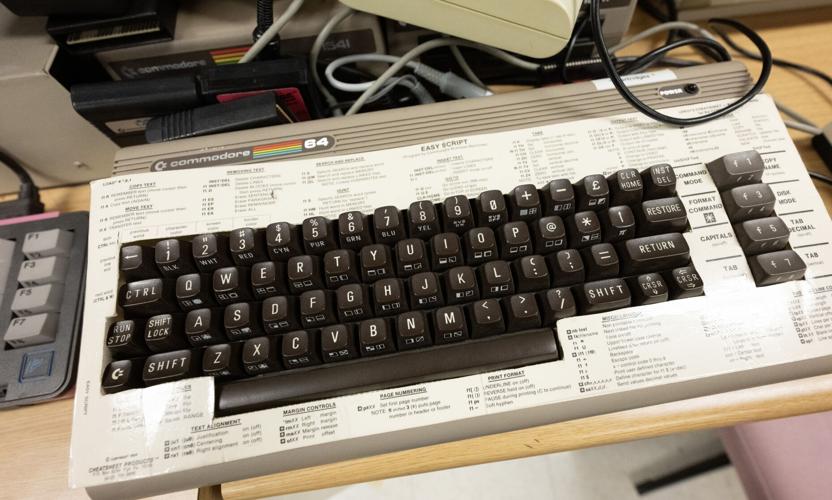
Instagram shows the clunky array of extinct machines that are kept in working order here. Yes, to step into the MAL is to step into a time capsule.
The PDP-8 among other computers, including the Apple lineage. The TRS-80 Model 100 among “laptops” of the day. The Walkman among portable music players and the 1913 phonograph among larger ones.
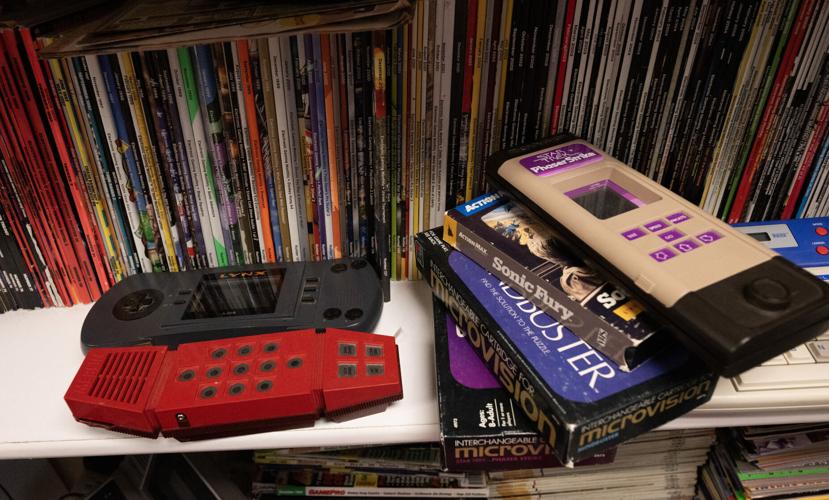
The brick-sized IBM Simon among early cellphones. Among radios is the Panosonic that flips up a TV screen. The handheld Blip is among forgotten video games.
“Duck Hunt, anyone?” reads one Instagram post showing a more familiar game.
And another, though appearing in an unfamiliar format: “It’s been a while since we played some wrong screen Mario.”
Modern minds manipulating technology of old — this happens in the MAL.
“If you come in and all you want to do is play Mario, awesome,” striegl said. “But also if you come in and want to try and run some modern software on this older device and work to painstakingly rewrite it and make Mario work on a system that it never was supposed to, also awesome.”
This is not a typical lab. Not a typical lab “where it’s a principal investigator telling all their minions what to do,” striegl said.
The MAL’s website adds: “Nearly all digital media labs are conceived of as a place for experimental research using the most up-to-date, cutting-edge tools available. By contrast, the MAL — which very well might be the largest of its kind in the world — is a place for cross-disciplinary experimental research and teaching using still functioning media from the past.”
The results vary like the rainbow colors of the carpets and furniture down here, vary between interests of engineering, history and art.
One came to research the early ways of journalism. Another came to study the early mechanisms behind closed captioning. A couple came to write their wedding vows on a vintage typewriter.
For the youngest students born into the world of touch screens, the typewriters are a hit.
“Because they’re getting this very tactile, mechanical feedback,” striegl said. “Something more present. And maybe there’s more separation between you and the technology when you feel it.”
Another time, members of a band came to add static, ambient sounds to their avant-garde music. Using a piano, a bunch of radios and a cape of wires, one showcased an instrument called a Trans-Harmonium.
Using other machines here, one more recently from the University of Toronto revived a 1980s-era facial recognition system. This was part of a postdoctoral project regarding artificial intelligence, which is as much of a hot topic down in the MAL as it is around the world above.
I came down here with a feeling of dread about AI — a feeling not quite shared by striegl. She shrugged and nodded to shelves of dusty manuals and fiction and nonfiction books meant to add cultural context to technological eras displayed here.
“I can find a book from 30 or 40 years ago that says something similar” about AI, striegl said
History is another lesson of the MAL. The motto here: “The past must be lived so that the present can be seen.”
This was the thinking of Lori Emerson back around 2009. That’s when she got the idea for the Media Archaeology Lab, based on a rather fringe field of research related to her rather fringe teachings on digitally produced literature and poetry.
The field of media archaeology “was exactly what I was after,” Emerson said. “It was getting at anti-humanism. The humanities have been obsessed with humans; humans are the pinnacle of all things. But if you start working at anti-humanism you start working at, ‘What’s the life of the machine?’”
The machine, after all, was increasingly living with the human.
“We keep looking at what it produces,” Emerson said. “We should be looking at, ‘What’s the infrastructure? How does the software work? How is it shaping what’s being made and created?’”
Starting with lessons on the poet known as bpNichol and his 1980s works using Apple IIe programming, Emerson went on to collect more retro machinery for demonstration. And indeed, just as the machinery would be for using and creating, it would be for dissecting and understanding. The machinery would be for understanding the past, for perspective.
The MAL tells an important story, Emerson said. “A story about what the world was like before it was dominated by two or three massive companies.”
Before the likes of Microsoft, Apple, Amazon and Meta, there was a more crowded race to the top. The stories have been lost over time, as the MAL’s residents have found.
An artist in residence was once scanning old copies of Byte Magazine — “to make … err … something?” the artist wrote — when “The Untold Story of Lore Harp McGovern” came up on a page. The story dates to 1970s California, where the “housewife and mother of two” began assembling computer parts: “With her friend Carole Ely, she grew their company, Vector Graphic, into a major manufacturer of microcomputers, eventually taking it public before Big Blue — IBM — muscled into the market.”
Today’s muscle aims to control what we buy (algorithm-based ads) and how we think and maybe even vote (content also based on algorithms or special interests of, say, the companies controlling social media).
Before visiting the MAL, I had read an article by The New Yorker’s Jill Lepore, who cited a political philosopher “arguing that preserving democracy will require making hard choices about technology.” Lepore went on: “So far, those choices are being made by corporations, especially American corporations, and especially in the United States, where people now live in what can be best understood as an artificial state.”
Maybe that, too, contributed to my techno-pessimism upon arrival at the MAL.
I thought I sensed it in Emerson (“I use technology in order to hate it properly,” reads her email signature, quoting the multimedia artist Nam June Paik). And yet the MAL makes Emerson hopeful.
“I really believe this gives people the tools to empower thinking about the present and future of their lives,” she said.
People are in control here. They can play, create and learn. They’ve learned from the book club (“Low Power to the People,” about a small group’s radio rebellion around regulatory changes at the turn of this century) and from speakers (the author of a new book, “Governable Spaces: Democratic Design for Online Life”).
Here people can understand. They might look around at once-mighty technology and understand what the lab’s manager understands: “We are on no set path in terms of how technology is going in the future,” striegl said.
The future would be up to corporations, yes, but corporations depend on consumers, she pointed out. “So, if you don’t like the way it’s going, you can change it.”
Everything here in the MAL rose and fell, she pointed out. “Everything happens in a cycle.”

New Dark Sky Community designated in Colorado, joining short list
Seth Boster
seth.boster@gazette.com
Updated 2 days ago
Another part of Colorado has been recognized for its rare celestial view. In announcing the state’s next Dark Sky Community, DarkSky International described Old Snowmass as a “spectacular corner of the Roaring Fork Valley” ー an unincorporated corner between Aspen...

Seth Boster
Reporter
Will Denver’s dueling underground music fests face off at once?
John Moore
john.moore@denvergazette.com
Updated 10 minutes ago
Less than a year ago, local music fans collectively pondered whether the summer music festival might be dead in Denver. (To our credit, we opined in this space: “Categorically not.” Actually, our exact words were: “Don’t be daft, punk!”) But...

John Moore
Reporter

Data: U.S. maternal deaths fell in 2024 and may have dropped again last year
The Associated Press
the-associated-press@denvergazette.com
Updated 3 hours ago
NEW YORK — Fewer U.S. women died around the time of childbirth in 2024, a government analysis shows, and provisional data suggests the trend may have continued last year. The U.S. Centers for Disease Control and Prevention on Wednesday reported...

The Associated Press
Reporter
Colorado hot springs celebrates ‘first-of-its-kind’ expansion
Seth Boster
seth-boster@denvergazette.com
Updated 4 hours ago
A hot springs destination in Colorado has marked a “major” expansion. And it’s not exactly the expansion you’d expect at a soaking retreat. In Glenwood Springs, Iron Mountain Hot Springs is calling its newly opened Sauna Summit “the country’s most...
Seth Boster
Reporter
It’s time to apply for big game hunting licenses in Colorado
Seth Boster
seth.boster@gazette.com
Updated 2 days ago
Colorado Parks and Wildlife’s new big game brochure has been hitting hunters’ mailboxes ー the annual reminder to start planning for the seasons ahead. CPW also reminded in a recent social media post: “Whether you’re after a long-awaited lifetime tag...
Seth Boster
Reporter
Is your diet causing UTIs? Here’s how it may be at fault
Tribune News Service
tribune-news-service@gazette.com
Updated 2 days ago
Miriam FauziaThe Dallas Morning News UTIs can be painful, and they’re not something people like to talk about. But they happen often, affecting an estimated 60% of women and 20% of men in their lifetimes. While we might view these...

Tribune News Service
Reporter
What it’s like to be part of Denver’s potentially smallest parade
Bernadette Berdychowski
bernadette.berdychowski@denvergazette.com
Updated 2 days ago
The Richey family was up until 1:30 a.m. on Sunday working on their second-ever float entry for the Dairy Block’s Petite Parade in Lower Downtown. Lexi, Scott and their son dressed up in all pink to match their float titled...

Bernadette Berdychowski
Reporter
A Colorado Life: Janelle Orsborn’s final message: ‘Definitely live big’
John Moore
john.moore@denvergazette.com
Updated 3 days ago
Actor, author and former Miss Colorado’s Teen fit a lot into her ambitiously adventurous and tragically abbreviated 33 years Janelle Orsborn was big sister to Anna, Abigail, Jake, Daniel and Natalie. But really, says Abigail: “Janelle was a big sister...
John Moore
Reporter
PIKES PICK: A ‘K-Pop Demon Hunters’ day awaits
Linda Navarro
linda-navarro@denvergazette.com
Updated 1 week ago
It’s the music that makes you move and Black Sheep plans a dance party to the soundtrack of “K-Pop Demon Hunters” coming up April 18, 11 a.m. Costumes expected and it’s for all ages. $21.12-$24.21 at blacksheeprocks.com — Linda Navarro

Linda Navarro
Reporter

Sweet and spicy Korean fried chicken will fire you up
Gretchen McKay, Pittsburgh Post-Gazette
gretchen-mckay@gazette.com
Updated 6 days ago
Bold, spicy flavors have never been more in demand, especially when they add a global element to a dish. One of my favorite foods these days is Korean fried chicken, which I ate twice on a recent trip to New York...

PREV
PREVIOUS
8 quintessential winter events to check out in Colorado this season
When the temperatures drop, Colorado’s party fever rises. Yes, we love our winters. Where the cold and snow once froze activity in the early days of our historic mountain towns, activity now ramps up with much more than skiing. Here are eight bucket list events across the state: International Snow Sculpture Championships Breckenridge, Jan. 20-29 […]

New International Dark Sky Park in Colorado
Colorado has a new International Dark Sky Park. That’s an exclusive, metrics-driven designation by DarkSky International, the organization raising awareness around light pollution and adding protections and inspiring tourism to certain parts of the world. Now that includes Browns Canyon National Monument. Popular for whitewater rafting and camping, the Arkansas River-cut canyon encompasses nearly 22,000 […]