







A new year in Aurora: Officials reflect on 2024, look ahead to 2025

The Aurora Municipal Center, and city skyline, in this undated photo.
Courtesy photo, City of Aurora


Aurora encountered an array of challenges this past year — the tentacles of an international gang, turnover in police leadership, among but a few — and city leaders said they look to the coming year with hope.
At the same time, elected officials passed new policies, notably strictly enforcing car registration and insurance laws, repealing a prohibition on pit bulls following a public vote and banning homeless encampments along the I-225 corridor.
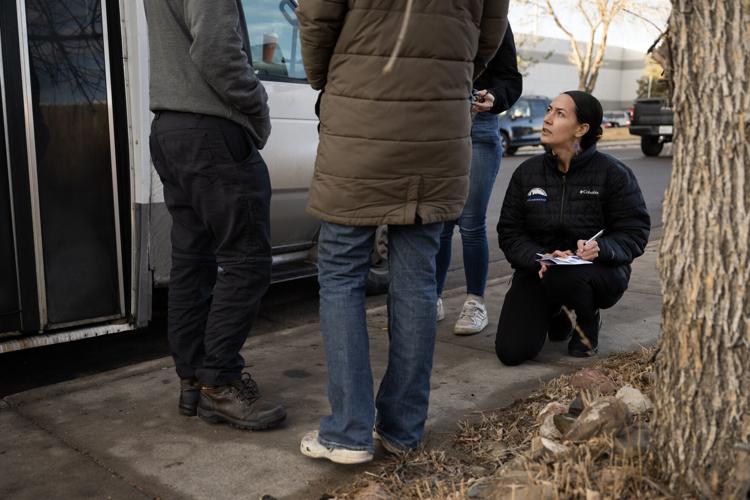
In the coming year, the city is poised to open a regional navigation campus, which officials hope would make a serious dent in their campaign to curb homelessness. Officials are also in the final stages of designing the city’s first multimodal transportation master plan.
And a new councilmember has joined the city.
“I’m hopeful,” Councilmember Stephanie Hancock told The Denver Gazette. “We’ve had some squabbles and it’s healthy … we’re going to continue to work together for the common good of our city.”
Here are a few of the city’s biggest moments in 2024.
Police chief turnover
Three police chiefs had led the Aurora Police Department over the past year, with Interim Chief Art Acevedo leaving the department in January, replaced by Interim Chief Heather Morris, who was then succeeded by current Chief Todd Chamberlain.
The Aurora Police Department has had a hard time keeping a chief in the role since former Chief Nick Metz left the role in 2020.
Initially appointed as the police force’s interim leader, Vanessa Wilson became then permanent chief in 2020. She was fired in April of 2022. Soon after, Daniel Oates took over as interim chief. Acevedo, previously of the Houston Police, was hired for the role in November 2022. He resigned last January.
Morris was sworn in as the interim chief in January.
After initially saying she would “consider that a privilege” to lead the department full time, she decided against pursuing the position when the city posted it in July.
In August, the department introduced Chamberlain as its new police chief.
A councilmember departs, a new member joins
Mayor pro tem Dustin Zvonek, whose term on the city council was set to expire at the end of 2025, stepped down in October, citing family and “curveballs” thrown his way.
In his place, the council appointed Ethiopian community leader and U.S. Immigration and Customs Enforcement lieutenant Amsalu Kassaw, who will serve the remainder of Zvonek’s term starting in mid-January.
Residents may own pit bulls
Aurora lawmakers took the final step in getting rid of a ban on pit bull dog breeds following the voters’ decision in November.
Back in 2005, the City Council had passed an ordinance that banned the dog breeds.
Four years later, councilmembers considered an ordinance to repeal the ban but ultimately referred the decision to voters. In the November 2014 election, voters rejected the ordinance, with only 35.6% voting yes, meaning the ban stayed in place.
The council later repealed that ban with an ordinance — or so they thought.
In May 2021, Aurora resident Matthew Snider filed a complaint in court, asserting that in passing an ordinance retracting the ban after voters said they wanted it, the council overrode the public’s will.
In March, 18th Judicial District Court Judge Elizabeth Beebe Volz sided with Snider, ruling that the city’s charter and code require “that once an ordinance has been submitted to the voters by way of resolution or referendum, the subject ordinance cannot be revived, repealed, amended or passed except by electoral vote.”
The decision went back to voters in November and the repeal passed. Councilmembers then voted to pass an ordinance affirming voters’ decision.
Gang violence puts Aurora in the national spotlight
Aurora’s image took a hit following reports that a notorious and violent gang that originated in the prisons of Venezuela had taken over several apartment complexes.
Last August, the city had evicted 300 people from the Aspen Grove apartments, with officials claiming it was for the safety of the residents. Mountains of trash had overflowed into the parking lot, which brought rodents. Residents had also complained of heat issues, water leaks, broken windows and burned-out kitchens.
The city boarded up and fenced off the complex.
Initially, local officials dismissed the assertion by the property management company that the presence of gang members precluded it from doing its work at complex and that it feared for the safety of its staffers and residents. The city called it an “alternative narrative” to the numerous code violations and the poor condition of the building.
Officials eventually walked back their statements after a video of armed men barging into apartment units surfaced and a cache of letters from a law firm representing the property management — written a month before the federal government acknowledged TdA had extended its tentacles into Denver — became public. More information gathered by The Denver Gazette showed the city, in fact, knew about the presence of TdA at the apartment complexes for much longer than originally disclosed.
By the time Aurora’s officials went into a damage control mode, the city had attracted the attention of Donald Trump, whose campaign described the city as a “war zone” suffering from an influx of violent gang members and blaming the Biden-Harris administration for that predicament. In September, Trump opened his debate with Vice President Kamala Harris with that image.
Local officials, notably Aurora Mayor Mike Coffman, a former Republican congressman, disputed that characterization, insisting the Venezuelan gang’s influence had been “grossly exaggerated.” Other local officials, including U.S. Rep. Jason Crow, Gov. Jared Polis and Denver Mayor Mike Johnston, also downplayed the gang’s activities.
Coffman recently told the Denver Gazette that he believes the city “is recovering from” the presence of TdA in Aurora, and that once a second apartment complex, where recent gang violence has occurred, has shut down, “the problems will largely be resolved.”
Donald Trump visits Aurora
Aurora became a focal point of the 2024 presidential election because of the national conversation surrounding crime and immigration.
Donald Trump held a rare campaign stop at the Gaylord Rockies Resort & Convention Center 25 days before the November election. On stage, he blasted the Biden administration’s handling of illegal immigration, which he said contributed to the Venezuelan gang problem in Colorado’s third-most populous city.
Aurora officials look ahead to 2025
Here are some major developments coming to Aurora in the new year.
Opening of the homeless navigation campus
With a property purchased by the city in January, the proposed Aurora Regional Navigation Campus will consolidate services for homeless people in one location once it is established in 2025, according to city plans. It is expected to open in late 2025.
In early July, city staff sent out a request for proposals to nonprofit agencies seeking an operator for the campus. The city received proposals from the Salvation Army, Comitis, and Advance, Inc.
They chose Advance, Inc.
The campus will have three tiers, the first of which will be a “low-barrier” shelter with congregate housing for people who need services but aren’t working with case managers yet.
The second tier will require people to work part time, including jobs in and around the facility, and participation in programs for addiction and mental health recovery and job training. The second tier will have “materially better” living conditions, Mayor Mike Coffman said.
People in the third tier will have “even better” living conditions, including a private room.
The campus aligns with Aurora’s “tough love” approach to homelessness, which, officials said, measures success by employment and self-sufficiency, rather than how many people are taken off the streets.
Occupational privilege tax repealed
Aurora lawmakers kept a promise made to businesses to repeal the occupational privilege tax, which taxes companies for each employee.
The decision came after a series of meetings, during which councilmembers went back and forth on the issue, with some arguing for the repeal while others saying the city should keep the tax to fund new fire stations.
The occupational privilege tax collects $4 monthly from companies for each employee. Employers and employees split the dues, paying $2, respectively. The tax began in 1986 to support street maintenance, police and fire services.
Transportation master plan
The city has been working on a master plan for all types of mobility around the city. It is Aurora’s first multimodal transportation master plan.
The goal is to develop a city-wide plan that will act as a guide for transportation projects to help Aurora develop and maintain accessible options for getting around.
“Connecting Aurora” is being developed over two years, with its kickoff in late 2023. The next feedback opportunity will occur in the spring of 2025, with the final draft presented at the end of the new year.
Municipal court hands domestic violence cases to county
The Aurora City Council in September approved a resolution to shift all domestic violence cases from its municipal courts to county courts.
Aurora domestic violence cases will transition out of the Aurora Municipal Courts system to the county courts on July 1, 2025. All cases filed prior to that will remain in municipal courts.
Aurora councilmembers who approved the ordinance said they want a concrete start date for the transition so that county courts will have time to financially prepare for the expected increases in domestic violence cases.