







National Western Stock Show vendors bring colorful variety well beyond ag products

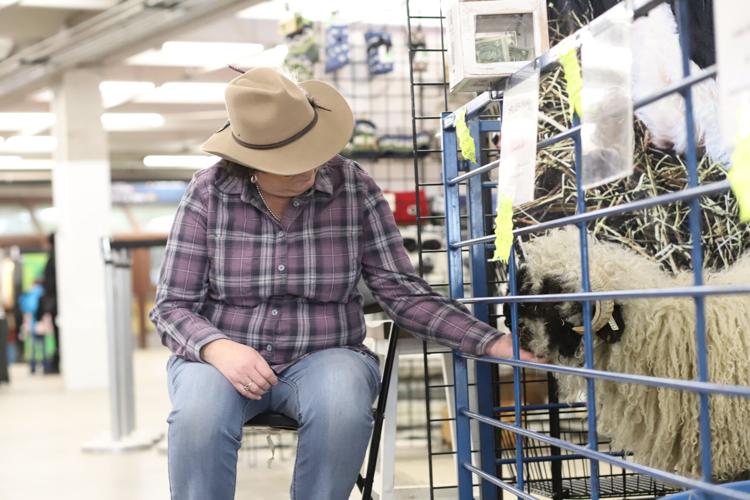
Monty, a Davis Family Livestock Valais Blacknose sheep Tuesday, Jan. 21, 2025, at the National Western Stock Show.
Kyla Pearce/Denver Gazette

The National Western Stock Show trade show is known for its variety of western wear for purchase — from custom cowboy hats to leather boots in every color.
Visitors to the trade show, however, are met with about 300 booths that sell much more than traditional western wear.
A walk down one of the trade show aisles in the Hall of Education takes a shopper on a journey. Agriculture equipment, like tractors and custom gates, are on one end. A hot tub vendor is on the other. In between, vendors are selling jewelry, taxidermy animals, perfume, local food, vintage collector items, toys, handmade silk woven art, alpaca yarn and sheep.
It’s a hub for colorful western wear, fun souvenirs and trinkets, good food and a fascinating collection of things people don’t realize they want until they see them.
Mike Trask and Ann Gooding at the Alpaca Breeders Association represent one of seven farms whose goods are sold at their stock show booth — a knitter’s dream with its wall of alpaca yarn in every color.
“Alpaca fiber is the best fiber for socks,” Gooding explained to two women browsing. “It keeps your feet warm and dry without the itchiness of sheep wool.”
While the Alpaca Breeder’s Association has had a stock show booth for about 20 years, Gooding and Trask — who have raised alpacas for 13 years — are staffing it for the first time this year, they said.
They’ve come to the Stock Show as visitors and proud parents of their children, who rode at the show when they were younger, for a long time.
“Going from visiting to vending is pretty cool,” Trask said. “It’s just the nicest people here who are all so interested in our product. We’ve met so many cool people who have neat stories to share.”
Just across the way down another trade show aisle, Forest Qing Zhing, a silk artist, embroiders a tapestry as shoppers pass by.
Silk art, the art of embroidering with thin strands of colorful vegetable-dyed silk, has been in Zhing’s family for generations, he said.
“This is an old art that dates back nearly 3,000 years,” Zhing said, explaining that showing his art is an important way to teach people about it by exposing them to it.
“Most people have never seen this kind of art before … this is a kind of lost technique,” he said.
From afar, the silk woven images look like colorful, detailed paintings. When the light hits them, the images come alive. Up close, each silk strand is visible, showing the time and dedication that goes into each piece.
“That one goes for $4,000,” Zhing told a shopper admiring a mountain landscape. “That piece took me 10 months to make.”
While his larger pieces sell for a lot of money, given the time that goes into them, he also sells smaller pieces for much less.
“I want everyone to be able to have this art,” he said. “If someone can’t afford it, I’ll bargain so that they can. I want this to be accessible to everyone.”
A floor below, Teresa Skeffington rubs the the neck of a Valais Blacknose sheep.
Skeffington started at the stock show as a visitor. Her purchase from a vendor three years ago turned her into a vendor herself and looped her into an effort in the United States to breed the sheep up to purebred status.
Valais Blacknose sheep originate in the Swiss Alps, according to the Davis Family Livestock website. The sheep are calm and friendly, making them ideal pasture pets, according to the website. Their fibers are used for felting and weaving outer apparel and rugs.
Restrictions don’t allow for importation of live sheep into the U.S., so livestock breeders use purebred semen and embryos to initiate breeding.
Valais Blacknose sheep were brought to the Stock Show for the first time three years ago. Skeffington and her husband left the show that year with Buckaroo.
“We just fell in love with him, so we bought him,” she said.
At first, Buckaroo lived in her house, she said, smiling at a video on her phone of the small sheep running around the house like an excited puppy.
Now, they have six sheep on their farm and are part of the breed-up program to try to get the breed to purebred status.
“It’s really neat to teach people at the show about the sheep,” she said. “They’re so sweet and people just love to come visit them.”