







What’s the risk of an air collision in Denver?
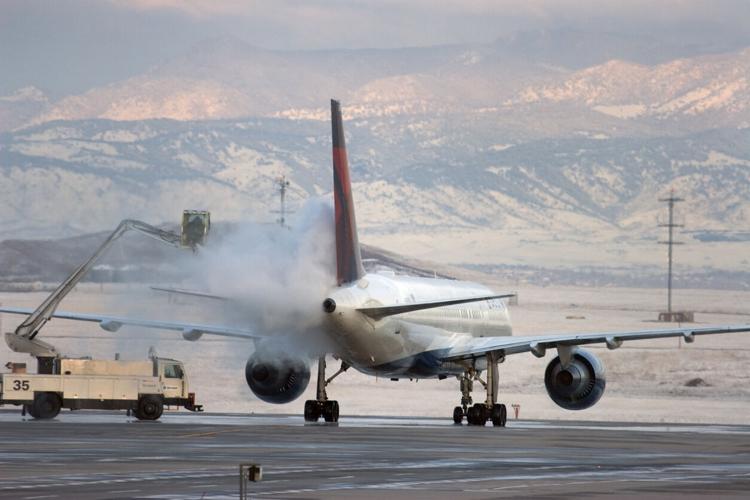
A plane prepares to take-off at Denver International Airport. DIA served more than 77 million passengers in 2023 — the all-time record.
milehightraveler/iStock.com

The collision between a military helicopter and a commercial jetliner over the Potomac River in one of the most highly regulated and carefully monitored airspaces in the nation has raised questions about aviation safety in the skies over metro Denver.
Aviation observers and experts, including a flight school director and a veteran Black Hawk helicopter pilot, said the chances of a similar accident occurring in Colorado’s airspace are very small.
Matt Beyer, director of safety at Rocky Mountain Flight School at Rocky Mountain Metropolitan Airport in Broomfield, said that the configuration of the various airports in the Denver area – Rocky Mountain Metro, Front Range, Centennial, Buckley and Denver International Airport – are such that nobody landing or taking off from any of them is flying directly at another airport.
Buckley Space Force Base has a runway that’s about 16 miles from DIA. It runs from northwest to southeast. This means aircraft using it are unlikely to infringe on the tightly controlled “class Bravo” airspace, which is like an upside-down layer-cake cylinder extending from the surface to 10,000 feet above the ground and to a diameter of about 10 miles from DIA.
None of DIA’s runways point directly at the Buckley runway or directly at any other airport.
Air traffic in class Bravo airspace is under tight control by air traffic controllers at all times.
“I feel that it’s very well controlled because there are maybe four types of operations, and all the controllers at Denver approach — and even the pilots — it’s well organized. It never surprises,” Beyer told The Denver Gazette. “In DCA (Washington D.C.), I worry that the military — with that Air Force base right there — it’s a lot of runways, and it’s a lot of odd activity, whether it’s protecting these critical sites like the White House, the Capitol — things like that. And so, I feel that the military operations in D.C. are way less normal or predictable compared to what we have here.”
Beyer said that given the space between airports and controlled airspace in Denver, there is little chance of inadvertent incursions into Bravo airspace by new or visiting pilots, and the military activity here doesn’t begin to match the activity in D.C.
“Buckley isn’t scrambling jets or helicopters to go intercept an aircraft where it might be lefts and rights and ups and downs, and now, oh boy, everybody’s going to be on their best attention,” said Beyer. “I feel that the operations we have in our five local airports are very well contained to typical procedures. So, the air traffic control can look for deviations.”
Retired Brig. Gen. Christopher Petty, who served as deputy director of operations for USNORTHCOM and who flew Black Hawk helicopters for years, agreed with Beyer’s assessment.
“Very low probability,” Petty told The Denver Gazette when asked about the chances of a similar collision in Colorado.
“You’re talking about controlled airspace,” he said.
“If I fly anywhere close to, let’s just say Centennial Airport, I have to talk to Centennial Airport, get cleared to go into their 4-nautical mile airspace around the airport just to transit through it,” he said. “So, those types of accidents are very, very rare for that reason.”
Petty said it’s important to wait for the National Transportation Safety Board to complete its investigation into the collision above the Potomac River.
He said the first question that came to his mind when he heard about the collision was what the sequence of communication was, given that both aircraft, based on the reports, were within the controlled airspace of Ronald Reagan National Airport.
“There’s a requirement to communicate to tower when you’re in that airspace, so they had to be talking to tower at some point,” he said. “So, from then on, what happened?”
Agreeing in part with the two experts’ assessment, aviation attorney Joseph LoRusso said the difference between Denver and D.C. is enormous.
LoRusso, who has examined radar tracks and communications recordings and is a legal expert in aircraft crash litigation and also an airline transport-rated pilot, said the D.C. area is “the most heavily controlled airspace in the country.”
And he said it’s also one of the busiest.
“That airspace is unbelievably difficult,” LoRusso said. “I mean, it requires additional training of flight crews to be able to operate within the D.C. triangle.”
On top of that, LoRusso said that flying in D.C. at night is extremely challenging. Beyer said the same about flying over the Potomac.
“As far as visibility, certainly at night, is a very, very difficult time to fly,” LoRusso told The Denver Gazette. “There’s a lot of light pollution where cityscapes can fall into stars. Stars can fall into cityscapes — bright spotlights coming off of clubs, off of boats, off of you name it. (It) just introduces a whole dynamic of obscurities that makes spotting aircraft very difficult, and honestly, that makes spotting airports very difficult as well.”
LoRusso did not draw any legal conclusions about what happened but offered his initial impressions based on the evidence he has seen so far. He pointed out that the helicopter crew had been advised by air traffic control to see and avoid an airliner in their path, which the crew acknowledged.
At that point the responsibility to avoid a collision was on the helicopter pilots, according to LoRusso.
“What it appeared to me was that the UH 60 (Blackhawk helicopter) identified another aircraft — I believe it was an American Airline flight — but another aircraft that was on approach to (runway) one. And I think that they mistook that aircraft for the one that they were supposed to maintain visual separation with,” LoRusso said. “And so, I think they got task saturated in that environment.”
He added: “You’re task saturated, No. 1, but then two, task saturated and fixated on what they believed to be the traffic that they were supposed to see and avoid. And then, because of that focus, completely missed the PSA (jet) that was coming in that they ended up colliding with.”
Petty, the former Black Hawk pilot, was careful not to weigh in on the investigation and offered insights with caveats, notably that there are numerous questions that the official probe will yet answer. He said it’s likely the helicopter crew was flying with night vision goggles because that’s what night training typically entails.
Whether the crew members were using night vision goggles, the challenge, he said, is that when aircraft fly at roughly 400 feet above the land, “lights start to not stick out as much when you’re that low.”
“City lights versus aircraft lights — because they’re all just lights in the background,” he said, adding it’s easier to spot the difference between city lights and aircraft lights at higher altitudes.
As for airline safety in Denver, LoRusso agreed with Beyer that Denver is safer than D.C., but he also has his finger on the pulse of aircraft accidents and noted that in 2024, there were a lot of crashes and near misses.
“I think that’s been, unfortunately, a negative theme of 2024 altogether. There were more near misses, it seemed, in the news than I’ve ever experienced in my more than 20 years of flying,” LoRusso added.
“I would compare it to the Hudson, flying through the New York corridor, right? It’s really, really tight, and there is a lot of traffic and every couple of years, there’s a mid-air there that happens,” LoRusso said. “I think the last one was like a Piper Saratoga and a tour helicopter. So, are we at the same risk here? I don’t think we have airspace that is as intense as they experience in D.C.”
Petty said the collision is a real tragedy.
“I feel for the families and the soldiers,” he said. “Whenever I hear about Army helicopters crashing, it hits closer to home.”
Editor Luige del Puerto contributed to this article.