







Leo Kubiak, NBA’s second-oldest living former player and ex-Denver Refiners star, is ‘alive and well at 98’
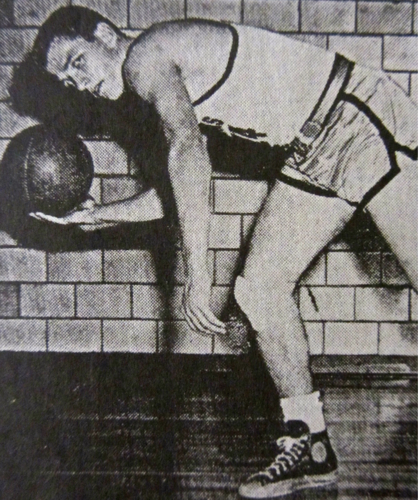
Leo Kubiak, who at 98 is the second-oldest living former NBA player, shown with the NBA's Waterloo Hawks in the 1949-50 season. The guard finished his career in 1950-51 with the Denver Refiners of the National Professional Basketball League before retiring due to a knee injury. (Photo courtesy of Brian P. Gaynor)
Photo courtesy of Brian P. Gaynor
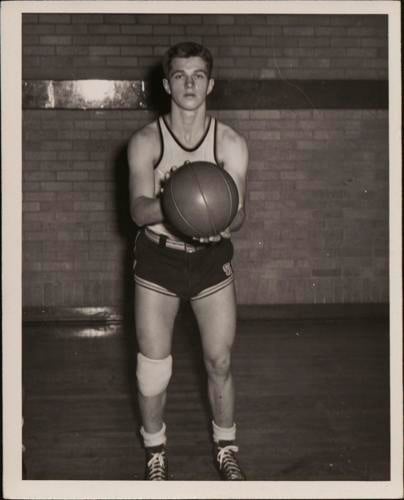
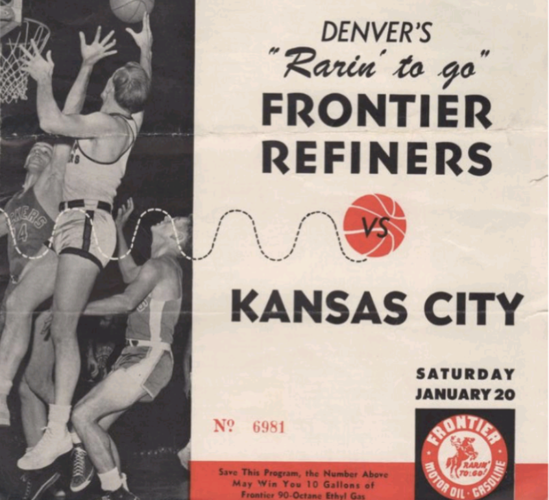
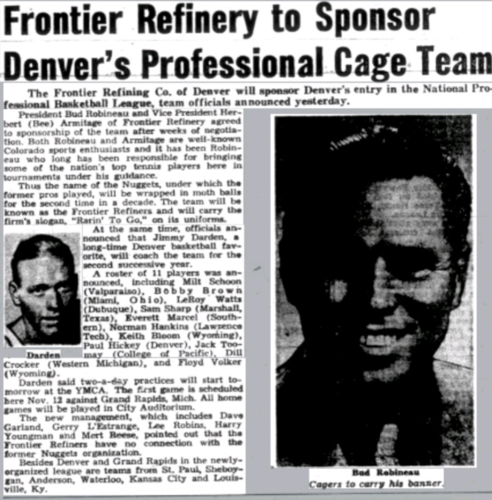
Leo Kubiak’s time as a professional athlete in Denver lasted only 12 games and 22 days, but he was around long enough to make some headlines.
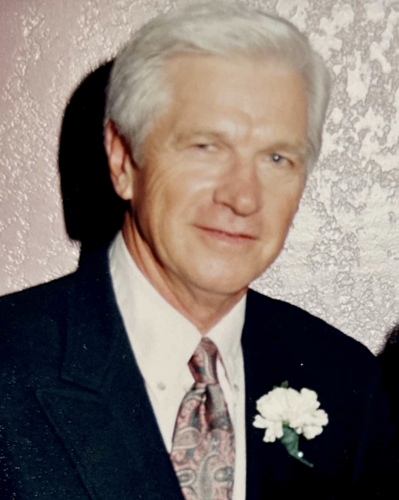
Kubiak is 98 years old and has lived the past 25 years in Lecanto, Fla. He is the second-oldest living former NBA player, having played for the Waterloo (Iowa) Hawks in 1949-50, the first true season in league history.
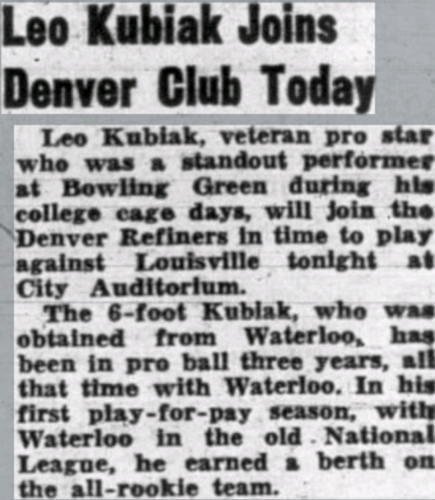
Kubiak, listed then as a 5-foot-11, 175-pound guard, ended up the next season with the Denver Refiners, a team in the fledgling National Professional Basketball League (NPBL). A headline in the Jan. 7, 1951, Rocky Mountain News read, “Leo Kubiak Joins Denver Club Today.”
Not long after that, Kubiak remembers his name again being in big type.
“One day the newspaper headline read, ‘Leo Kubiak Makes Seven Consecutive Shots,’’’ Kubiak proudly told The Denver Gazette from his home, an hour north of Tampa. “I never missed one.”
That was quite a big deal in an era when basketball teams rarely shot even close to 40%. Kubiak had shot 32.6% in his one NBA season while averaging 11.5 points. He was named Waterloo’s Most Valuable Player.
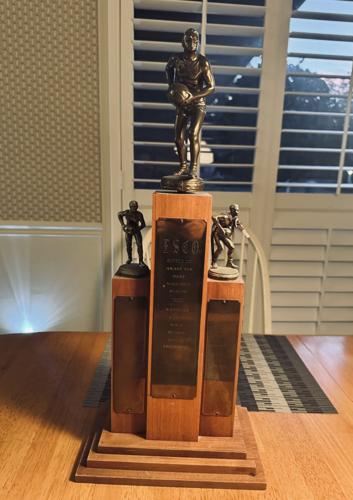
Kubiak still has the MVP trophy at his home, where he receives 24-hour care from nurses and uses a walker and an electric cart to get around while lamenting that his sight and hearing are fading. He said he doesn’t have any memorabilia from his time with the Refiners but pepped up when asked about them.
“The Refiners, that was a long time ago,’’ he said. “But I’m alive and well at 98 years old and I’m working on 99.”
The Refiners, playing in a league that would disband after one season, were Denver’s second pro basketball team. The first was the original Denver Nuggets, who played in the National Basketball League (NBL) when they debuted in 1948-49 and then went 11-51 in the NBA in 1949-50 before going out of business.
The NBA had been formed Aug. 3, 1949, when the Basketball Association of America (BAA) merged with the NBL and the new entity was dubbed the National Basketball Association. The NBA later added the BAA’s three-season history, which is why it calls June 6, 1946, its founding date, but it never has recognized NBL statistics.
In 1949-50, the 17-franchise NBA had teams in outposts such as the Anderson (Ind.) Packers, the Sheboygan (Wis.) Redskins and the Waterloo Hawks. Those teams were contracted after the season.
The NBA also lost teams in bigger markets, with the Chicago Stags, St. Louis Bombers and Nuggets all folding. But basketball historian Branigan Faurschou, who runs the website NBAHoopsOnline.com, said the Nuggets, as the league’s only team more than a few miles west of the Mississippi River, were pretty much booted out.
“The NBA was forcing out teams in smaller markets,’’ Faurschou said. “Denver wasn’t that small of a market, but teams didn’t like going out that far for games.”
The NPBL then was formed in what was supposed to be a rival to the NBA. The Packers, Redskins and Hawks all joined the eight-team league. Also added were the Louisville (Ky.) Alumnites, the Grand Rapids (Mich.) Hornets, the Kansas City (Mo.) Hi-Spots, the Saint Paul (Minn.) Lights and the Refiners.
The Denver team also was known as the Frontier Refiners since it was sponsored by the Denver-based Frontier Refinery. When the Refiners entered the new league, the Rocky Mountain News on Oct. 8, 1950, made sure to note it wasn’t a continuation of the Nuggets, writing that the name of that team “will be wrapped in moth balls.”
Nevertheless, the Refiners’ coach was Jimmy Darden, who had led the Nuggets during their one rugged NBA season. Darden also played guard for the team, and the Refiners had four other players who had been with the Nuggets the previous year.
As for Kubiak, he began that season with Waterloo, which marked the third different league he had played in with the Hawks in three seasons. He had been with them in the NBL as a pro rookie in 1948-49.
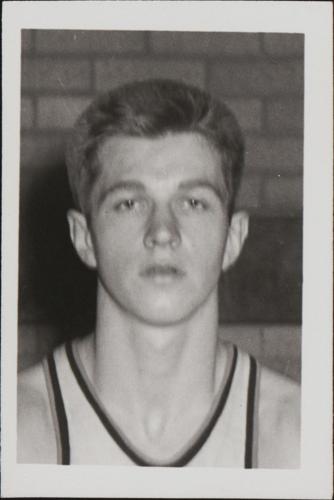
Kubiak had been a star at Bowling Green (Ohio) University from 1944-48 and is in the school’s athletics hall of fame. As a freshman with the Falcons, they advanced to the championship game of the National Invitation Tournament, then considered bigger than NCAA tournament, before losing 71-54 on March 26, 1945 at New York’s Madison Square Garden to DePaul, featuring legendary 6-10 center George Mikan.
“There was a picture taken of George Mikan getting ready to take a shot and there’s a guy hanging on his arm that’s about 3 feet off the ground, and it’s my dad, who was called for a foul,” said Kubiak’s son, Chris Kubiak, 69, who lives near him in Florida. “And The New York Times titled it, ‘David works on Goliath.”’
Kubiak was a nifty ballhandler and, being one of the early players to utilize a jumper, was considered a sharpshooter for his era. He was a fine athlete, and as a shortstop played minor league baseball in the summer of 1948, which included hitting .264 with five home runs and 33 RBI in 58 games for the Green Bay Bluejays of the Wisconsin State League.
Kubiak was drafted in the fourth round by the Rochester Royals of the BAA but opted to instead join the Hawks of the rival NBL for the 1948-49 season. He averaged 7.5 points while playing in all 62 games before Waterloo joined the NBA.
“Back then, the owners (in the NBL and the BAA) were fighting each other for players,’’ Kubiak said. “The owners said this is nuts, so why don’t we merge.”
In the 1949-50 NBA season, Kubiak played in all 62 games while averaging 3.2 assists to go along with his 11.5 points and was honored in a fan vote as the team MVP.
“When I first joined the Hawks, I was making $1,000 (for the season), but I was just happy to get paid to play basketball,’’ Kubiak said. “It was an honor. And then when I was named MVP, they gave me $2,700. That was a heck of a raise.”
Kubiak’s raise took effect when the Hawks entered the NPBL. But as far as his NBA career was concerned, it would be over.
Kubiak’s statistics from his one NBA season remain in the record book. That has led to Kubiak, a Christmas baby born in Toledo, Ohio, on Dec. 25, 1926, being the second-oldest living former NBA player. The only one older is Harry Donovan, 98, who was born Sept. 10, 1926 and averaged 5.6 points for the New York Knicks during his only NBA season of 1949-50. Kubiak, Donovan and Bill Calhoun, 97, who averaged 9.0 points for Rochester in 1949-50, are the only surviving players from the league’s true debut season.
Duane Klueh was the last surviving original Denver Nuggets player and had been the oldest living player in NBA history until he died June 2, 2024, at age 98. Kubiak is the only surviving Refiners player.
“That’s marvelous,’’ Kubiak quipped about being the NBA’s second-oldest living player. “I need some publicity. It was a thrill to be one of the original NBA players.”
Kubiak remained one of the Hawks’ top players when they entered the NPBL, but he said his play had slowed down a bit due to having suffered a knee injury. Playing in 26 Waterloo games to open the 1949-50 season, he averaged 9.0 points.
Kubiak then was traded to the Refiners, who absorbed the remainder of his $2,700 seasonal salary. Perhaps that wasn’t a good idea for team management considering money problems were starting to surface.
“Some of it was similar,’’ Kubiak said of the talent in the NPBL compared to the NBA. “But at that point it wasn’t the NBA. There was a lack of money.”
Kubiak said the Refiners usually played before “a few hundred” fans a game at the Denver Auditorium Arena, which had a listed capacity of 5,000 for basketball. The team played on a theater-type stage.
“You can’t compare what was going on in basketball then in the early days to now,’’ he said. “Nobody would believe it.”
The team also played two home games in Cheyenne. Road trips were often treacherous.
“We got tied up in snowstorms,’’ Kubiak said. “We went up to play in Wyoming, and they had one john that had to be shared by the whole team.”
In his 12 games with the Refiners, Kubiak averaged 8.0 points. While he had that big game in which he made seven straight shots, he was more of a distributor, passing to players on a roster that had some notable talent.
Of the 15 players who saw action for the Refiners in 1950-51, 10 at one point played in the NBA. The top scorers were forward Ed Dahler, who averaged 12.1 points; center Milt Schoon, who averaged 11.7; and forward Dillard Crocker, who averaged 10.1. Schoon scored an amazing 64 points in a Jan. 21, 1951, game against Kansas City, which at the time was considered a pro basketball record.
The Refiners had a Black player in guard Ziggy Marcell, although he appeared in just three games. During the 1950-51 season, Earl Lloyd of the Washington Capitols, Chuck Cooper of the Boston Celtics and Nat “Sweetwater” Clifton of the Knicks had become the first Black players in NBA history.
But with the Refiners being 18-16 on Jan. 29, 1951, the team, overcome by money problems, announced its intentions to fold. The Refiners eventually were sold to a group that moved them to Evansville, Ind., and they were renamed the Agogans. They went 0-6 the rest of the season before the league was shut down.
“I didn’t go with the team to Evansville,’’ Kubiak said. “I had hurt my knee. When you got hurt, they did nothing for you. So I went back to Toledo and rehabbed myself.”
Kubiak decided to retire from basketball and soon moved to Milwaukee, where he worked for about 20 years selling copper wire for Prestolite Wire. He moved to the San Diego area in the early 1970s and opened Kubiak Sporting Goods, having two stores that he ran for about 10 years.
But Kubiak’s athletic career hardly was over. He had begun to play a lot of golf after his basketball days and became a highly rated amateur.
Kubiak returned to Colorado for the 1967 U.S. Amateur at The Broadmoor in Colorado Springs. Chris Kubiak said he was playing extremely well in the first round of the tournament until it was rained out. Starting over the next day, he wasn’t able to duplicate his early success and fell out of contention.
Three years later, at 43, Kubiak finished second in the Wisconsin State Amateur.
Kubiak later became a senior golfer and, at 54, competed in the 1981 U.S. Senior Open in Birmingham, Mich., finishing 45th in a tournament won by Arnold Palmer over Billy Casper and Bob Stone in a playoff. Kubiak had been in 10th place after the first round and was just two shots behind Palmer after the second round. But he then faded, which included shooting 81 in the fourth round.
“I was good,’’ Kubiak said of his golf career. “I played against Billy Casper a lot. I’ve got a lot of trophies I won in golf.”
Kubiak won a number of local tournaments while always remaining an amateur. He biggest national win was claiming the 1995 Super Seniors North & South event at Pinehurst (N.C.) Country Club when he was 68.
Also during the 1990s, Kubiak played in several member-guest events at Castle Pines Golf Club. At one, he met Gary Kubiak, who played quarterback for the Broncos from 1983-91, was their offensive coordinator from 1995-2005 and head coach from 2015-16. Although the two are not related, Leo said he joked at the event about Gary, “If he was winning golf tournaments, he would be my cousin.”
“I do remember meeting him,’’ said Gary Kubiak, who called it “awesome” when told of Leo being the second-oldest living former NBA player. “There was some charity event I was at and somebody introduced him to me. It was sometime in the late ‘90s. I don’t know if there’s a lot of Kubiaks throughout the country, so us Polish guys got to stick together.”
After that meeting with Gary, Leo still had about a decade of golf left in him.
“He played until maybe he was 80 to 85,’’ said Chris Kubiak. “He played with some awfully good players (in Florida) and he put everything into it. Then he couldn’t walk for a few days. But he was very competitive.”
Chris is one of two sons Kubiak had with his wife of 70 years, Suzanne. His wife died in 2020 and their other son, Kent, had died in a 1971 car accident.
As for his father’s health, Chris Kubiak said he still “gets on an exercise bike every day” but that he has a variety of ailments. He gave up driving three or four years ago.
“He’s certainly taken phenomenal care of himself,’’ Chris said. “But at 98, it’s just what age has done to you. The last six months or so, he’s had good weeks and bad weeks. He doesn’t go out much anymore.”
When talking about his health, Kubiak provides realistic details but also speaks with optimism.
“Two years ago, I broke a knee and it’s like a dungeon, and I can’t do anything,’’ he said of his home. “I have a walker and an electric cart. I can’t see. My eyes aren’t very good. I can’t hear that well. I stutter a lot.”
But Kubiak soon pepped up and mentioned how “thankful” he is to still be able to talk about his basketball days. He sometimes gets cards in the mail asking for his autograph, and he happily signs them.
“I take things one day at a time,’’ he said. “The nurses and I, we sing that song, ‘One Day at a Time.’ I’m working on 99 and everybody tells me I look good enough to go to 200.”