







Auditors find Denver’s equity office lacks measurable objectives

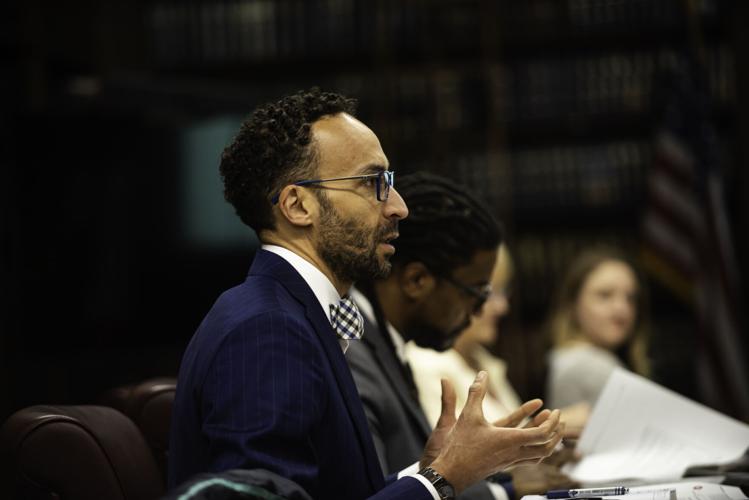
Dr. Ben Sanders, chief equity officer of the Mayor's Office of Social Equity and Innovation, center, answers questions from auditors on Feb. 20, 2025 during a follow-up audit. The office, made official though an executive order signed by former Denver Mayor Michael Hancock, has struggled to implement recommendations from a previous audit dating back to August 2022.
Deborah Grigsby, Denver Gazette
Nearly five years after its inception, auditors have found that the Mayor’s Office of Social Equity and Innovation lacks measurable objectives and has yet to develop fully detailed programs, strategies, policies and procedures.
A follow-up audit revealed that only two of the 16 recommendations made by auditors in August 2022 have been fully implemented. Of the remaining 14, seven have been partially implemented and seven have not been implemented at all.
“I’m disappointed the Mayor’s Office of Social Equity and Innovation has yet to develop fully detailed programs, strategies, and policies and procedures four years into its existence and two years after our initial audit,” said Denver Auditor Tim O’Brien. “An improved detailed plan will lead to significant progress on reducing racial and social injustices in Denver.”
Auditors said the office has created a strategic plan, but it lacks measurable objectives, updated metrics, cost and responsibility designations, and a detailed feedback analysis process.
“When there is no formal process to track performance metrics, we can’t guarantee these programs are achieving their intended outcomes,” O’Brien said.
However, OSEI’s biggest challenge comes from the vague executive order that created it.
In December 2022, former Denver Mayor Michael Hancock issued Executive Order No. 146 that formalized and launched the office.
But the executive order’s lack of clarity means the office does not have the authority to enforce its requirements for city agencies, such as ensuring city employees complete race and social justice training.
Because OSEI exists only by executive order, it remains at risk of change or closure by future mayors.
“We’ve seen what happens when new administrations take office,” O’Brien said. “It is critical the Mayor’s Office of Social Equity and Innovation engage with the Mayor’s Office to ensure the city’s commitment to combating injustices and inequities in Denver is an embedded practice.”
OSEI, like several other offices, has endured an unusually high rate of turnover in its leadership, including the loss of two chief equity officers in almost as many years.
Former DOTI Deputy Chief of Staff Ben Sanders has served as the city’s chief equity officer for the past 18 months, inheriting challenges from his predecessors.
“It goes without saying that these are very full and complex times for an office like ours,” Sanders told auditors.
A year into his current position, Jessica Calderon, a former city employee, filed a lawsuit against both Johnston and Sanders, alleging discrimination and First Amendment retaliation for her support of a candidate who ran against Johnston.
The case, 24-cv-02046, Calderon v City and County of Denver, Office of the Mayor, remains in litigation.
In May 2024, Johnston announced the creation of the Office of Neighborhood Safety, transferring $11 million and 65 employees from the Department of Public Safety to OSEI.
Sanders told auditors that progress would be made before their next visit.
Because not all risks and recommendations were fully addressed, future audits may reevaluate them again to ensure the city acts accordingly, auditors said.