







Colorado Springs lawmakers push for advisory committee to establish Black history standards in schools
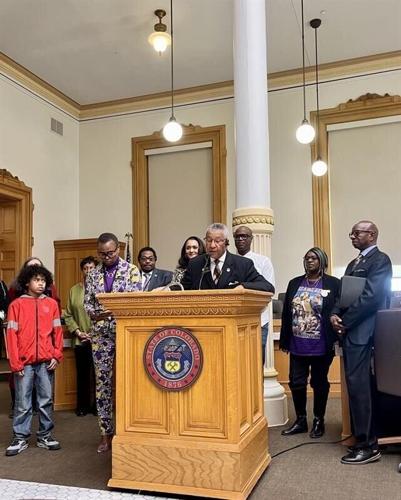
Sen. Tony Exum, D-Colorado Springs, speaks during a press conference on HB 1149, which requires the state Board of Education to adopt standards on Black historical and cultural studies.
Marissa Ventrelli
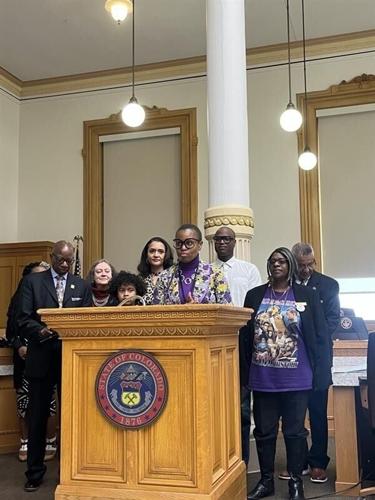
Colorado Springs Democrats Rep. Regina English and Sen. Tony Exum have introduced a bill to establish an advisory committee that will recommend standards to the Department of Education for teaching Black history and culture in K-12 schools.
The bill expands upon a law passed in 2019 requiring schools to teach students about the history, cultural, and social contributions of American minorities.
English and Exum said they felt it was necessary to require specific standards on Black history education, particularly in light of the federal government’s crackdowns on Diversity, Equity, and Inclusion (DEI).
Dani Newsum, a former civil rights attorney and professor of African American history, mentioned the controversy surrounding the Air Force Academy’s brief removal of educational materials about the Tuskegee Airmen from its curriculum. As the daughter of a Tuskegee Airman, Newsum expressed her outrage over the decision, which was reversed days later.
“The current attempts by the White House and several states to literally whitewash American history are contemptible, but not new,” said Newsum. “If these attempts are ultimately successful anywhere, all American students will be left ignorant of actual history, which, of course, is exactly the goal of the latest iteration of American no-nothings.”
While students are often taught about slavery and the Civil Rights movement, they rarely learn about all of the other contributions Black Americans have made in fields like science, medicine, and the arts.
“It is not just mine, but our obligation to make sure that we are teaching not only our students, but all students, true history and what that looks like for Black Americans,” said English. “There’s more to Black people than slavery and oppression. We are inventors, we are entrepreneurs, we are creators, we are educators, we are doctors, we are attorneys, we are judges, and the list goes on and on.”
History is more than just a collection of dates, English said. Teaching Colorado students Black history allows them to have meaningful discussions about race, identity, and social justice and learn empathy and respect for all people, regardless of race.
“In today’s world, where inequality and prejudice persist, it is our job as educators to guide our students through these conversations,” said English. “By fostering an environment where Black history is openly discussed, we empower young minds to think critically about societal challenges. They learn to question the narratives they encounter and to seek out truths that may have been overlooked or marginalized. Understanding the significance of Black history also helps students cultivate relationships with peers from diverse backgrounds.”
The bill passed in an 8-5 vote in the Committee of Appropriations on Feb. 20.

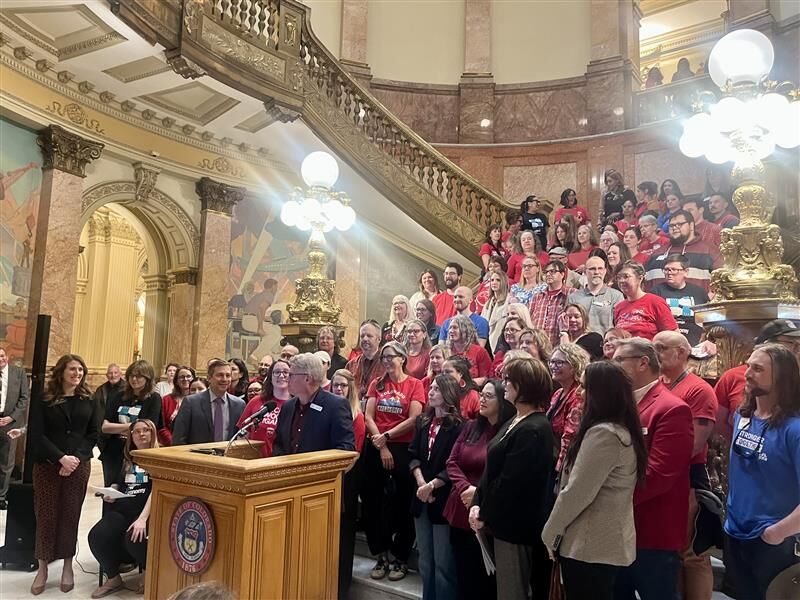
Another TABOR fight: Democrats plan to redirect refunds to Colorado residents
Marianne Goodland
marianne.goodland@coloradopolitics.com
Updated 4 hours ago
Colorado voters could decide this fall whether billions of dollars that would otherwise be returned as refunds under the Taxpayer’s Bill of Rights should instead go to public schools under a ballot measure unveiled Thursday by Democrats. Supporters say the...

Marianne Goodland
Reporter
Procedural clash exposes rift on Denver school board
Nicole C. Brambila nico.brambila@denvergazette.com
nico.brambila@denvergazette.com
Updated 9 hours ago
The coalition that restored the president’s gavel to Denver school board Director Xóchitl Gaytán showed cracks Thursday, with board members trading accusations during its regular meeting and arguing over procedure while the district’s general counsel flipped through Robert’s Rules of...

DPS board considers policy designating schools as ‘safe zones’ from immigration enforcement
Nicole C. Brambila nico.brambila@denvergazette.com
nico.brambila@denvergazette.com
Updated 14 hours ago
The Denver school board discussed a major policy amendment that, if passed, will designate all district properties as “Safe Zones” and “Sensitive Locations.” In practical terms, the proposed policy amendment would restrict federal immigration agents from interacting with students and...
Over 60 Colorado school districts to look for candidates at recruitment fair
Sage Kelley
sage.kelley@denvergazette.com
Updated 1 day ago
Colorado school districts are looking for the next generation of teachers and employees this weekend. The Colorado Educator Recruitment Fair will be held from 8 a.m. to 4 p.m. on Saturday at Frederick High School, 5690 Tipple Parkway, according to...

Sage Kelley
Reporter

Broomfield High School keeps 26 students out after confirmed measles case
Nicole C. Brambila nico.brambila@denvergazette.com
nico.brambila@denvergazette.com
Updated 3 days ago
After state officials confirmed a measles case last week at Broomfield High School, 26 students are not allowed to attend class, the district said Monday. On Friday, school officials requested students who are not vaccinated against measles to not attend...

Jeffco teachers’ unions want guarantees on how mill levy money will be spent
Sage Kelley
sage.kelley@denvergazette.com
Updated 1 week ago
Teachers’ unions in Jefferson County won’t back the school district’s mill levy override (MLO) attempts without guarantees on how the money will be spent. During the Jeffco Public Schools’ Board of Education meeting on Feb. 12, union leaders and teachers...
Sage Kelley
Reporter
Ex-Cherry Creek superintendent must repay one month’s salary after abrupt resignation
Nicole C. Brambila nico.brambila@denvergazette.com
nico.brambila@denvergazette.com
Updated 1 week ago
Former Cherry Creek School District Superintendent Chris Smith must repay one month’s salary for failing to provide the board of education with three-month’s notice of his resignation, The Denver Gazette has learned. The board of education has not waived the...
Parent group accuses DPS of racketeering in challenge to school financing structure
Nicole C. Brambila nico.brambila@denvergazette.com
nico.brambila@denvergazette.com
Updated 1 week ago
The parent advocacy group that previously accused Denver Public Schools of financial misconduct in court documents has escalated its claims, alleging the district engaged in racketeering through its bond and lease-financing structures. Mamás de DPS filed a complaint in Denver...
Senate committee kills bill to track education violations
Sage Kelley
sage.kelley@denvergazette.com
Updated 1 week ago
A proposed bill following in the wake of multiple Jeffco Public Schools sexual misconduct cases won’t make it to the Senate floor. The Colorado Senate State, Veterans and Military Affairs committee denied proposed Senate Bill 26-055 on Tuesday afternoon with...
Sage Kelley
Reporter
Cherry Creek school district to pay ex-superintendent $165K after resignation amid toxic workplace claims
Nicole C. Brambila nico.brambila@denvergazette.com
nico.brambila@denvergazette.com
Updated 1 week ago
The Cherry Creek School District will pay nearly $165,000 to former Superintendent Chris Smith following his resignation last month amid allegations of a toxic workplace. The board of education announced last week that the district is contractually obligated to pay...
PREV
PREVIOUS
Commerce City students attend National Western Stock Show, gain insight into food sustainability
Facebook Twitter WhatsApp SMS Email Print Copy article link Save While an untold number of visitors to the National Western Stock Show go for the food and shopping, Rey Padilla went with a question. A sophomore at the STEAD School in Commerce City, Padilla and his classmates wandered the animal pens interviewing ranchers last month […]

Colorado voters may get another say in funding free school meals for all
Less than three years after Colorado voters approved a ballot measure to provide all students with free school meals, state lawmakers are considering asking voters for more money to keep the popular program afloat. A bill introduced this week in the state legislature proposes putting two measures on the ballot in November that would allow […]