








As Trump administration pauses military aid to Ukraine, Colorado nonprofit ramps up help

Ukraine Power co-founder and Ukraine refugee Yana Malyk warms her hands with one of the heaters Ukraine Power purchased while touring a government hub Monday, Dec. 11, 2023, in Dnipro, Ukraine. (The Gazette, Christian Murdock)
Christian Murdock/The Gazette



As the Trump administration paused U.S. military aid to Ukraine and Russia advanced on more territory, a tiny non-profit in Colorado Springs is ramping up reinforcement to Ukrainians, one family at a time.
“It’s not stopping me,” said Yana Malyk, the Ukrainian woman who fled the country with her two teenage daughters in 2022 and landed in Colorado.
For Malyk and other fervent supporters of Ukraine, the ground has crumbled beneath their feet in the last week.
On Friday, Feb. 28, President Donald Trump and Vice President JD Vance publicly castigated Ukrainian President Volodymyr Zelenskyy in the Oval Office for not being grateful enough for U.S. aid. On Monday, Trump temporarily suspended all military aid to Ukraine, which remains in effect.
Then came Thursday’s news that the Trump administration is weighing revoking temporary legal status for some 240,000 Ukrainians who fled to the United States. The Malyks are in Colorado on United for Ukraine (U4U) status and Temporary Protected Status (TPS), a program started a month after Ukraine was invaded and allowed Ukrainians displaced by the war to stay in the U.S.
Reuters reported that the decision would potentially put Ukrainians on a fast track to deportation as soon as April.
“We’re not looking to hurt anybody, we’re certainly not looking to hurt them, and I’m looking at that,“ Trump told reporters in the Oval Office when asked about revoking the Ukrainians’ status and deporting them. “There were some people that think that’s appropriate, and some people don’t, and I’ll be making the decision pretty soon.”
White House press secretary Karoline Leavitt pushed back on the Reuters report in a post on X, saying “no decision has been made at this time.”
The uncertainty is exhausting for Malyk.
“Most of us don’t have a home to return to,” she said. “We’ve lost everything.“
A life left behind
In the lifestyle she lost, Malyk had a nice home and a thriving career.
In the past, she had been an advisor and assistant to the governor of the Luhansk Region on humanitarian issues and was instrumental in evacuating people and coordinating relief efforts after the original Russian invasion of her district in 2014.
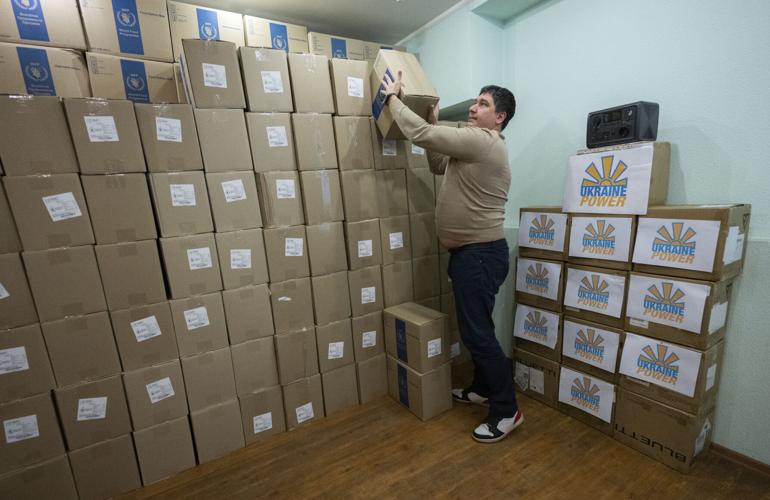
She brought her insight to co-found Ukraine Power in November 2022. In two-and-a-half years, the small group with big plans has raised more than $380,000, most of which was donated by Coloradans.
In the beginning, as the frigid winter of 2022-2023 loomed, the money went to purchase generators bought in London and trucked to various Ukrainian towns in hopes of providing heat and power. They also sent heaters, rechargeable lamps, cookstoves, and other critical supplies to help Ukraine survive that first winter.
As time went by, the generators became more of a problem than a lifeline as they ran on gas, which was in short supply, couldn’t be operated indoors, and were noisy, which put Ukrainians who were in hiding in danger.
Without hesitation, Malyk pivoted and redirected Ukraine Power’s energy to the needs of families devastated by the war. Not only did the group begin sending large power banks instead — large rechargeable batteries that could be used indoors, and could power entire households — but also found others who were in need.
The group worked with local government officials to help establish a series of hubs across the country, where internally displaced people could come for warmth, get some hot food, wash their clothes, find medical assistance, and connect to the internet as a means of communicating with friends and family.
So far, 32 hubs have been set up, and the Ukrainian government estimates that as many as 1.5 million people have visited them in the past two years.
The next phase of Ukraine Power’s efforts was directed toward aiding specific people devastated by the effects of the war. Among them are parents who have taken in war orphans and children who were in volatile family situations, where their birth parents could no longer care for them.
Power Ukraine has provided small power stations, power banks, kitchen items, and televisions, and one young boy was given a phone “so that during air raid alerts, he can stay in his school’s shelter and keep in touch with his mother.”
“That gives her peace of mind,” said Malyk.
Looking forward, Malyk has established relationships with other organizations like the Ukrainian Red Cross and UNICEF to provide help.
On Ukraine Power’s Facebook page, there are dozens of photos and videos of young war survivors giving a thumbs-up in thanks to the organization. They stand in front of power boards and sit at plastic tables draped with lace tablecloths in front of open laptops. In one video, a toddler pulls clothes out of a brand-new washing machine. In another, one of nine children picks through Jingle Bells on a piano sent by Ukraine Power.
The Karptsovs
Families of four who lived under one roof have now expanded to as many as a dozen as they gather displaced children. One of those is the Karptsov family, who lost their eldest son in one of the bloodiest battlefields of the war in 2023.
Yegor Karptsov, 21, had just called his mother the day before he died to beg her to adopt an orphaned child he had seen and lost in the crowds. Oksana Karpstov assured him that she would find the little girl.
The next day Yegor was killed while he was evacuating people from the city of Avdiivka, important to the Russians because it is the gateway to Donetsk, which opposing forces needed for its value as a communications and logistics hub.
A year later, as the Karptsovs emerged from their despair, they decided to honor their son’s last request. They found the girl he had seen in the crowd in a Netherlands orphanage with two younger sisters and a brother. The Karptsovs adopted all four of them, including one child with special needs.
Malyk works with families like the Karptsovs every day as their needs change with political winds.
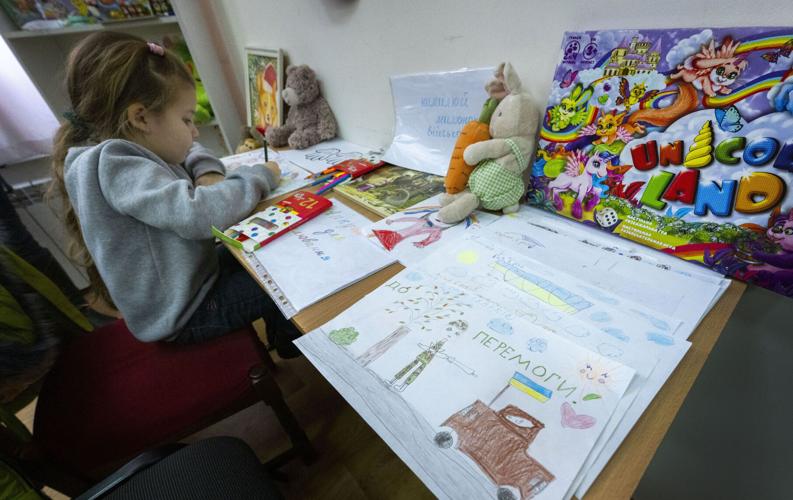
She has sent lamps to replace candlelight and laptops for online learning.
The war in Ukraine has interrupted their studies so much that around 80% of education is conducted online. Many lack access to technology and networks.
Recent data indicates that at least 1.5 million internally displaced people in Ukraine are children, about 225,000 of whom are school-aged, according to Education Cannot Wait, an education fund administered by UNICEF.
Yana’s escape and recovery
The Malyk family fled the only home they’ve ever known by car and crisscrossed Europe to eventually arrive at Denver International Airport at midnight on July 21, 2022. There, her adopted sponsor Marc Luckett balanced a handful of balloons and a welcome sign and drove them to his home in Colorado Springs.
The Lucketts own an international logistics company and Malyk has the connections. Malyk owned multiple businesses in Svatove, including a women’s health clinic, a travel agency, several commercial buildings, and a sunflower seed farm. All of this was lost, and the family arrived in America with just two suitcases.
Three years after the war started, the Malyks have set up stakes in Colorado, and are living the American dream. They’ve gotten jobs, and cars, and even managed to purchase a home of their own. The older daughter graduated from high school and is now finishing her freshman year in college. The younger one is in middle school “and is so American now.”
“I can’t change what happened. If I think about it all the time I will be sick,“ Malyk told The Denver Gazette. “I want a good life for me and my family. That’s it.”
Reuters contributed to this story.


FBI says it disrupted a New Year’s Eve attack plan inspired by Islamic State group
Erik Verduzco
erik.verduzco@associatedpress.com
Updated 4 hours ago
CHARLOTTE, N.C. (AP) — The FBI said Friday it disrupted a New Year’s Eve attack plot targeting a grocery store and fast-food restaurant in North Carolina, arresting an 18-year-old man who authorities say pledged loyalty to the Islamic State group....

Erik Verduzco
Reporter

Trump’s all-in AI push is paying off handsomely, making up for his failed tariffs gamble at least somewhat
Tiana Lowe Doescher, Washington Examiner
tiana.lowe.doescher.washington.examiner@gazetteedit.wpenginepowered.com
Updated 5 hours ago
When politicos look back on President Donald Trump’s first year in his second stab at the presidency, early 2026 may mark the nadir of his career-wide economic approval. The inflation crisis inherited from former President Joe Biden has kept the...


Europe struggles to keep pace as US cracks the whip on defensive self-reliance
Timothy Nerozzi, Washington Examiner
timothy.nerozzi.washington.examiner@gazetteedit.wpenginepowered.com
Updated 5 hours ago
U.S. military leaders are demanding that Europe shoulder its own defense responsibilities, but overturning decades of Washington-led security arrangements requires a monumental effort. The United States is reportedly pressing European powers to assume responsibility for the bulk of NATO defense...

Timothy Nerozzi, Washington Examiner
Reporter

Maduro says Venezuela is ready to discuss an agreement to ‘combat drug trafficking’
Washington Examiner Staff, Washington Examiner
washington.examiner.staff.washington.examiner@gazetteedit.wpenginepowered.com
Updated 5 hours ago
Venezuelan President Nicolas Maduro announced that his regime was open to negotiations with President Donald Trump to come to a deal regarding drug trafficking. Maduro’s admission comes after United States military strikes on suspected drug-trafficking vessels in the Caribbean Sea...


Rising unemployment puts threat of AI competition in stark relief
Nick Thomas, Washington Examiner
nick.thomas.washington.examiner@gazetteedit.wpenginepowered.com
Updated 5 hours ago
“Brutal,” “disheartening,” even “traumatic” — these are just some of the daily descriptions, on platforms such as LinkedIn, about searches for decent white-collar work. It’s a problem compounded by the rising unemployment rate during President Donald Trump’s second, nonconsecutive term....

Nick Thomas, Washington Examiner
Reporter

What can Trump do to change the tide before the 2026 midterm elections?
NAOMI LIM Washington Examiner
naomi-lim-washington-examiner@denvergazette.com
Updated 5 hours ago
History will be against President Donald Trump when he tries to hold on to his control of Congress after this year’s midterm elections. From pressuring state Republicans to redraw their congressional districts to create more GOP-leaning seats in the House...

NAOMI LIM Washington Examiner
Reporter

Trump says he ‘aced’ cognitive test amid fresh questions about his health
NAOMI LIM Washington Examiner
naomi-lim-washington-examiner@denvergazette.com
Updated 5 hours ago
President Donald Trump boasted about his cognitive test results after admitting he regrets disclosing he had advanced imaging because of the scrutiny it has stoked regarding his health. “The White House Doctors have just reported that I am in ‘PERFECT...
NAOMI LIM Washington Examiner
Reporter

Mamdani voids Adams’s pro-Israel executive orders on Day One as mayor
Brady Knox, Washington Examiner
brady.knox.washington.examiner@gazetteedit.wpenginepowered.com
Updated 5 hours ago
New York Mayor Zohran Mamdani began his term by voiding all of his predecessor’s executive orders signed after his September 2024 indictment, including several pro-Israel ones. In his opening moves as mayor, Mamdani signed executive orders dealing with housing and...

Brady Knox, Washington Examiner
Reporter

Zelensky selects Ukraine spy chief Kyrylo Budanov to replace disgraced chief of staff
Timothy Nerozzi, Washington Examiner
timothy.nerozzi.washington.examiner@gazetteedit.wpenginepowered.com
Updated 5 hours ago
Ukrainian President Volodymyr Zelensky is replacing his disgraced chief of staff with his nation’s spy chief. Kyrylo Budanov, the 39-year-old head of Ukraine’s Main Directorate of Intelligence, accepted his new role on Friday as the head of the Office of...
Timothy Nerozzi, Washington Examiner
Reporter

Swiss investigators believe sparkling candles atop wine bottles ignited fatal bar fire
Jamey Keaten
jamey.keaten@associatedpress.com
Updated 4 hours ago
CRANS-MONTANA, Switzerland (AP) — Investigators said Friday that they believe sparkling candles atop Champagne bottles ignited a fatal fire at a Swiss ski resort when they came too close to the ceiling of a bar crowded with New Year’s Eve...

Jamey Keaten
Reporter