







Undocumented immigrant activist Jeanette Vizguerra’s deportation case headed to court
U.S. Immigration and Customs Enforcement
The future of Colorado’s most well-known undocumented immigrant may be decided in a courtroom as her attorneys square off with U.S. Immigration and Customs Enforcement lawyers over whether or not strict final deportation orders are still in effect for her.
Though Jeanette Vizguerra’s official deportation date is unknown, immigration advocates said they believe that a plan to deport her to Mexico has been slowed by legal wrangling.
The deportation of the 53-year-old mother and grandmother — one of Time magazine’s 100 most influential people of 2017 — has become one of the most recent flashpoints of America’s immigration debate.
She was apprehended by ICE agents Monday. The next day, U.S. District Court Judge Nina Y. Wang ordered the defendants — including the Aurora ICE center’s warden, U.S. Secretary of Homeland Security Kristi Noem and U.S. Attorney General Pamela Bondi — to respond to Vizguerra’s petition by Monday. Wang also scheduled a hearing for March 28 to hear arguments in the case.
“This is, in a sense, a test case because this administration wants to show that no one is safe, not even someone who presents no public safety threat,” said University of Colorado law professor P. (Deep) Gulasekaram. “They want to show that ‘Wee can do this. This is how far we will go.'”
The gist of what, on paper, is a complex web of legalities is simple: the legal duel rests on whether the final deportation order from 22 years ago is valid.
For ICE, the law is clear. Vizguerra, an undocumented immigrant who has lived in the United States for 28 years, is under a “final order of deportation issued by a federal immigration judge.”
But in a writ of habeas corpus filed Tuesday, her attorneys insist that the order is moot because of a procedural violation when Vizguerra re-entered the U.S. illegally after a visit home in 2013.
Since her detention, multiple Democratic elected officials have issued statements in support of Vizguerra.
Denver Mayor Mike Johnston deemed it “Putin-style persecution of political dissidents.” U.S. Reps. Diana DeGette, Joe Neguse, Jason Crow and Brittany Pettersen accused the Trump administration of “going after mothers with U.S.-born children and immigrant advocates, like Ms. Vizguerra.”
However, retired ICE Field Office Director John Fabbricatore, who followed Vizguerra’s case for over a decade, said: “It’s a case we’ve been trying to remove for years.”
He reasoned that President Joe Biden wouldn’t have given her a stay if she hadn’t had a valid order to begin with.
He remembers one instance where he made a deal with Vizguerra that if she voluntarily departed the U.S., he wouldn’t take her into custody. He said she was a no-show at the airport. He acknowledged he’s “had heartburn over this case.”
Who is Jeanette Vizguerra?
Vizguerra has lived almost half of her life in the United States as an undocumented immigrant. She entered the U.S. from Mexico on Christmas Eve in 1997, got a job as a janitor, and stayed under the radar until March 2008, when she appeared in an Arapahoe County courtroom for speeding, having no driver’s license or proof of insurance, and failure to use a turn signal, court documents show.
That issue was resolved, according to court records obtained by The Denver Gazette.
In February 2009, during a second traffic stop for expired tags, officers found fake documents in her vehicle. She said she bought a fake Social Security card in order to find a job and did not realize that the number she came up with for the card belonged to a real person.
Originally charged with seven counts, including one felony count of identity theft and two felony counts of forgery, she pleaded guilty to a misdemeanor for attempted use of false documents, was sentenced to 23 days in jail but given credit for time served, paid her fines and was released when the case was closed in late February.
A long and winding road
ICE provided The Denver Gazette with a timeline of almost two dozen documented actions involving Vizguerra including stays of deportation, appeals, and a notable incident in September 2012 when she voluntarily left for Mexico to see her mother, who was dying of cancer.
Her mother died while she was en route, but she unlawfully re-entered the United States through Presidio, Texas, according to court filings, in April 2013 to be with her children.
She was apprehended, charged with misdemeanor illegal entry, and sentenced to a year of unsupervised probation by the U.S. District Court for the Western District of Texas. ICE reinstated her deportation order but allowed her to remain in the U.S. under its supervision.
Vizguerra’s lawyers said that ICE is now trying to deport her based on that order, which they say was never valid.
“They are putting immigration authorities on notice that they have done something incorrect; therefore, a federal court must intervene,” said Gulasekaram.
Since 2014, Vizguerra’s history with ICE has been a web of filings for petitions or appeals for stays or visas.
It’s a tale of two ideologies depending on which political party was in charge.
The Obama and Biden administrations granted four of her petitions or appeals, and six of them were denied during Trump’s first term, according to the ICE chronology.
The final date on the timeline ICE provided is March 17, the afternoon Vizguerra was surrounded by agents in a Target parking lot where she was an employee and was taking a break.
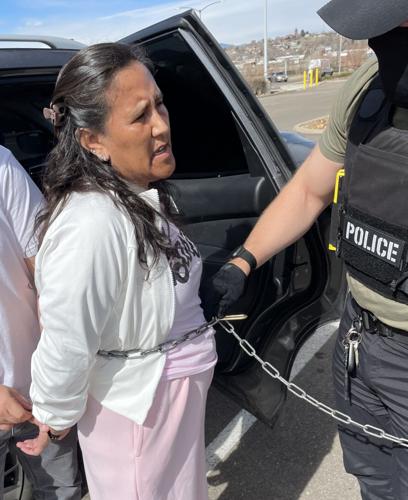
On Wednesday, ICE provided journalists with a photo of Vizguerra being handcuffed with a chain around her middle.
For Fabbricatore, her capture was a victory. On Monday, he posted on X: “Finally! The Biden Administration kept me from deporting Jeanette Vizguerra 4 years ago. She should have been deported in 2009 as well. She hid in a church the first time Trump was president. She is a criminal, hates Trump, and is an open-borders advocate. Bye!!!!”
Colorado Politics reporter Michael Karlik contributed to this report.


Competing overtime bills for agriculture workers split Colorado Democrats
Marianne Goodland
marianne-goodland@denvergazette.com
Updated 3 days ago
Competing bills setting the overtime threshold for farmworkers have split legislators at the Colorado state Capitol, with one group saying a law passed in 2021 has harmed, rather than helped, farming operations and workers alike, while the other side insists...

Marianne Goodland
Reporter
Denver City Council to vote on police identity bill and quarterly reporting
Deborah Grigsby
deborah.smith@denvergazette.com
Updated 18 hours ago
Two bills are up for final consideration by the Denver City Council on Monday. The first is Council Bill 26-0125, which proposes an ordinance to prohibit law enforcement officers, including federal immigration agents, from concealing their identities while interrogating, detaining,...

Deborah Grigsby
Reporter
Garfield County sheriff illegally collaborated with ICE, cease and desist letter claims
Michael Braithwaite
michael.braithwaite@gazette.com
Updated 3 days ago
A cease and desist letter filed Wednesday alleged that the Garfield County sheriff intentionally violated state law by collaborating with the U.S. Immigration and Customs Enforcement (ICE). The letter, filed by the law firm Towards Justice, claimed that Garfield County...

Michael Braithwaite
Reporter
Gov. Jared Polis moves to end ICE subpoena fight over Colorado workers’ personal data
Marianne Goodland
marianne-goodland@denvergazette.com
Updated 3 days ago
The effort by Gov. Jared Polis to comply with an administrative subpoena from U.S. Immigration and Customs Enforcement for information held by several state agencies is over. Polis, in a motion filed Feb. 20, asked for a permanent injunction and...
Marianne Goodland
Reporter

Denver mayor says city police will detain ICE officers using ‘excessive force’
Deborah Grigsby
deborah.smith@denvergazette.com
Updated 2 hours ago
Denver Mayor Mike Johnston on Thursday outlined his city’s response to immigration enforcement operations, including intervening to stop federal officers when local police observe them using “excessive” force. Johnston also said the city will not allow federal authorities to “stand...
Deborah Grigsby
Reporter

Denver ends contract with license plate camera vendor Flock
Deborah Grigsby
deborah.smith@denvergazette.com
Updated 4 days ago
After months of tension between Mayor Mike Johnston and the City Council, Denver is ending its relationship with license plate-reading camera vendor Flock Safety, awarding the contract to Axon. “We’ve heard the community loud and clear, and it is time...
Deborah Grigsby
Reporter

Colorado senators hold heated debate on latest immigration bill
Marianne Goodland
marianne-goodland@denvergazette.com
Updated 5 days ago
A bill that would allow individuals who get injured during an immigration action to sue federal agents in state court won preliminary approval from the Colorado Senate on Monday. The bill would permit a “cause of action” by such individuals...
Marianne Goodland
Reporter

The freest man in Colorado history | Vince Bzdek
Vince Bzdek
vince-bzdek@denvergazette.com
Updated 1 week ago
Every Coloradan should know the story of Buffalo Soldier John Taylor, who fought harder and longer than perhaps any man in our history to be truly free. Taylor’s story stands out above all others in a thought-provoking exhibit about Buffalo...

Vince Bzdek
Reporter

Colorado bill disqualifies former ICE agents from getting job in local law enforcement | Bills in Brief
Marissa Ventrelli
marissa-ventrelli@denvergazette.com
Updated 7 days ago
Colorado lawmakers introduce hundreds of bills each year. Bills in brief cuts through the noise by explaining which proposals matter, what’s at stake, and how decisions at the Capitol could affect everyday life across the state. Colorado legislators are pushing legislation to...

Marissa Ventrelli
Reporter

In legal filing, Denver insists ‘sanctuary policies’ make jurisdictions safer
Deborah Grigsby
deborah.smith@denvergazette.com
Updated 2 weeks ago
Denver has joined some 140 cities, counties and elected officials in filing two amicus briefs backing Minnesota and Rochester, New York — jurisdictions sued by the Trump administration’s over their “sanctuary” policies. In a statement, Denver Mayor Mike Johnston characterized...
Deborah Grigsby
Reporter