The case for and against eliminating the NEA
JOHN MOORE

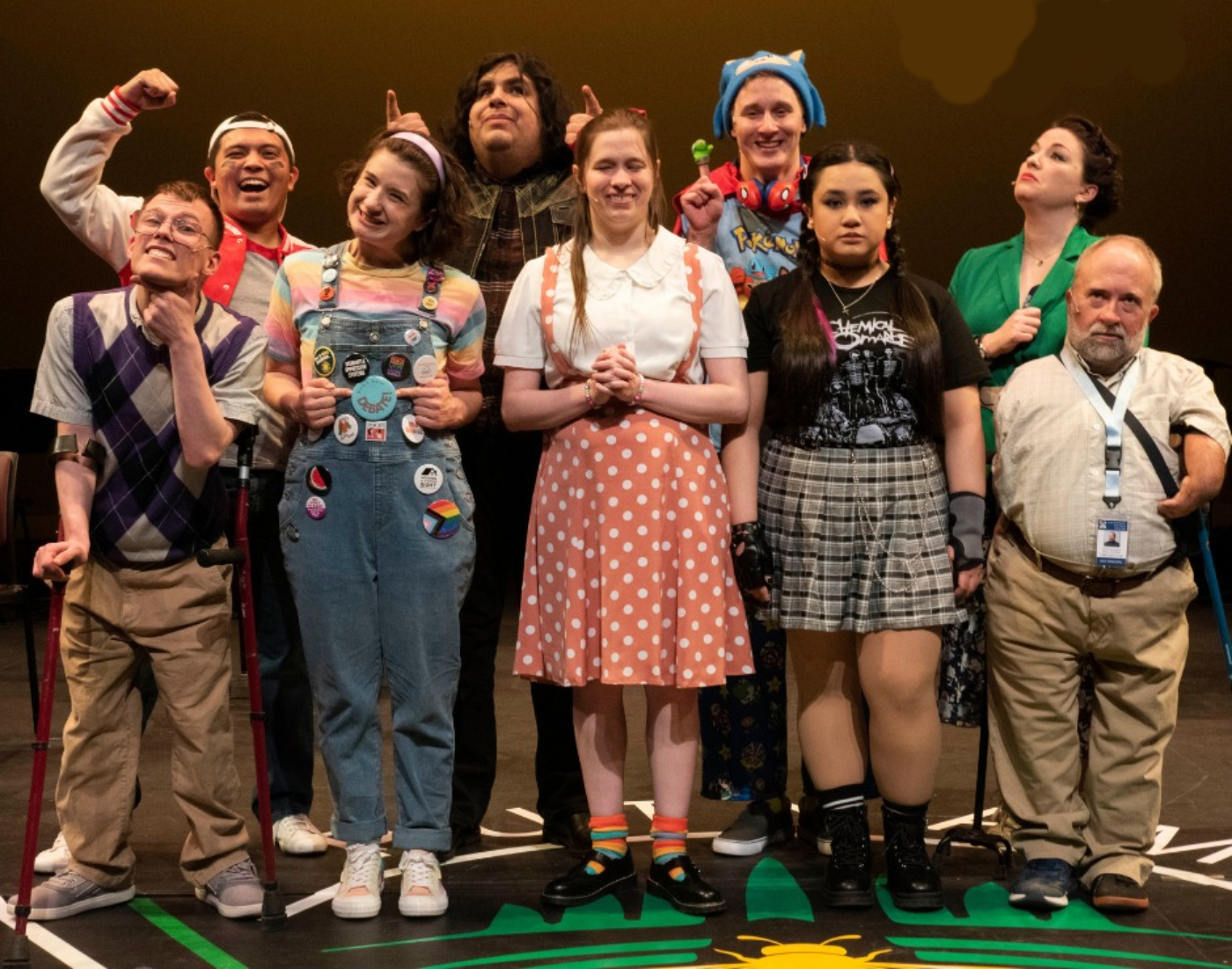
He wasn’t about to get political – not standing in front of a nearly sold-out house before the disability-affirmative Phamaly Theatre Company’s closing performance of “The 25th Annual Putnam County Spelling Bee” on Sunday afternoon in Northglenn.
But Artistic Director Ben Raanan made it abundantly clear to all those gathered that Phamaly has long-relied on federal funding for its continued existence. And with all the ongoing uncertainty over the ongoing gutting of the federal budget, the fate of the nation’s oldest theater company dedicated to the disabled is nothing if not uncertain.
On Wednesday, the Cato Institute, a libertarian think-tank that advocates for limited government, issued a position paper calling for the full abolishment of the National Endowment for the Arts. It pretty much follows the blueprint of a similar paper issued by the Heritage Foundation that called the NEA “welfare for artists” back in 1997.
“There is no robust argument on constitutional or economic grounds for the NEA to exist,” said Cato economist Ryan Bourne. “Great art can be created without the NEA, which distorts and politicizes artistic endeavors, crowds out private and charitable giving, forces taxpayers to fund projects they object to after diverting money to its bureaucracy, and redistributes resources toward the tastes of the relatively affluent.”
As the kids say: That’s a lot to unpack. Starting with: Wait. Federal funding “crowds out” private and charitable giving? That is some serious spin-doctoring.

First, some perspective. Even after the Biden administration managed a 29% increase to the NEA’s budget last year, bringing it to $207 million, that still accounts for only 0.004% of the $9 billion federal budget. Chump change. But how important is that $207 million to the 2,400 companies that rely on it – as well as all 50 states that distribute it?
“What I can say pretty confidently is if the NEA goes away, Phamaly would most likely close,” Raanan told the Denver Gazette on Thursday. “And that one-fifth of all nonprofit theaters in the United States will close within a year.”
The NEA was conceived under a Republican (Eisenhower) and realized by a Democrat (Johnson). Its funding has ebbed and flowed over the years, largely based on who has occupied the White House. But for decades, there seemed to be a majority bipartisan consensus that the arts are both a core, common American value – and an economic generator. Arts and culture added $1.2 trillion to the U.S. economy in 2023, according to new data from the NEA itself. That represents 4.2% of the nation’s GDP.
Imagine that: 0.004% of the budget produces 4.2% of our combined economic activity. Sounds like a pretty good investment, says me.

Fake news, says Bourne, who dismisses all claims that the arts are an important economic generator as having “no basis in evidence.” (Not even, you know, the widely accepted mathematical formula that produces all economic-impact statements.)
Here we are again. Back to a world of: “Whose facts do you choose to believe?”
Ironically, Bourne also argues that the NEA’s teeny-tiny footprint on the present federal budget “merely highlights how unnecessary this body is.” (Tell that to Phamaly and every other nonprofit arts organization that receives NEA support.)
Bourne’s real beef is that he doesn’t want to help pay for art that he doesn’t like. The problem there, of course, is that art does not exist to please everyone. It exists to make our communities richer. So the value of any kind of art will not be perceived as the same from one person to the next. It shouldn’t. So your personal taste cannot be the delineator. It’s the same as: You either believe in free speech for all, however objectionable – or you don’t.
Bourne is essentially saying if art can’t pay for itself, it has no right to exist. He believes federal seed money can and should be somehow replaced by private donors (as if private donors are not already a critical component of the ecology of making art, and paying for it.)
Bourne believes consumers should be able to pick and choose their art the way they pick a car off a dealer’s lot. If you can’t pay for the full cost of the car, you can’t have the car.
“Museums can charge admission fees, and theaters and dance companies sell tickets,” Bourne argues. “If you don’t pay for a Broadway show, you don’t see it.”
You could say the same thing about a soup kitchen, Raanan responded. “You could say that if a soup kitchen that feeds hungry people isn’t 100% self-sufficient, then we shouldn’t feed homeless people. Regardless of where you fall on the political spectrum, I don’t know anybody who would argue that we should not feed homeless people.”
Even public murals, Bourne went on, don’t require universal taxpayer funding to exist. And yet, nearly every community in the country puts money aside for public art because most people understand the concept of art as a common good. The city of Denver, for example, has invested more than $40 million in its public art collection since 1988. We’d be a far more boring city without it.
And I hate to break it to Bourne, but Broadway shows are commonly developed through, yes, public funding. You know what show would not exist without public funding? “Hamilton,” which was developed at the publicly funded and aptly titled Public Theatre in New York.

The Cato Institute report simultaneously damns art both for being a subsidy and for being elitist, but you can’t have it both ways. It’s true that by the time most any show makes it to Broadway, it is privately capitalized – often at a loss. Still, the average price of a Broadway show is currently $137, which is not exactly a solid argument that privately financed art is more likely to produce “art for all” than publicly subsidized art. Quite the opposite.
How would the Broadway model work on the local level?
“If we were completely self-sustaining, we would have to charge 200 bucks a ticket,” Raanan said. “People value the arts – but not at that price. They would stop coming.”
The biggest irony is that most art created from the beginning of time has been funded in some way through government assistance. And since the NEA’s creation in 1965, it has provided more than $6.4 billion to support more than 70,000 projects in all 50 states. Almost all of it to increase arts access to marginalized, underrepresented and economically challenged communities. If you advocate for the elimination of the NEA, Raanan contends, you might as well be advocating for the elimination of the arts altogether.

“And without art, the world would be very uninteresting,” Raanan said. “That’s one thing most people would agree on. If we were to take away all movies, all TV shows, all theater – what’s the point of life then?”
And yet, the writing appears to be on the wall for the NEA. Staffing at its sister wing, The National Endowment for the Humanities, was just slashed by 75%, one week after Donald Trump eliminated grants to 1,200 school programs. Bourne is all for it – and more.
“It is time for Congress to act,” he said. “The NEA is a good litmus test of whether DOGE and Congressional Republicans can reduce the scope of government. If this tiny agency can’t even be abolished, what hope is there for eliminating others?”
Let’s hope none.
In the meantime, people have to decide what matters to them – and stand up for it.