Alex Marrero said he needed October count for DPS schools closure list — documents suggest otherwise

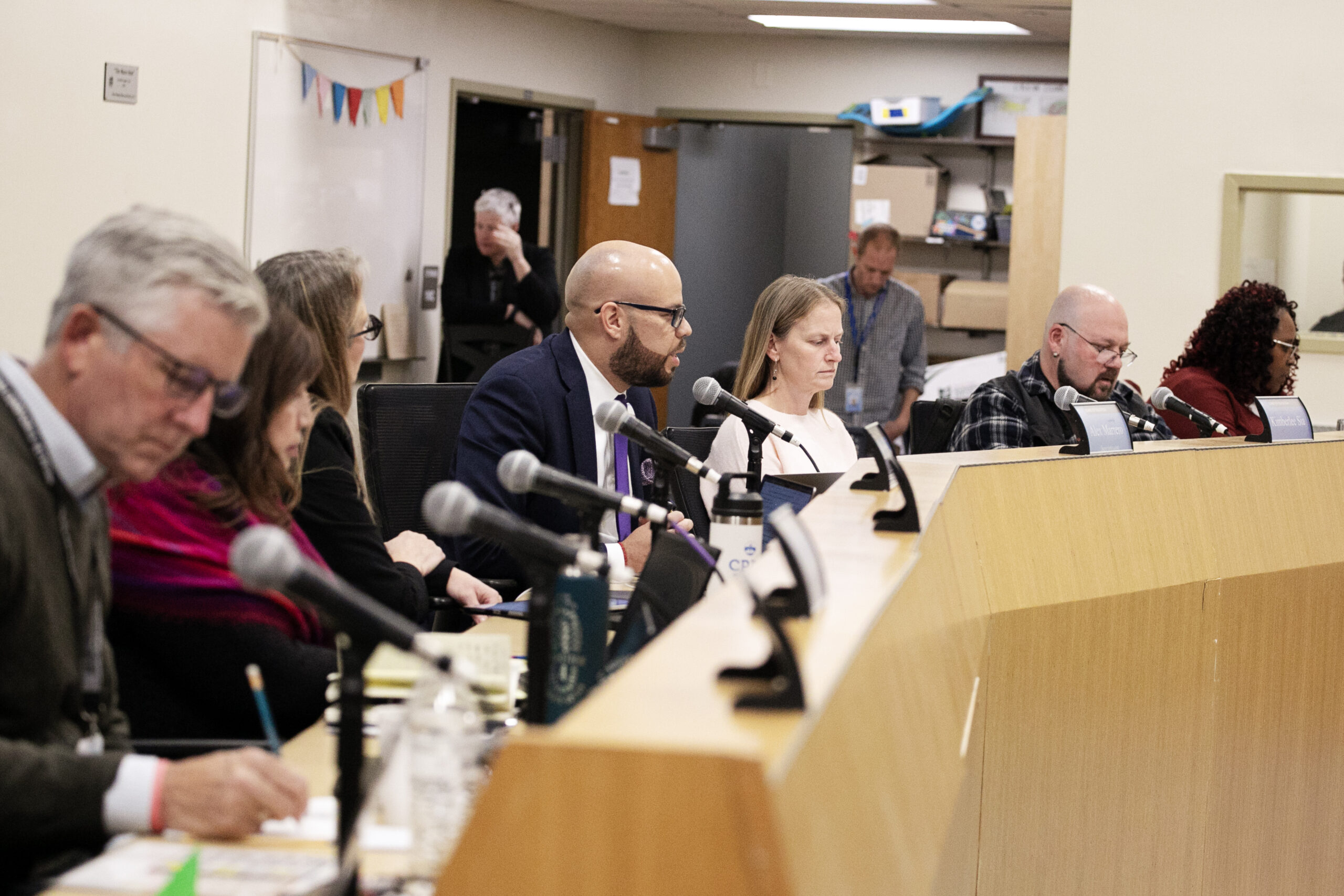
Last year, when the Denver Public Schools (DPS) Board of Education established guardrails for campus closures, Superintendent Alex Marrero requested a one-time extension before releasing his closure list, citing the need for the October Count enrollment data for his team to complete the analysis.
“I don’t believe that we’re going to have an accurate count no earlier than October,” Marrero told the board during the Aug. 15 meeting, in which he requested additional time.
District documents suggested otherwise — specifically, that the district obtained enrollment numbers in September. In public documents, the September data was cited as justification for the closure list.
Some have suggested the reason for the delayed release was to avoid antagonizing voters at a time when the district needed their support to pass a nearly $1 billion bond. District officials and the board defended Marrero, saying his actions were not nefarious.
In the documents reviewed by The Denver Gazette, Marrero’s team publicly cited an “actual count” taken two weeks before the October Count, despite Marrero’s earlier claim that the official data — from the October Count — was essential to determine which schools should be considered for closure.
The October Count is taken every year on Oct. 1 to determine school funding, which follows students in Colorado. That is, a consistent dip in the count over a few years would mean a drop in funding.
Just two months before that August meeting, the board adopted Executive Limitation 18 — also known as EL-18 — which restricted the superintendent from using low enrollment and test scores as the sole justification for closing a school. It also required the superintendent to provide a closure list to the board no later than October.
The board members’ insistence on an October deadline isn’t arbitrary. They have said the timing is designed to align with the district’s school choice process, which begins in January, giving families enough time to explore other options if their school is slated to close.
Still, the board approved Marrero’s request for a one-time extension to present the closure list in November.
For future closure lists, the superintendent must provide it October and only once every three years.
‘Materially the same’
A school closure presentation on Nov. 7 — two days after Denver voters overwhelming approved a nearly $1 billion bond for infrastructure and maintenance projects — showed the 2024–25 enrollment numbers were, in fact, captured on Sept. 17 before the October Count.
District officials maintained they did rely on October Count data internally, but because the state had not yet certified and released the figures, they couldn’t publicly identify it as such. Instead, they referenced September enrollment figures in public materials, while using internal data aligned with the October Count to inform the Nov. 7 closure recommendation, Scott Pribble, a district spokesperson said.
“Every year, the Colorado Department of Education embargoes formal October Count results until the following January when they release the statewide data,” district officials said in statement Friday. “Because of that, DPS was not able to share that information in the public meeting held on Nov. 7.”
While technically accurate, a sworn affidavit submitted months later still cited September enrollment figures — even after the state embargo on the October 1 data was lifted. DPS Chief Financial Officer Chuck Carpenter confirmed in an interview Friday that the district relied on that September data to inform the closure recommendation, consistent with what was shown to the board and public on Nov. 7.
“It may not be perfectly accurate, but it’s materially the same,” Carpenter said.
On Oct. 1, DPS had 90,450 students enrolled, state data shows.
The state’s enrollment number reflected 8,353 more students than DPS is publicly reporting.
Students excluded from count
According to court documents in the Mamas de DPS lawsuit challenging the school closures, district staff reported 82,097 students were enrolled in September 2024.
That publicly presented figure — used to support the district’s declining enrollment claim tied to falling birthrates — excluded 3,317 immigrant students and about 5,000 Early Childhood Education (ECE) students. Primarily, though not exclusively, geared toward low-income families, ECE includes preschool programs for 3- and 4-year-olds and are often the first point of entry into a district.
The lawsuit argues that omitting ECE students distorted the district’s enrollment picture — because many of these students eventually feed into DPS elementary schools.
“The District did not consider ECE because not every school has an ECE program, and the District decides where those programs are located based on a variety of factors; thus it wanted to fairly compare enrollment and building utilization without penalizing schools that lack ECE classrooms,” Heather Covey, the district’s director of Planning, Analysis and Real Estate, said in a sworn affidavit in March.
It is unclear why the roughly 3,300 students who showed up at DPS schools amid the city’s illegal immigration crisis, were excluded from the district’s count.
The omitted ECE data, highlighted in the lawsuit, is among several decisions raising questions about how the district has handled enrollment figures to justify closures.
Critics have questioned whether the monthlong delay was driven by data availability.
Or whether political timing may have also played a role.
Marrero’s closure recommendation came just two days after voters approved the district’s bond package, which officials sold to the public on the promise every school would benefit from its passage.
‘Somebody’s lying’
Some observers have suggested that postponing the release of the school closures list until after the Nov. 5 election helped avoid raising red flags for voters considering the $975 million bond measure.
“It’s not surprising that the district would want to wait until after a big bond measure to announce a series of closures,” said Parker Baxter, director of the Center for Education Policy Analysis at the University of Colorado Denver. “It’s what you can expect from a district worried about voter support for a big bond initiative.”
Baxter added: “I think, to the extent that there is evidence the superintendent’s justification for the delay was, in fact, not the justification for the delay, I think that speaks to issues related to public transparency and the trust of district leadership.”
Robin Pulliam, a former DPS deputy chief of staff who was laid off in 2022, questioned the over emphasis on the October Count, arguing that decisions about school closures should be driven by long-term enrollment trends across the city, not a single data point.
“This seems like a scapegoat — to blame it on the October Count,” Pulliam said.
The Denver Gazette reached out to the entire board for comment.
Only Board President Carrie Olson responded.
“Dr. Marrero did not mislead the Board of Education with regard to the data shared,” Olson said in an email. “Count data cannot be shared publicly and is embargoed until December each year. Thus, the district had to utilize data for a public presentation from a reasonable time period prior to the count period.”
Former DPS Board President Theresa Peña said she would have supported the extension if her superintendent had requested more time to analyze the data. And, she also would have backed delaying its release until after the bond measure to avoid politicizing the school closure decision.
But Peña also said she’s disturbed by the lack of transparency — especially given the public criticism Marrero has faced.
“What is troubling to me is this is a pattern of obfuscation by the superintendent and enabled by the board,” Peña said. “This feels very disingenuous to the community.”
Peña added: “Somebody’s lying.”