







Kilyn Lewis family files lawsuit against Aurora, officer who killed him
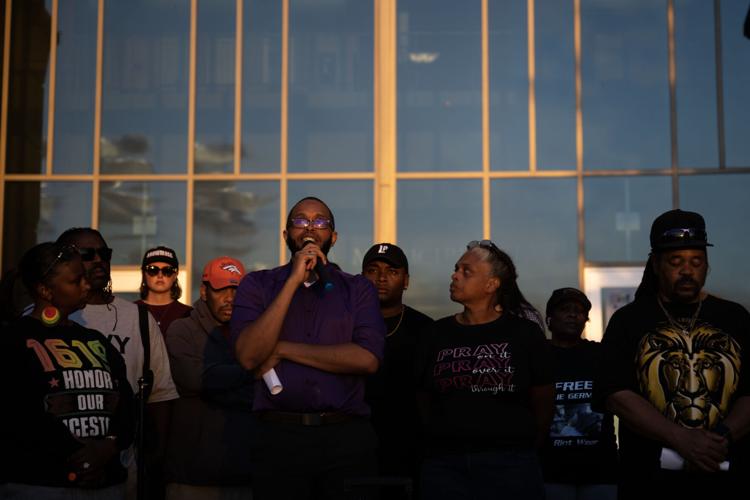
FILE PHOTO: Kiawa Lewis, Kilyn Lewis’ Brother, gives remarks to the press before attending an Aurora City Council meeting on Monday, Oct. 14, 2024 after the DA decided on Friday not to press charges against the officer who killed his brother last May. The Lewis family filed a lawsuit against the Aurora Police Department, the City of Aurora, and the officer who shot and killed him.(Stephen Swofford, Denver Gazette)
Stephen Swofford / Denver Gazette
Exactly one year after Kilyn Lewis was shot and killed by an Aurora police officer, the Lewis family filed a lawsuit against SWAT Officer Michael Dieck and the City of Aurora alleging wrongful death.
Lewis, 37, was unarmed while shot by Dieck on May 23, 2024, while officers were attempting to arrest Lewis on a warrant for attempting to commit first-degree murder in the shooting of a blind man.
The lawsuit, filed Friday in the Arapahoe County District Court, claims that Dieck’s lethal use of force against Lewis was not reasonable, was “willful and wanton,” and deprived him of his legal rights.
Additionally, the lawsuit accuses Dieck of “unconstitutionally interfering with (the family’s) right of association with Kilyn” and depriving the Lewis family of “reasonable care in the exercise of his duties as an APD officer.”
It also states that the City of Aurora had the “right and ability” to control Dieck’s actions within the scope of his employment.
The lawsuit requests compensation for past and future economic losses and other losses.
Aurora spokesperson Ryan Luby said Tuesday officials couldn’t comment on the allegations because they had not been served a copy of the lawsuit. The city has not had any recent communication with the family’s legal counsel, Luby said.
Every investigatory body, both internally and externally, determined Dieck acted lawfully in the case, Luby said, and his use of lethal force was deemed justified.
“Aurora City Attorney Pete Schulte agrees with those determinations and his office will strongly defend the actions of the officer and the Aurora Police Department,” he told The Denver Gazette Tuesday.
The Aurora Police Department’s investigation determined that Dieck — a 13-year veteran of the department and eight-year Aurora SWAT member — did not violate agency policy.
The review included the Aurora Police Department’s Force Investigations Unit, the Force Review Board — which includes the city’s chief of police — and the Independent Consent Decree Monitor, according to a news release.
The department decision came a little over a month after the investigation conducted by the 18th Judicial District’s Critical Incident Response Team (CIRT) also deemed Dieck justified in his use of force, with the district attorney deciding there was no basis to file criminal charges.
The case was also presented to the Arapahoe County Grand Jury, which found insufficient evidence to charge Dieck.
The incident
The shooting — which has been followed by protests from Lewis’s family and supporters at every City Council meeting since then — started as an attempted arrest by Denver and Aurora SWAT teams around noon May 23.
The teams attempted to arrest Lewis on a warrant for attempting to commit first-degree murder after the man was connected to an attempted homicide in Denver on May 5 in the area of 48th Avenue and Colorado Boulevard around 11:30 a.m.
Lewis was arrested in 2004 and again in 2005 on felony charges of aggravated robbery with a deadly weapon, according to court records.
He was sentenced to six years in the Department of Corrections and four years of intensive supervision. Lewis was arrested on burglary charges in 2015, pleaded guilty the next year and was sentenced to five years in prison.
Court records also showed he was arrested on child abuse charges in 2005 and received a four-year prison sentence and three years of intense supervision probation.
Officers from both police departments confronted him outside an apartment complex on South Ironton Street in Aurora. Lewis was working on a red vehicle that appeared in security camera footage connected to the May 5 shooting.
Four officers, including Dieck, exited vehicles with weapons drawn to arrest Lewis. They commanded the man to drop to the ground, but Lewis walked toward the driver’s side door and pulled a cellphone and tube with a fruit snack in it from his back right pocket.
The lawsuit alleges Lewis received “sometimes conflicting commands,” with one officer yelling “get on the ground” and another yelling “show us your hands.”
“Kilyn attempted to comply with the conflicting verbal commands being shouted at him,” according to the lawsuit. “Hearing those conflicting verbal commands, Kilyn turned towards Defendant Dieck and raised his hands while squatting to get on the ground as ordered. Immediately after Kilyn raised his hands and began to bend his knees, Defendant Dieck fired one shot directly at Kilyn, aimed at center mass.”
Dieck ultimately fired a shot into Lewis’ abdomen, leading to his eventual death at a nearby hospital.
“Before fatally shooting Kilyn, Defendant Dieck did not issue any verbal warning that he would shoot, nor did he allow sufficient time for Kilyn to comply with the overlapping and conflicting commands being shouted at him, as Kilyn was attempting to do,” according to the lawsuit. “A mere seven seconds elapsed between Defendant Dieck exiting his vehicle and Kilyn being shot.”
While cocaine was found in Lewis’ pants after the shooting, no gun was found at the scene, according to the district attorney’s letter.
In follow-up interviews conducted by CIRT, Dieck claimed that he believed Lewis pulled a firearm from his pocket and that caused him to fire at the suspect.
When Dieck saw Lewis rummaging in his pocket, he believed he was pulling a gun because, based on his experience, “relatively few people who illegally carry guns utilize a holster, but instead carry their guns in the waistband or a pocket,” the letter said. He also claimed it wasn’t common for someone to start reaching into their pants when approached by officers randomly, instead usually freezing from shock.
The other officers involved supported Dieck’s concerns about Lewis pulling a gun, calling Lewis’ behavior in the face of arrest “unusual.”
Prior to being cleared in the killing of Lewis, Dieck was involved in two other shootings and one arrest that led to the conviction of another Aurora police officer.
The lawsuit also alleges Lewis made no attempts to flee, and that Dieck was supposed to use a less-lethal weapon: a 40mm baton launcher.
“Defendant Dieck chose to use a lethal weapon, notwhitstanding that he was assigned to use a less-than-lethal weapon,” according to the lawsuit.
Aurora’s consent decree monitor — which was initially set up following the handling of the death of Elijah McClain in an effort to improve how officers use force and interact with people of color — questioned the use of force in its report on the incident in October.
“I think there are issues that have to be answered,” said Jeff Schlanger with IntegrAssure, Aurora’s independent consent decree monitor.
The report also raised the concern of how the department selects and retains its SWAT officers, especially with Dieck’s past of two previous shootings.
Since then, however, the monitor has released its latest report, which praises the department’s follow-up to the Lewis shooting and says the police chief has made important changes to the SWAT team.
Following the district attorney’s decision, the Lewis family said in a public statement that the decisions made by Aurora leaders are a “grave injustice.”
“Just like those before us who have been faced with these tragedies, our fight will continue without disruption,” the family’s statement said. “This decision is not only a failure of justice but a message that the life of an unarmed Black man like Kilyn means nothing to the very system that is supposed to protect us.”
Denver Gazette reporter Sage Kelley contributed to this report.