








Boulder Jewish community, allies hold vigil following Boulder attack that injured 15

Boulder Mayor Aaron Brockett and Consul General of Israel to the Pacific Southwest Israel Bachar speak at a memorial outside of the Boulder courthouse.
Greta Kerkhoff
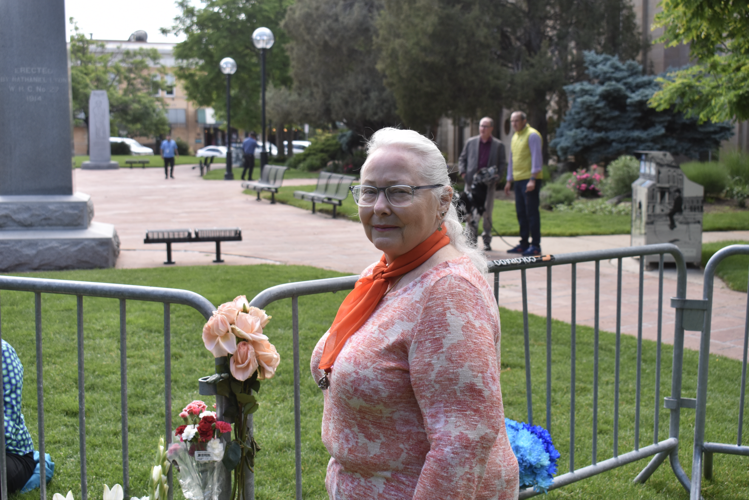

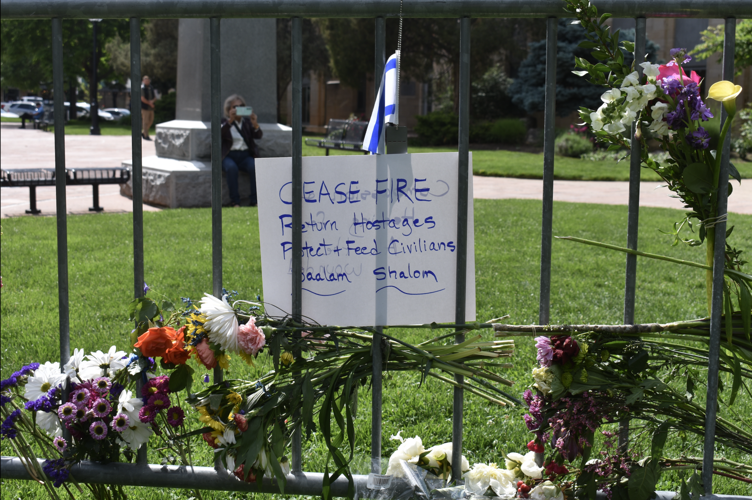
Longtime Boulder resident Vicki Muzika wore a very bright orange scarf and a coordinating orange outfit on Wednesday afternoon.
“It’s not a fashion statement. It’s a statement to never forget the hostages, and in particular, it’s an expression of love for the Bibas family,” she said. “Orange is their color.”
Muzika was referring to Shiri Bibas and her children Kfir, then 9 months, and Ariel, then 4, who were taken hostage by Hamas on Oct. 7. They died while in captivity. Hamas also abducted Yarden Bibas, the father. The militant organization released him alive in February.
The Boulder chapter of “Run for Their Lives” has been holding weekly walks to advocate for the release of Israeli hostages still in the hands of Hamas, which the U.S. government regards as a terrorist organization.
Last Sunday, members of the Run for Their Lives were injured during a march when a man hurled Molotov cocktails, injuring 15 people and a dog. The police said the suspect, Mohamed Soliman, a 45-year-old Egyptian national, had been planning the attack for a year.
Soliman had dressed as a gardener to “get as close as possible” to the participants. He wore an orange vest and carried flowers and a backpack weed sprayer from a Home Depot in Castle Rock, according to authorities. He filled the backpack sprayer with gas, which he sprayed on himself because “he had planned on dying,” his arrest affidavit said.
Before heading to a community vigil held on Wednesday night, Muzika paid her respects at a makeshift memorial set up outside the Boulder courthouse for Sunday’s victims.
When Muzika, who is Jewish, heard the news that day, she was “frozen,” she said.
She has been waiting to hear the names of victims to see if anyone she knew was hurt.
Wednesday’s vigil, held at the Boulder Jewish Community Center, drew members of the Jewish community and allies from far and wide.
One of the victims attended the service. He was identified only by his first name, Mark.
Rachel Amaru, founder of the Boulder chapter of Run for Their Lives, introduced Mark.
Mark said he was heading into a local restaurant to use the restroom when he heard the explosion go off. When he saw what was happening, he turned back toward the march to try and keep people away from Soliman, as he still had Molotov cocktails in his hands.
He and his group are undeterred, he said.
“But what now?” he said. “We’re walking again. I’m looking to walk on Sunday.”
Like many, Muzika went into the vigil worried about the rise in antisemitism across America.
“For the Jewish community, it’s been unifying, but there is deep concern, not only for our community, but for the country at large, because this is one act in a series of recent violence,” she said.
At the vigil, religious leaders spoke and attendees prayed and sang songs.
Jonathan Lev, executive director of Boulder Jewish Community Center, said their presence brought more than just comfort.
“It helps bring a process of healing,” he said. “It reminds us that we are not alone, that even in our deepest pain, we have one another.”
Maya Bajayo, the Denver organizer for Run for Their Lives who also attended Sunday’s march, expressed her desire for more protection.
“I think one thing we really need is for law enforcement to recognize that, even though we look like a powerful, strong, successful community, we are very vulnerable,” she said.
Gov. Jared Polis, who is Jewish, was among several Colorado leaders who attended the vigil.
“Antisemitism has no home in Colorado,” he said.
Polis noted the pattern of targeting Jewish people, including the killing of two Israeli Embassy staffers in D.C. two weeks ago.
“For 19 months, we’ve witnessed an alarming rise in antisemitism in this country, around Colorado, around the world, and, of course, that we need to do more,” he said.
Israel Bachar, the consul general of Israel to the Pacific Southwest, flew to Colorado to attend to vigil.
“You describe yourself as a small community,” he said. “However, I see a giant community.”
In an interview with The Denver Gazette, he described the event as “emotional.”
Bachar also said there is no distinction between anti-Zionism and antisemitism.
“It’s encouraging that people understand what we are facing,” he said. “People need to be more willing to stand up, not to be quiet.”
Rabbi Diane Tiferet Lakein, of the Congregation Nevei Kodesh, spoke about the need for an open and understanding community.
“My prayer is that we have a truly diverse Jewish community, a community where we come together and each of us feels like we belong, each of us feels safe enough to engage with each other with curiosity,” she said.
Susan Rona, the regional director for the Anti-Defamation League Mountain States Region, urged the attendees to “reach out, call out, stand up and reclaim Jewish joy.”
“Joy is not a denial of pain. It’s our oldest remedy for despair,” she said.


Has DU Pioneers basketball found coaching answer after big road wins? | The Starting Lineup
Paul Klee
paul-klee@denvergazette.com
Updated 10 hours ago
Turn on the game! Three must-see events this week: 1. Nuggets at Dallas Mavericks (6 p.m. Tuesday, NBC) — The Denver Gazette’s Vinny Benedetto will be in Dallas to cover the Nuggets’ attempt to avenge a Mavericks win on Dec....

Paul Klee
Reporter
Fort Lewis College student proud of new Turning Point USA chapter despite backlash
Elizabeth Pond, Special to The Denver Gazette
elizabeth.pond@gazette.com
Updated 18 hours ago
Before Fort Lewis College senior Jonah Flynn became president of the newly formed FLC Turning Point USA chapter, he described himself as a liberal-leaning atheist. Flynn, a senior studying philosophy and Spanish, gained local and national attention after the Associated...

COLUMN: Learn from the mistakes of legalized marijuana
The Gazette
the-gazette@denvergazette.com
Updated 17 hours ago
By Greg Schaller Thirteen years after Colorado became one of the first two states to legalize recreational marijuana, the verdict is in: it has been a public policy failure of historic proportions. What began as a slick, well-funded campaign promising...

The Gazette
Reporter

EDITORIAL: Underlying Colorado’s rocky economic terrain — overregulation
The Gazette Editorial Board
thegazette-editorial-board@gazette.com
Updated 19 hours ago
Colorado’s robust economy has long established the state as one of the nation’s fastest growing. Originally built on tourism and outdoor recreation, the Centennial State has become a haven for high-tech industries like telecom, IT and aerospace — driving an...

The Gazette Editorial Board
Reporter
Bondi Beach and the resurgence of global antisemitism
Daniel Ross Goodman
daniel-ross-goodman@denvergazette.com
Updated 2 days ago
By Daniel Ross Goodman In an attempt to lift our spirits during what had already become a dark start to Hanukkah, a friend forwarded me a YouTube sketch titled “Jewish Jeopardy!” It begins with the host cheerfully announcing, “Welcome back to Jewish Jeopardy!...

Daniel Ross Goodman
Reporter
Didn’t like the blackouts? Better get used to them | Jon Caldara
Jon Caldara
jon-caldara@denvergazette.com
Updated 17 hours ago
I usually write this column at home. That was impossible this time, since I was one of the lucky 110,000 households without power for a full day during the recent windstorms. For those of you who shared this magical experience,...

Jon Caldara
Reporter
COLUMN: The high cost of ‘clean heat’
Jake Fogleman
jake-fogleman@gazette.com
Updated 11 hours ago
By Jake Fogleman For most Coloradans, the Colorado Public Utilities Commission (PUC) is perhaps the most important state agency they’ve likely never heard of. In the energy space, where it oversees utilities with government-granted monopolies, the three-member commission is above...

Jake Fogleman
Reporter

A Desert Icon Blooms
Sponsored Feature
sponsored-feature@denvergazette.com
Updated 4 days ago
A $200 million transformation elevates The Oasis at Death Valley into an extraordinary retreat. Just beyond the Nevada-California border at Death Valley Junction, Highway 190 stretches west in a nearly straight line. Flanked by rocky slopes and desert scrub, the...

Sponsored Feature
Reporter

Kiszla: Nuggets, Rockets deliver holiday basketbrawl behind Durant-Brown feud
Mark Kiszla
mark-kiszla@denvergazette.com
Updated 11 hours ago
All I want for Christmas is to get Bruce Brown and Kevin Durant together under the mistletoe and see who gets popped in the kisser first. “As a man, there are certain things you don’t say to another man,” Brown...

Mark Kiszla
Reporter

Nikola Jokic appreciates David Adelman’s support after Nuggets’ coach’s ejection
Vinny Benedetto
vinny-benedetto@denvergazette.com
Updated 10 hours ago
Nikola Jokic liked what he saw from his new coach Saturday. With 8:40 left in the fourth quarter, David Adelman had seen enough after Jokic spent an extended stretch of the third quarter on the bench with four fouls. Rockets...

Vinny Benedetto
Reporter