








Lakewood residents vexed over county’s rising homelessness

Timothy Harris began living in Lakewood, Colo. after safety concerns in Denver drove him to branch out into surrounding areas.
Tom Hellauer tom.hellauer@denvergazette.com



Timothy Harris stood a block away from West Colfax Avenue in Lakewood, his items methodically packed in a cart, a tent propped up beside him.
Harris, who is homeless but originally from Mesa County, has lived in Lakewood after being in Denver for years. To him, Lakewood offers more safety and accessible open space.
“Downtown Denver is kind of scary. It’s a little intimidating,” Harris said. “There are shootings and crime. But, back home, people freeze or get attacked by animals. There’s a difference in death, but it weighs out the same.”
Chanel Lewis, a homeless woman who has been in the Denver metro area since 2002 and now lives in Lakewood, also raised the issue of safety while interviewed at another spot, saying Denver has “a lot of chaos, violence, gangs, stuff like that.”
To her, it’s a “little bit” safer in Lakewood.
Cities surrounding Denver have seen an influx of homeless over the last few years despite fewer services available for them in the suburbs. Some officials faulted the homeless migration to issues within Denver, while others said it’s a growing problem across the board. In any case, Lakewood residents said they are increasingly becoming anxious with the seemingly high numbers of homeless in their city.
“We don’t know who’s down there. If we have a sexual predator move into our neighborhood, we’re supposed to be notified of it. Because they have no address, we don’t know who they are. We don’t know what they’ve done,” said Bob Meulengracht, a lifelong Lakewood resident. “It’s this anxiety that is caused when you see somebody pushing a shopping cart through your neighborhood.”
Numbers up in Lakewood
Lakewood’s point-in-time count in 2024 — part of an annual nationwide survey to provide a single night’s snapshot of homelessness in America — found 329 homeless people in the city on Jan. 22.
Out of that total, 94 were living in their vehicles, 142 were residing in tents, and 93 were living on the streets or staying in an extreme weather shelter for the evening.
The next closest city, Arvada, had 292 homeless people. In all, 925 were homeless in Jefferson County, while Denver had 6,539.
During the 2023 point-in-time count, the Metro Denver Homeless Initiative found 854 homeless in Jefferson County and 5,818 in Denver. The count did not break down how many were in Lakewood proper.
The 2022 count found 493 in Jefferson County and 4,794 in Denver.
“The number of people experiencing homelessness has steadily grown in the metro area, and we continue to work to find new ways to help the ever-growing population,” Stacie Oulton, a spokesperson for the City of Lakewood, told The Denver Gazette.
Pam Brier, CEO of the Action Center, maintained that it was a statewide problem.
“Certainly, in the Denver metro, the statistics are homelessness has increased by 10% just in the last year. That’s not a Lakewood problem. That’s a regional problem. It’s actually a national problem,” Brier said.
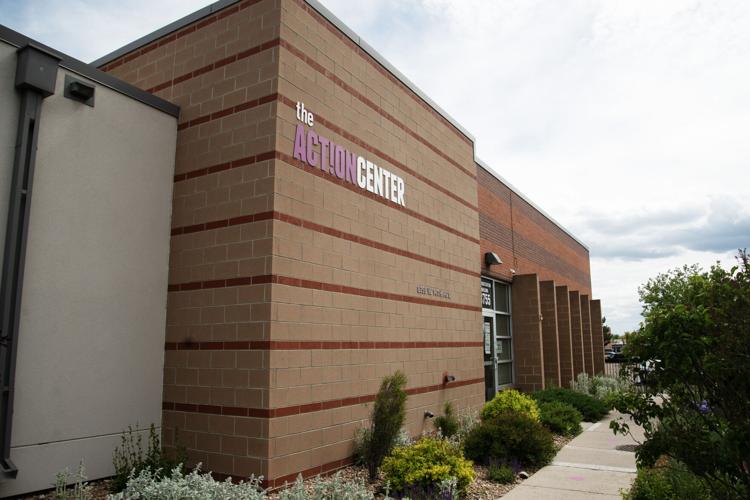
The Action Center is a nonprofit organization that has been in Lakewood since 1968, nestled near West Colfax Avenue.
The organization aims to prevent homelessness and help the homeless by providing services such as free clothing and groceries. It also offers mailboxes and a location to receive mail, along with financial programs like rent and utility assistance.
Sophia Mayott-Guerrero, the Lakewood City councilmember who serves the ward where the Action Center is located, agreed with Brier on the upward trend. The numbers are up in Lakewood, but they’re also up across the map, the councilmember said.
“It’s not just a Lakewood problem,” she said. “The amount of homelessness and unhoused people in Colorado, and metro Denver in particular, is increasing. Lakewood does not specifically have a problem,” Mayott-Guerrero said.
Regardless of what’s driving the increase, Lakewood residents said they are feeling the effects.
Worried about safety — and fire
Noah Shoemaker stood in the parking lot of the U-Haul facility on Wadsworth Boulevard, about 1.5 miles from the Action Center and West Colfax Avenue.
Shoemaker, a metro Denver resident and U-Haul employee, gazed at a 499-gallon propane tank towering over the corner of the parking lot.
“Underneath that bridge, they like to start fires,” Shoemaker said about the homeless, pointing to the Wadsworth overpass and the walkway next to Lakewood Gulch beneath it.
He added: “They’ll light fires, and it’s barely 100 feet away from the propane tank. Getting that caught on fire will level out Wadsworth and potentially kill a lot of people.”
Shoemaker said that in his past two months of working at U-Haul, he’s seen homeless people siphon gas from the U-Haul trucks, steal boxes, light fires, trash the box trucks, and gather under the overpass.
“There was one time where they pulled a black SUV down there,” Shoemaker said of the bridge.
Shoemaker peeked down to see what was happening.
“They were unloading tents, all kinds of stuff,” he said.
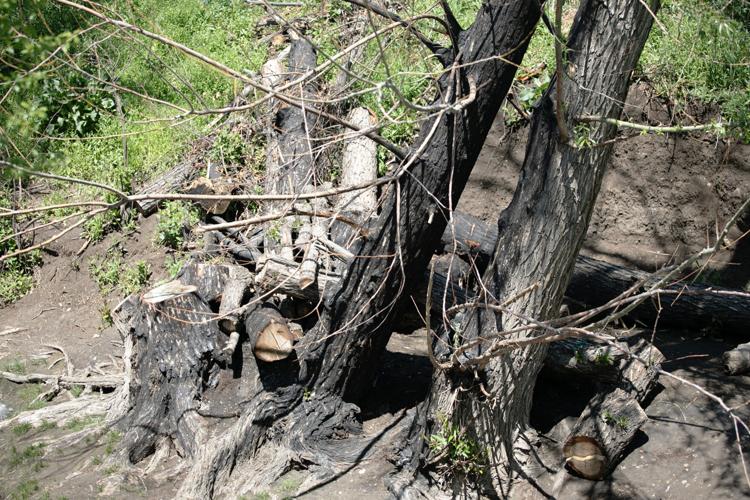
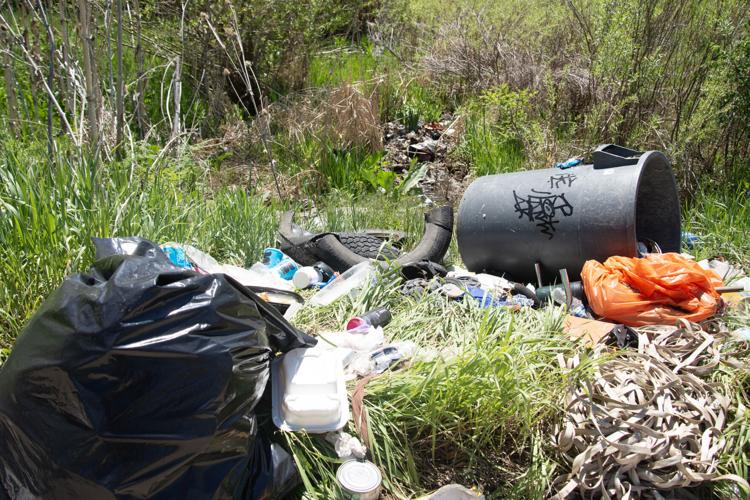
Just across Wadsworth, Meulengracht stood off the West 6th Avenue frontage road, looking at a collection of black trees marred by fire down next to the gulch. Garbage, blankets, and a makeshift tent surrounded the burn area.
“These people are down there,” he said. “If (the fire) gets up in the trees and they start burning up this gulch, we’re going to lose houses. We’re going to lose pets. We might lose lives.”
Meulengracht said the homeless population has been increasing over the past few years, but it has gotten significantly worse since September 2024.
He added that people often camp near West 6th Avenue, in a grass section stretching between the City of Lakewood and the Colorado Department of Transportation’s jurisdiction.
Despite calling the police and requesting a cleanup, he said little has been done. He added that authorities swept the area a few weeks prior, but people have already returned.
“It’s unsustainable to not address the root causes of this,” he said. “From a taxpayer’s standpoint, this makes absolutely no sense,” adding that the time and money spent on cleaning the area up is wasted unless the issue is resolved.
Oulton, the Lakewood spokesperson, said the city responds to fire dangers.
“When the fires are reported, either CAT (Community Action Team) agents or Lakewood police agents will respond, and this can result in either a warning or a citation for a violation under the Municipal Code, which prohibits open fires,” Oulton said. “If the fires are reported near dangerous or flammable areas, West Metro Fire Rescue will respond to assess safety concerns and extinguish the fires if they are found to be dangerous.”
Oulton said the city works with state agencies, such as the Colorado Department of Transportation, to clean up the encampments and provide police presence. She added that the police and agency need to work together in order for the cleanup to happen effectively.
“Otherwise, without this coordinated approach, the homeless living without shelter simply come back to the site if a cleanup hasn’t occurred because all their personal items remain in place,” she said.
Shoemaker said U-Haul had contacted the police multiple times.
“They come by, kick them out. But they come right back, or they’ll go fort up right across the street,” he said. “This is generally a hotspot for them because they have access to the wall and the bridge. If you go up to Colfax, it’s just flooded.”
Why West Colfax?
Just a few feet away from Lakewood Gulch sits the intersection of West Colfax Avenue and Wadsworth Boulevard — a spot both residents and officials point to as a hotbed for tents and homeless activity.
The Regional Transportation District’s (RTD) Wadsworth light rail station is a few feet from the intersection. RTD buses also run down both intersecting roads at regular intervals.
“This tends to be the area in Lakewood where people who are experiencing hardship or are unhoused are centralized,” Brier of the Action Center said. “I think it’s partly because it’s Colfax, and there’s transportation up and down Colfax. Other organizations are serving folks. People will go where they can get help but, also, it’s just a place where people are congregated in large numbers.”
Around a mile away, down Colfax, is the Action Center and RecoveryWorks’ navigation center. A block over, off West 14th Avenue, was the Mean Street Ministry.
Mean Street Ministry offered daytime shelters, recovery meetings, and meals to people in need but closed its doors earlier this year. It is expected to reopen in August at a new location on Colfax.
The navigation center opened in November 2023 to provide essential needs like food, showers, laundry, and mail service. It also acts as an emergency shelter, but the entire building has been closed for renovations since April.
Whether or not RecoveryWorks will be the operator of the building is up in the air, but it will continue to provide for those in need after reopening.
“The hope for that new build is to have over 100 transitional beds, not emergency shelter beds,” said Mayott-Guerrero, the councilmember.
“The new model will provide individualized, housing-focused support for each enrolled participant, with the mission to provide a lasting impact by moving residents off the streets into stable, long-term housing,” Oulton said of the building.
It would be the only shelter in Jefferson County open other than for emergencies, according to Brier.
Mayott-Guerrero insisted the increase in homelessness in the area is not necessarily because of services. Instead, the councilmember said, it’s because of the lack of them.
“I think there’s a misconception that when you provide services, more homeless people show up. That’s not true,” she said. “There is an increase in unhoused folks across the county.”
She added that there has been an uptick in complaints about homelessness in the area since the navigation center and Mean Street Ministry shut down. That, she argued, shows that those facilities are important, as they give people a place to go instead of being out in the open.
“Homelessness doesn’t know geographic barriers,” Brier said. “Folks don’t have houses, so they’re moving. They end up where there are parks, green spaces, and water. That just happens to be here.”
Lewis pointed out that there are also many cheap motels on West Colfax Avenue, adding that she had just left a motel before going to the Action Center for food.
“There are a lot of people just spread out wherever they can find,” she said.
According to Amy Beck, founder of the advocacy group Together Denver, the increase of homeless people in cities surrounding Denver is due to Denver itself.
“Denver has a strategy of executing sweeps so that they sweep away from downtown. It’s something I’ve watched happen over the past five years,” she said. “In the spring, they start sweeping downtown and start sweeping outward. They are sweeping our homeless community into our neighboring cities.”
Some have argued that cities like Denver, which is spending tens of millions of dollars in programs and services for homeless people, have only served to attract more while failing to address mental health issues and drug addiction, which they described as the real culprits behind homelessness. Others have insisted that Denver’s “housing first“ approach — which means not putting preconditions to get shelter or receive housing assistance — has helped many homeless people, and that the root cause of homelessness is the lack of affordable housing.
Coming from Denver
Since taking office in July 2023, Denver Mayor Mike Johnston’s administration has spent $155 million on homelessness in the city — $65 million more than the mayor initially estimated.
Under Johnston, Denver has swept various homeless encampments over the last two years. Once the encampments were swept, the city offered shelter options.
Among the options are the three non-congregate micro-communities built in 2023 — one in northeast Denver on 38th Avenue, one in south Denver off Santa Fe Drive, and another off Elati Street downtown.
The micro-community off Santa Fe Drive saw nearly 2,000 emergency 911 calls over eight months in 2024.
The former DoubleTree hotel at 4040 Quebec St., one of the five hotels turned into homeless shelters toward the end of 2023, had more than 1,200 calls to 911 within three months in the area at the end of 2023.
Citing their personal experiences, Lewis and Harris said Denver just doesn’t feel safe for homeless people.
Harris said Lakewood police told him to go to Denver because there aren’t any shelters in Lakewood.
“I don’t like Denver. I don’t want to go to Denver. So, I’m not going to go,“ he said.
Other than safety concerns, Harris and Beck said that the police and outreach teams, like Denver’s Street Engagement Team (SET), can make living in Denver uncomfortable, leading to migration outward.
SET comprises civilians who enforce city ordinances and inform homeless people of available resources.
While Beck agreed that crime may be up in the area, she argued there’s safety in numbers such as being able to report medical issues or overdoses.
“Keeping people in small groups is a huge safety factor,“ she said, adding that breaking up the camps has made things more dangerous for the homeless. She said that a man froze to death in a wheelchair in Denver because he couldn’t get into a shelter and that being at a camp would have been safer.
“You can’t help people get off the street without some other place to live. They’ll just go outside of Denver,“ Beck said.
The Lakewood Police Department uses a similar approach. It has a Community Action Team (CAT) specializing in working with the homeless and providing information. Its work includes moving people into emergency shelters and providing a navigation center for potential placement in housing.
“Since their inception, our CAT homeless navigators have permanently housed 176 individuals,“ Oulton said.
Finding a way forward
Harris, the homeless man, said his most significant need is a place to store his stuff while he works. He’s attempting to find a job, but he fears his belongings will be stolen during those eight hours.
“You got to get a place to stash your stuff, hide it, then you have to go to work,“ he said. “Then you’re nervous at work all day. You’re worried about your stuff. Did someone find it? Then you’ve got to re-set up that night.”
According to Mayott-Guerrero, the renovations to the Navigation Center may just provide those services to people and she is excited about that.
Homelessness cannot be addressed by the City of Lakewood or the nonprofits within it, according to Brier, who has been CEO of the Action Center for seven years.
“This is something that’s going to take the effort of everyone in the community,“ she said. “It’s not just government, it’s not just nonprofits, it’s going to take individuals. It’s going to take businesses to really come together to create the kinds of solutions that are going to be needed to address the problem effectively.”
Oulton added, “Homelessness is a communitywide crisis requiring a communitywide solution, and solving it is a shared responsibility.”
To Meulengracht, the Lakewood resident, the problem is much deeper.
“It’s not the homeless that we’re angry about,“ Meulengracht said. “They’re in a situation where they’re not getting the proper care they could possibly get. We’re addressing putting a roof over their head and not the root causes of drugs and alcohol, not the root causes of mental health, not the root causes of whatever their life story is that led them to this.”


Clinching AFC’s top seed gives Broncos a playoff bye and an extra week of rest
Chris Tomasson
chris.tomasson@gazette.com
Updated 39 minutes ago
Which is better for the Broncos, being assured of having advanced past the wild-card round of the playoffs or having an additional week of rest? How about both? The Broncos defeated the Los Angeles Chargers 19-3 on Sunday at Empower...

Chris Tomasson
Reporter

Broncos’ opponents set for 2026 with additions of Jaguars, Panthers, Steelers
Chris Tomasson
chris.tomasson@gazette.com
Updated 1 hour ago
The Broncos on Sunday learned all their opponents for the 2026 season. The Broncos, who wrapped up the AFC West on Dec. 27, entered the day knowing they would play at home next season against the AFC South champion and...
Chris Tomasson
Reporter
Mark Kiszla: Why the Broncos have the advantage on the sideline with Payton, but not under center with Nix
Mark Kiszla
mark-kiszla@denvergazette.com
Updated 1 hour ago
While the Broncos rope-a-doped their way to a 14-3 record, only a fool believes they can win the Super Bowl this way. On a Sunday when Denver earned the No. 1 seed in the AFC playoffs by beating a poor...

Mark Kiszla
Reporter

Despite not scoring an offensive TD, Broncos top Chargers 19-3 to clinch AFC No. 1 seed
Chris Tomasson
chris.tomasson@gazette.com
Updated 2 hours ago
The Broncos rolled out their usual celebratory props in the locker room after Sunday’s win. There was loud music, a disco ball and a smoke machine. But the celebration was a bit more muted than one might think. Yes, Denver...
Chris Tomasson
Reporter

Paul Klee: Bo Nix’s Broncos earn No. 1 seed the only way they know — the hard way
Paul Klee
paul-klee@denvergazette.com
Updated 2 hours ago
Now comes the hard part. “I think it’s the best possible position to be in,” quarterback Bo Nix said late Sunday after the Broncos secured the No. 1 seed in the AFC, the ninth in team history, by beating the...

Paul Klee
Reporter

Chargers at Broncos grades: Denver claims No. 1 seed with ugly win
Chris Schmaedeke
chris.schmaedeke@denvergazette.com
Updated 3 hours ago
The Broncos (14-3) will be the No. 1 seed in the AFC playoffs after beating the Chargers (11-6) on Sunday at Empower Field at Mile High. Here are the grades from the 19-3 win: Offense An ugly and vanilla performance...

Chris Schmaedeke
Reporter

Broncos’ special teams ace Devon Key steps up on defense against Chargers
Kyle Fredrickson
kyle-fredrickson@denvergazette.com
Updated 3 hours ago
Devon Key did not flinch when hard work met opportunity. “I always go into every game with that hunger,” Key said. “Just knowing that if I get my chance, I’m going to make the team proud.” The Broncos’ special teams ace stepped up defensively in a 19-3 win on...

Kyle Fredrickson
Reporter

Banged up Broncos offensive line might need No. 1 seed and bye week more than anyone
Tyler King
tyler-king@denvergazette.com
Updated 2 hours ago
The week off is good for Garett Bolles’ ankle. It’s good for Ben Powers’ biceps. It’s good for Mike McGlinchey’s shoulder. It’s good for Alex Forsyth’s ankle. The Broncos’ offensive line has been banged up all season. Through multiple different...

Tyler King
Reporter

Avalanche fall to Panthers, lose Gabriel Landeskog to injury | 5 takeaways
Evan Rawal
evan-rawal@denvergazette.com
Updated 2 hours ago
Every game matters, but some lose their luster due to extenuating circumstances. This was one of them. The Colorado Avalanche fell 2-1 to the Florida Panthers on Sunday, but the greater concern is the health of their captain, Gabriel Landeskog....

Evan Rawal
Reporter

Broncos star Nik Bonitto sets new career high in sacks in win over Chargers | Cheers and Boos
Tyler King
tyler-king@denvergazette.com
Updated 2 hours ago
Cheers… to Nik Bonitto for living up to his $100 million contract he signed back in September. Denver’s latest star edge rusher finished with 1.5 sacks in the 19-3 win over the Chargers, taking him up to 14 on the...
Tyler King
Reporter