







Colorado’s new economic and cultural hot spot? Believe it or not, it’s Greeley

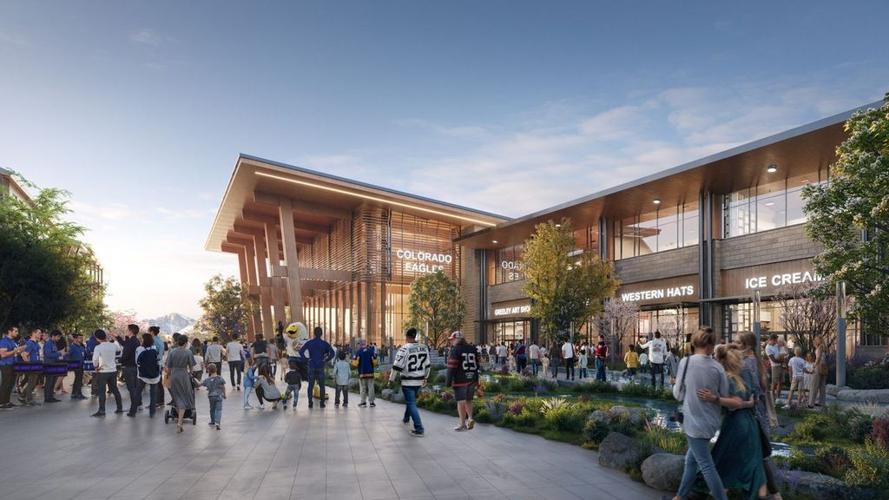
The West Greeley Development Project will feature an 8,600-seat multi-use arena and ice center which will be new home to the Colorado Eagles – a popular minor-league affiliate of the Colorado Avalanche.
Rendering courtesy of SideCar PR.

GREELEY — John Hall couldn’t be certain, but he had a hunch, an intuition, so to speak, as to how things might play out in front of the Greeley City Council on April 15.
Sitting behind his desk on a late spring Friday morning, the then City of Greeley’s Director of Economic Development and Urban Revitalization exuded an air of confidence.
Perhaps it came with knowing the proposal to be determined — the West Greeley Development Project — could significantly alter the landscape and perception of Greeley for years to come.
“I can’t really give you a read on council and how the vote will turn out,” Hall said two weeks before the vote. “What I would say is that this (project) is one of the ways we can be proactive about driving future growth instead of letting growth happen to us.”
Turns out, Hall and the rest of those in support of the project had little to worry about. The Greeley City Council voted 5-2 to support the $1.1 billion West Greeley Development Project that is also being referred to as “Catalyst” by city officials for good reason.
The project, which will feature an 8,600-seat multi-use arena and ice center, will serve as a state-of-the-art entertainment district on the west side of the city.
It will be the new home to the Colorado Eagles — a popular minor-league affiliate of the Colorado Avalanche — which has operated out of Loveland since the team’s inception in 2003. The Eagles are scheduled to begin playing games at their new Greeley home in 2028.
Plenty of other bells and whistles dot the new entertainment district, but the primary ones include:
• A year-round, family-friendly indoor waterpark and resort destination;
• A full-service conference hotel that can host banquets and regional gatherings, and
• Restaurants, entertainment venues and retail shops.
Greeley Mayor John Gates said the “vote represents a once-in-a-generation opportunity to shape Greeley’s future. We’re investing in our quality of life, our economy, and the kind of community we want to be. This vote sends a clear message that Greeley is ready to lead, grow, and invest in a future that reflects the energy and ambition of our community.”
The entertainment district will be built on 300 acres, northwest of Promontory Park and will be bounded by U.S. Highway 34 on the south. City officials expect much of the district to be completed and operational by 2028.
The entertainment district is part of a larger project called Cascadia, which will encompass over 1,000 acres and will feature a combined 6,000 residential, commercial, office and retail units. Windsor-based Water Valley Company will work closely with Greeley on the project’s construction, development and completion.
The city will finance the public-private project through bonding, general improvement district financing and operating revenues generated after it opens.
Yes, the project is big, and it is ambitious, but it is also representative of where Greeley now finds itself and where the Weld County seat is heading.
“This project is going to have regional impacts to the whole northern Colorado area,” said Greeley City Manager Raymond Lee. “We feel with this type of project, when you talk about the northern Colorado region eventually being a million people, we’re going to need attractions. We’re going to need amenities like what this project will bring that our residents, our citizens, our businesses and our visitors can truly enjoy within our community.”
Why Greeley now
There is a certain symbolism that comes with the West Greeley Development Project.
Fair or not, Greeley has, to a degree, lurked in the shadows of another northern Colorado city — Fort Collins, which is home to Colorado State University, Horsetooth Reservoir, the Cache La Poudre River, and nostalgic and hip Old Town.
The West Greeley Development Project not only steals a precious commodity from Larimer County — the Colorado Eagles — it also positions Greeley to become an entertainment hub that could very well be the envy of its neighbors, Fort Collins and Loveland.
“I was pretty excited when I heard about it,” Greeley resident Bryan Emmett said. “Something like that is going to be ginormous. It’s like something that a big city would do. It’s going to be something that can definitely put Greeley on the map.”
In many ways, Emmett exemplifies the current and incoming Greeley residents whom this project targets.
A mortgage broker and co-owner of Excel Mortgage Brokers, Emmett grew up in Denver, attended CSU and lived in Fort Collins for a number of years.
He said he had no intention of leaving Fort Collins, but began to consider Greeley in 2017 when he and his young family were shopping for a house.
Todd Sledge, with The Group Real Estate, said that the May market report indicated that the median sale price for a home in Greeley was $433,750 compared to Loveland ($507.500) and Fort Collins ($572,876).
“I wanted to stay in Fort Collins, originally, but my wife and I started looking at houses and the housing market in Greeley was a much better deal than in Fort Collins,” Emmett said. “We found a big, beautiful house that was probably a little over our budget. We thought about it and when it was still there at the end of the summer, we got it. It was a good move for us.”
More and more people are echoing Emmett’s sentiments.
Growth in numbers and diversity
According to the U.S. Census Bureau, Greeley is the fourth fastest-growing metro area in the United States and it experienced a 30 percent population growth from 2010 to 2020.
Additionally, in April, the Common Sense Institute revealed that Weld County experienced the largest population increase in Colorado between July of 2023, and July of 2024, adding 9,529 new residents, surpassing Douglas County, which added 8,854 during that time frame.
It also conveyed that Weld is the only county along Colorado’s Front Range to report consistent annual increases in birth rates since 2021.
Looking further ahead, Greeley’s population is expected to skyrocket … exponentially.
World Population Review highlights that Greeley’s present population is 114,833. City officials like Raymond Lee are quick to point out that Greeley is expected to grow to around 260,000 residents in the next two to three decades, and the city has the capacity to build out to 450,000 people.
Greeley is also diverse.
Data USA indicates that Hispanics comprise 41.5 percent of Greeley’s population. Other city officials, including Greeley Housing Director Deb Callies, are quick to spotlight the city’s diversity as a strength.
“We are a very diverse community,” Callies said. “We have a lot of Latino families that have been in Greeley for multiple generations. It’s really, really important that we are in touch with all of our neighbors.”
During an interview with The Denver Gazette, City Manager Lee said:
“Greeley is on the rise. We have a lot of momentum happening as a community. We have the right thought process. We are very business-friendly and we have citizens who are committed to seeing this community be successful and creating a great place to live.”
Part of a grander vision
The West Greeley Development Project is just a piece of a larger puzzle for Greeley’s calculated and intentional growth.
The city unveiled its “Vision 2037” in 2024 to serve as a roadmap for city leaders, council and employees as they look ahead and prepare for Greeley’s future.
The plan encompasses seven different priorities to ensure sustainable and efficient growth. Economic development, housing, infrastructure and mobility were among the key components spotlighted in “Vision 2037.”
There might be some a little skeptical of the area’s pending growth.
The growth of the oil and natural gas industry in the area caused an alarm in April when some residents in the Galeton area were ordered to evacuate as emergency personnel investigated a “control incident” at a nearby Chevron well site.
Others might be afraid Greeley is losing its small-town charm.
Still, growth is imminent.
Greeley city officials appear to be embracing the projected growth, as also evidenced in the creation of city jobs such as the director of innovation and high performance, and Callies’ position as its housing director.
“Greeley is unique, in that we have the ability to build out affordable housing as the city grows versus what just about every other municipality has to do, which is try to backtrack and get affordable housing in a community that doesn’t have as much land to build on,” said Callies, whose department is responsible for housing resiliency and strategic planning for the city. “I think it’s brilliant that Greeley had the forethought to even create a housing department.”
Investing in infrastructure and healthcare
One of the most intriguing wildcards in Greeley’s deck is the infrastructure piece, specifically the Greeley-Weld County Airport, which is equipped with a 10,000-ft runway.
City officials realize the significance of having an airport with that type of runway capacity and are quick to point out that it has the potential to become the state’s third major airport, behind Denver and Colorado Springs. They are working to accomplish just that in the future.
Paul Trombino, the city’s managing director of public works, noted that the airport is “undergoing over $5 million in infrastructure improvements in 2025 to attract corporate business aircraft and future commercial service.”
He added that JBS USA has committed to relocating its flight operations to a new multi-million-dollar hangar scheduled to open in 2026.
Another ace in Greeley’s stack of cards, is it water availability.
City officials noted that the city has enough water rights to sustainably support a population of over 300,000 residents, positioning Greeley well for reliable service, economic development and growth. Much of Greeley’s water supply and conservation efforts are fueled from the Integrated Water Resource Master Plan the city adopted in 2023, which includes the Terry Ranch aquifer storage and recovery project.
To further add to the momentum, the third medical school in the state is slated to open in Greeley at the University of Northern Colorado.
The College of Osteopathic Medicine at the University of Northern Colorado is scheduled to open in 2026, with its inaugural class arriving on campus in August of 2026.
UNC President Andy Feinstein said the new medical school at UNC will increase the number of physicians ready to start providing care in state healthcare facilities.
A tidal wave of momentum
Add it all up – the new entertainment district, increased investments in housing, infrastructure and healthcare – and it doesn’t take one long to see that Greeley is on the verge of something big.
“We’ve got big goals, big dreams and big personalities,” Callies said. “They’re not going to let this vision go as to where Greeley can go.”
John Hall noted that Greeley is “kind of the last big, underdeveloped tract of land within the major cities in northern Colorado.”
Taking front and center of it all right now is the West Greeley Development Project, which Hall helped shepherd before leaving the post earlier in June to work as a consultant and advisor for the city.
“Greeley is a city that’s being intentionally developed,” Hall said. “It’s safe, innovative, sustainable, healthy and inclusive. Developing a community in a place is not only about business and industry strategies; it’s about people-based strategies. It is truly about helping people and helping communities achieve their potential.”