







Cal Duran sculpts a colorful worldview

For his sculptures, Cal Duran developed his process amalgamating papier mâché and clay over chicken wire. He credits his teacher Diana Stell, a Mexican-American artist, for teaching him the basics.
Courtesy photo, Manuel Aragon



To call Cal Duran a colorful character would be putting it mildly.
Duran, a Denver-based folk artist, drives a pickup truck playfully painted from grille to tailgate in the colors of the rainbow. Duran is an artist and a mystic who considers color nothing short of magic.
“Color is a vibration,” Duran said. “A color can spark the imagination. I do believe surrounding myself with color is like a warm hug of safety that gives me a sense of belonging and helps me remember the fluidity of the rainbow.”
Duran’s installation at Little Dry Creek Park and Plaza in Englewood, on exhibit until the end of October, features colorful flowers, butterflies, dragonflies and other insects rendered in his signature variation on papier mâché.
“It’s inspired by the flora and fauna and the river right there,” said Duran, who also included a giant Ojo de Dios, or Eye of God, traditionally made with sticks and yarn.
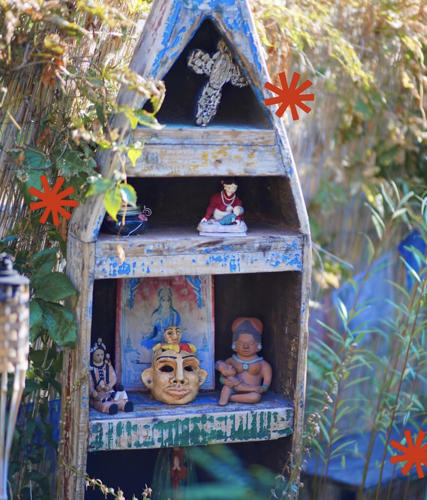
Duran’s home — a 1920 brick bungalow on a corner lot in Congress Park — is festooned with brightly colored fringed garlands. On the lawns, the artist’s large-scale, vibrant papier mâché sculptures hold court. A tall mermaid with an iridescent tail stands near an antique china cabinet painted in the rainbow’s spectrum. A Corn Goddess and an Earth Mother strike reverent poses in the boisterous gardens with towering sunflowers and hollyhocks and lush squash plants. Duran shares the house with his partner and their pets: a slinky, short-haired black cat, a lizard and a tarantula. Neighbors affectionately refer to their place as “the art house.”
“We have beautiful neighbors, and they love it, and the kids love it,” Duran said. “Sometimes we have whole school groups visit, or people bring their families to see. It brings joy. It’s not for everybody and never will be. To each their own, but for me I am wrapping my life around color. I see the space in my garden and the pieces as extensions of me and my lineage and my ancestors.”
Duran’s art bears ancestral influences from myriad cultures indicated by stickers adorning the tailgate of his rainbow truck. Frida Kahlo and Our Lady of Guadalupe reflect his Mexican-Catholic heritage. Hindu gods Shiva, Parvati and Ganesh nod to his Eastern Indian, Bengali, ancestry. Doran’s lineage also amalgamates Indigenous Manitou, Latinx, Mestizo and Chicano. Born on Beltane, the Gaelic Spring holiday, Duran claims some Celtic blood in his gene pool, too.
“When younger I realized how these bloodlines ran parallel and intersected — like the marigolds for Mexicans and Hindus, and also in the colors, the folk art and dance and the spirituality,” said Doran. “I believe we are all interconnected and trying to remember our roots. I believe we are woven. My teacher says we are a woven tapestry.”
Duran is, himself, a teacher at various institutions including Denver Public Schools, the Art Students League of Denver and Denver Art Museum (DAM).
“As teacher, I always say, ‘Your art is your soul.’ I am putting my soul into my art, and I don’t create to sell,” Duran said. “I have to create to survive, but it’s my way of transmuting my emotions into physical form. Artists are visionaries, bridge-builders and change-makers. Art is a safe space, and the imagination is the ultimate safe space with no judgment in that field where you can activate play and memories.”
Manager of Creative and Public Engagement at the DAM Sarah Rockett has worked directly with Duran since 2023, though Duran’s imaginative and playful art has been shown at the DAM since 2016.
Duran was a Featured Artist for the DAMS’ October 2022 Untitled: Artist Takeover. In 2023, he joined the DAM’s Creative Classes program as a teaching artist. Rockett noted Duran’s unique perspective on Indigenous and Chicano art practices in a contemporary context.
“While Cal incorporates a heavy cultural perspective into his work, he uses it as a means of connection for everyone from anywhere,” Rockett said. “He is an extraordinary educator in relaying his cultural art practices and finding entry points for people from all cultures to understand and relate to them, teaching connection, care, consideration for our fellow humankind, and how we can approach these things by looking back to our own cultural beginnings and ancestry.”
Rockett added that Duran’s process is “instinctive, spiritual and accessible.”
“His process focuses on the intention behind the work,” she said. “The intention of his artworks is always at the forefront of his creations. Cal’s approach to life and treatment of others is deeply tied to his art practice and spiritual journey. Cal practices what he preaches in all aspects of life, and that brings a true authenticity to the artwork he produces.”
Duran is most noted for producing artful altars, and he specializes in works designed to celebrate Dia De Los Muertos, the Day of the Dead — a Mexican holiday observed each November.
“I honor death and life as one,” Duran said. “I always have faith. Faith is fabric of the universe.”
His faith includes faith in himself, a self-confidence that has served as the armature of his art career.
“I didn’t go to art school. I started making art in ninth grade, and I was winning prizes. My art was sent to the Guggenheim when I was 17,” Duran said.
“I was the youngest member of Pirate Art Gallery on Navajo Street, and I learned a lot from elders in the community about Dia De Los Muertos. I couldn’t afford college, so I just kept making art and showing whenever I could.”
Duran eventually exhibited in Core Art Space in Lakewood and now is affiliated with ReCreative Denver, a nonprofit that reuses donated art supplies.
At Meow Wolf in Denver, Duran collaborated with David Garcia to design and install a room honoring Colorado’s indigenous tribes.
For Duran, the city of Denver and the state of Colorado provide continuous inspiration.
“The mountains,” he said. “I love the mountains and the rivers here. The colors. How sunny it is but how our weather switches. Colorado will aways be my home. My center.”
Duran also finds his center in his garden and in his materials.
“I center myself in the clay,” he said. “Clay has all the elements: It is made of earth. It takes water to mix and air to dry, and it goes into the fire. And clay is one of the oldest mediums on the planet.”
Duran is largely self-taught and considers his folk art his life’s work connecting him to his past, his present, his future, as well as to his ancestors and his current community of family, friends, students ranging in age from 5 to 90 years old.
“When I was young, I thought folk art had a bad reputation because it was not fine art and not getting into galleries,” said Duran. “I embrace that now, within the last decade, and I’m proud of it because folk art has such a lineage and generational teachers. Sometimes, we’re programmed as artists at college and in art school. I believe the best teachers are the elders.”
Duran acknowledged the late Rita Wallez de Flores, known as Denver’s First Lady of Mexican Folk Art, as a mentor.
“We met when I was pretty young and reconnected about four years ago,” Duran said. “She was in a lot of dementia. I visited her every week, and we worked together. After she died recently, I got all her scraps from her weavings. I created the storyteller sculpture now outside the front door to honor her at the Return of the Corn Mothers event held at the Colorado History Museum not long before she passed away.”
Duran also emphasized the influence of Danette Montoya.
“We were roommates, and then she grandfathered me into this house,” said Duran.
The interior of the house is, Duran said, “our big art installation.” Inside, candles flicker and incense scents the air. With about 100 houseplants, shelves of books, an array of bright textiles from his travels to Peru and Guatemala, altars and santos and Eyes of God, the space feels sacred.
“Our house is a sanctuary,” Duran said. “I study cundarizmo, the healing art of Mexico. It’s folk medicine and spiritualism. We pray. We honor the plants that are family and teach us. We hold ceremonies. We host fire ceremonies in our back yard. I play the flute, the drum, the rattle.”
Duran leads sound healing classes at the DAM. The next class will be held from 10 a.m. to 2 p.m. Aug. 2. More information at denverartmusuem.org.
“I lead ceremonies, but everything can be a ceremony. Stepping outside to stand still and listen to the birds can be a ceremony,” Duran said. “For me ceremony is a way to bring us back into a circle of community.”
Another fixture in the Denver art community, multimedia artist Jonathan Saiz met Duran around the year 2000. The artists crossed paths regularly at Denver Art Museum in 2019 when Saiz was installing his 10,000 miniature artworks forming his exhibition titled “What is Utopia?”
“I’ve loved watching Cal transform literal tons of raw clay into a direct conversation with ancestral Earth energy,” Saiz said. “His artwork feels like an invitation to connect more deeply with nature but also celebrate a sacred inner world we all have. His work feels like an invitation to a spiritual world filled with ancestors and animals, directly tied to a powerful Earth spirit.”
Saiz emphasized the authentic undercurrents of Duran’s work: “There’s a sacred sincerity in Cal’s artwork that makes the cynicism of the art world seem more cold and plastic compared to the warm clay world he creates,” he said. “I’ve worked beside him in this community for the past 25 years, and his work, and humanity, has always inspired me to listen deeper inside myself as I create.”
The shared spark of inspiration lights up Duran’s artistic path as he listens to his own deep callings. Asked what he hopes his art teaches people who look upon his colorful, fanciful, multicultural works, Duran said: “Gratitude is the medicine for us all to hold in our hearts. I hope they take away that.”