







Colorado’s TABOR-exempt revenue has increased nearly 30% since 1996, study finds
State spending that is exempt from Colorado’s Taxpayer’s Bill of Rights has increased by nearly 30% over the past 30 years, according to a report by the public policy think tank Common Sense Institute.
While TABOR places a limit on how much revenue the state can retain each fiscal year, certain sources — such as voter-approved changes, federal funds, and state enterprises — are exempt.
According to the Bell Policy Center, enterprise funds are state-owned “businesses” that provide goods or services in exchange for revenue. Examples include the state lottery and the Colorado Healthcare Affordability and Sustainability Enterprise (CHASE).
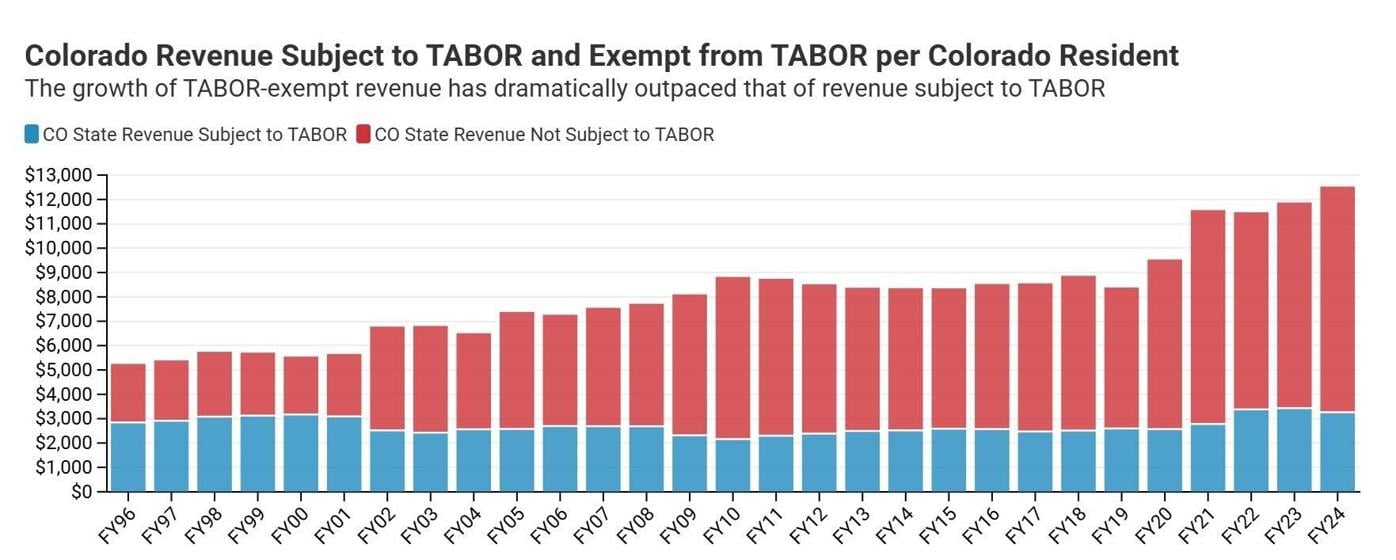
According to the Common Sense Institute report, 46% of total state spending — about $5,264 per resident — was exempt from TABOR in 1996. By fiscal year 2024, 74% of the state’s revenue was now exempt from TABOR — just over $9,000 per Coloradan.
In 2020, voters approved Proposition 117, which requires voter approval to establish enterprises expected to generate more than $100 million in revenue within their first five years.
Since then, the state has created 10 new enterprises, costing Coloradans more than $124 million.
Additionally, four new laws passed during the 2024 and 2025 sessions are set to take effect soon and are projected to generate more than $300 million in TABOR-exempt state revenue.
The report also found that revenue from enterprise fees has grown from $742 million in Fiscal Year 1994 to nearly $26 billion in Fiscal Year 2024, a 3,369% increase.
Colorado’s higher education enterprises, which include most of the state’s public colleges and universities, have consistently brought in the most TABOR-exempt revenue, growing from $360 million in FY 1994 to over $15 billion in FY 2024.
Unemployment compensation, CHASE, and the CollegeInvest program also each generated over $1 billion in TABOR-exempt revenue last fiscal year.
The report said the total amount of TABOR-exempt revenue collected by enterprises per Colorado resident has more than tripled since 2008, and fee revenue grew “substantially faster” than revenue to the state’s general fund, which supports services like roads and transportation, courts and prisons, and K-12 education.


State revenue from enterprises and the General Fund per Colorado resident since 2000. Courtesy Common Sense Institute.
“The more that fee increases assume the character of tax increases, especially in the aftermath of Proposition 117, the more appropriate it becomes to characterize them as such,” wrote the study’s authors, Erik Gamm and Judah Weir, adding that fee revenue growth is driving Colorado’s “tax burdens” without giving citizens a say in the process.


Paul Pazen, a former police chief, launches bid for Denver City Council
Deborah Grigsby
deborah.smith@denvergazette.com
Updated 5 hours ago
Former Denver Police Chief Paul Pazen announced his bid for the District 2 City Council seat to be vacated by Kevin Flynn in 2027. Flynn is term-limited. Pazen, who began his law enforcement career in 1995 with the Denver Police...

Deborah Grigsby
Reporter

Denver advances face covering ban for law enforcement
Deborah Grigsby
deborah.smith@denvergazette.com
Updated 5 hours ago
A Denver City Council committee on Wednesday advanced a proposed ordinance banning law enforcement officers, including federal immigration agents, from covering their faces during an arrest or detainment or inside a city facility. The proposed ordinance also establishes a minimum...
Deborah Grigsby
Reporter

CU Boulder, state launch economic research in coal-transition areas
Scott Weiser
scott-weiser@denvergazette.com
Updated 7 hours ago
Communities in northwest Colorado built on coal mining and power plants are losing hundreds of high-paying jobs and a major share of their tax revenue as operations wind down. In a yearlong effort, the University of Colorado Boulder is teaming...

Scott Weiser
Reporter
Arvada councilmember under investigation for alleged ethics violation
Sage Kelley
sage.kelley@denvergazette.com
Updated 7 hours ago
A third-party investigator will look into potential ethics violations from Arvada City Councilmember Sharon Davis. Davis was excused from the dais during the council’s regular business meeting on Feb. 3. The rest of the council then approved the outside investigation...

Sage Kelley
Reporter

Aurora councilmembers discuss Regional Navigation Campus, ADA requirements
Kyla Pearce
kyla-pearce@denvergazette.com
Updated 12 hours ago
The Aurora City Council tackled several major city topics at a Saturday winter workshop, moving forward with ADA accessibility improvements for the council chambers, addressing concerns about the Regional Navigation Campus and debating a new impact fee for businesses. In...

Kyla Pearce
Reporter

Colorado lawmakers take aim at ‘imposter’ peaches, melons and chiles
Marissa Ventrelli
marissa-ventrelli@denvergazette.com
Updated 5 hours ago
Do you know where your Palisade peaches come from? What about your Rocky Ford melons? Your Pueblo chiles? You might think they were grown right here in the state, especially if they have the “Colorado Proud” logo — but that’s...
Marissa Ventrelli
Reporter

Denver moves to codify quarterly financial updates to the City Council
Deborah Grigsby
deborah.smith@denvergazette.com
Updated 12 hours ago
The Denver City Council unanimously advanced a proposed ordinance on Tuesday that aims to codify quarterly general fund reporting to the council from the city’s Department of Finance. The council currently does not receive regular budget updates, relying instead on...
Deborah Grigsby
Reporter

Colorado Title Board rejects challenges to graduated income tax ballot measure
Marianne Goodland
marianne-goodland@denvergazette.com
Updated 18 hours ago
The state body that determines whether a ballot measure contains a single subject has rejected challenges to eight versions of the push to change Colorado’s flat rate to a graduated income tax, thereby increasing the taxes on higher income earners....

Marianne Goodland
Reporter

Lakewood City Council urges residents to keep zoning changes
Sage Kelley
sage.kelley@denvergazette.com
Updated 12 hours ago
Lakewood’s long-running zoning fight is headed for a spring showdown at the ballot box, spearheaded by a new resolution from the City Council. The Lakewood City Council amended and confirmed a resolution on Monday expressing the councilmembers’ desire for residents...
Sage Kelley
Reporter

President Pro Tem Sen. Dafna Michaelson Jenet to resign from Colorado Senate
Marianne Goodland
marianne-goodland@denvergazette.com
Updated 1 day ago
A top Democrat in the Colorado General Assembly is resigning to take a new job. President Pro Tem Sen. Dafna Michaelson Jenet of Commerce City, who has served in the General Assembly since 2017, will become the director of the...
Marianne Goodland
Reporter
PREV
PREVIOUS
Aerospace and defense firm expanding operations in Colorado Springs, to add 500 jobs
Facebook Twitter WhatsApp SMS Email Print Copy article link Save A veteran-owned aerospace and defense firm headquartered in Colorado Springs is expanding its operations locally, expecting to create around 500 jobs and invest more than $7 million into the community. Company leadership on Thursday afternoon joined Gov. Jared Polis and community and economic leaders in Colorado […]

Denver City Council to hear proposed election-related changes to city charter
Facebook Twitter WhatsApp SMS Email Print Copy article link Save The Denver City Council returns to chambers on Monday with a full agenda, including three proclamations and two half-hour courtesy public comment sessions. Items of particular interest include Council Bill 25-0920, which proposes asking Denver voters to approve an amendment to the Charter of the […]