








Eighty years ago this week, a flock of flyboys saved the world | Vince Bzdek
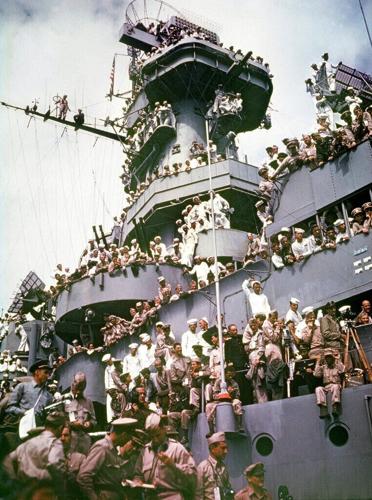
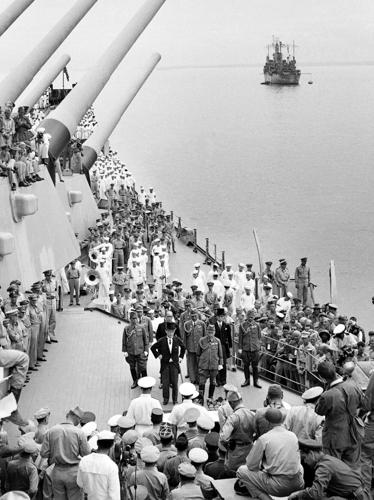
Servicemen, reporters and photographers perch on the USS Missouri on Sept. 2, 1945, for the onboard ceremony in Tokyo, in which Japan surrendered, ending World War II.
associated press file
The flyboys were in the air as long as 17 hours on the night bombing raids from the Mariana Islands to Tokyo. Round trip was approximately 3,000 miles. Along the way the crews — average age 22 — faced Japanese Zeros, anti-aircraft fire, mechanical issues, air sickness, high winds and turbulence.
“The Japanese fire from the ground was good up to about 7,000 feet,” said Maj. Gen. Thomas Moore, as quoted in a special exhibit at the National Museum of World War II Aviation in Colorado Springs. “All their heavy antiaircraft weren’t worth a damn below 10,000 feet, so you had a neutral zone of 3,000 feet.”
“We would just pour the bombers through there at night …”
Gen. Curtis LeMay ordered his bomber wings to change tactics when they started attacking Japan to use incendiary bombs and “area bombing,” otherwise known as carpet bombing. The precision bombing championed by the “Bomber Mafia” and used on industrial sites in Europe was more humane, sparing civilians, but May was determined to hasten the end of the war.
On the night of March 9, 1945, 279 B-29 bombers dropped 1,665 tons of bombs on the Shitamachi neighborhood of Tokyo. The ordnance consisted mostly of 500-pound E-46 cluster bombs, which released 38 napalm-carrying M69 incendiary bomblets.
Temperatures from the ensuing firestorm reached 1,600 degrees F.
“When you got the conflagration going with the whirl, we lost planes flying through the billows,” said Moore. “The up-current was so violent that it would just run planes upside down and sometimes throw them into other planes.”
The strikes, code-named Operation Meetinghouse, were the single most destructive aerial bombing raid in human history. Sixteen square miles of central Tokyo were destroyed, leaving an estimated 100,000 civilians dead, more than either Hiroshima or Nagasaki, and over 1 million homeless.
A New York Times reporter wrote: “The heart of Tokyo is gone.”
The key development that enabled the Allies to bomb Japan at scale was the B-29 Superfortress strategic bomber, which had an operational range of 3,250 nautical miles and was capable of attacking at high altitude, above 30,000 feet. Almost 90% of the bombs dropped on the Japanese home islands were delivered by the B-29.
“I’m firmly convinced the B-29 was the turning point” in ending the war, said Blair Stewart, a docent at the aviation museum. “The bombing of Japan was decisive in the Pacific. They wouldn’t have surrendered without that.”
Eighty years ago this week, in other words, World War II was won in the skies.
“The main thing was to (remove the need for) the invasion of Japan,” Moore said. “We thought we had them on the run when we burned all the major cities. Intentionally, we left half of Tokyo … didn’t touch it.”
In 1944, Moore had been assigned to the 313th Bomb Wing at Peterson Air Force Base in Colorado Springs, where he was put in charge of getting the B-29 bomber unit ready for deployment.
Moore had been promoted to colonel at 29 years old after ably performing squadron commander duties for bombers in the Caribbean Air Command. Earlier he had made a name for himself as a pilot and squadron commander of the famous 1st Pursuit Group at Selfridge Field, Mich.
When the U.S took the Mariana Islands in June 1944, Moore’s bombers could finally be deployed close enough to launch runs on mainland Japan.
In February 1945, Gen. Moore became deputy chief of staff for operations, 58th Bombardment Wing, in the Marianas. B-29 raids from the Marianas began in earnest and lasted until Aug. 15, 1945, the day of the Japanese surrender.
Moore personally flew seven bombing runs on Tokyo.
Many claim the horror of the A-bomb is what finally persuaded the Japanese to agree to unconditional surrender. But Stewart and others argue that Hiroshima and Nagasaki were just the “punctuation marks” on that devastating series of bombing raids on Japan whose cumulative impact was the real reason for the surrender.
“I’m convinced that the Japanese were fanatical enough that they were going to fight to the death and they were going to lose a lot of guys” if the U.S. invaded, docent Stewart told me. “And I mean, my dad was loaded on the ships, ready to go into Japan.”
A strategic bombing survey conducted by the U.S. War Department in 1945 concluded that airpower was the decisive factor in winning the war.
And Moore was one of the decisive leaders of that decisive factor.
“We were just heroes for flying airplanes. It was out of this world,” he once said.
Moore retired to Colorado Springs after 37 years of service and more than 6,100 flying hours. His decorations include the Distinguished Service Medal, Legion of Merit with two Oak Leaf Clusters, WWII Victory Medal, Bronze Star, National Defense Service Medal, Air Medal, Meritorious Service Medal, American Defense Service Medal and Asian Pacific Campaign Medal. He was also named an honorary general in the Chinese Air Force.
During his time at Peterson during the war, Moore, an avid hunter, got to know film star Gary Cooper, who also hunted. Cooper invited Moore to other social events attended by other famous stars who had enlisted, including Bing Crosby, and Moore and the crooner became lifelong pen pals. Many of those letters are on display in the museum.
Retired in the Springs, Moore became a member of the Fine Arts Center, the Broadmoor Community Church and the Lance P. Sinjan chapter of Retired Officers. I understand he was quite an outdoorsman, as well.
When Moore died in 2007, his Gazette obituary read:
“Major General Thomas E. Moore ‘slipped the bonds of earth and touched the face of God’ on September 21, 2007.”
His widow was quoting a sonnet, “High Flight,” written by John Gillespie Magee Jr. while Magee was flying a British Spitfire during World War II.
Three months after penning those lines and sending them in a letter to his parents, Magee became one of the first post-Pearl Harbor American casualties on Dec. 11, 1942.
His words live on as perhaps the best expression of what those young flyboys like Moore experienced 80 years ago when they were saving the world:
“Oh! I have slipped the surly bonds of Earth
And danced the skies on laughter-silvered wings;
Sunward I’ve climbed, and joined the tumbling mirth
of sun-split clouds, — and done a hundred things
You have not dreamed of — wheeled and soared and swung
High in the sunlit silence. Hov’ring there,
I’ve chased the shouting wind along, and flung
My eager craft through footless halls of air …
Up, up the long, delirious, burning blue
I’ve topped the wind-swept heights with easy grace
Where never lark, or even eagle flew —
And, while with silent lifting mind I’ve trod
The high untrespassed sanctity of space,
Put out my hand, and touched the face of God.”
Vince Bzdek, executive editor of The Gazette, Denver Gazette and Colorado Politics, writes a weekly news column that appears on Sunday.


Trump says the US has seized an oil tanker off the coast of Venezuela
Aamer Madhani
aamer.madhani@associatedpress.com
Updated 3 days ago
WASHINGTON (AP) — President Donald Trump said Wednesday that the United States has seized an oil tanker off the coast of Venezuela amid mounting tensions with the government of Venezuelan President Nicolás Maduro. It’s the Trump administration’s latest push to...

Aamer Madhani
Reporter
Nonprofit ActivateWork focused on free tech training looks to serve military community
Mary Shinn
mary-shinn@denvergazette.com
Updated 1 week ago
Amid a changing tech industry, ActivateWork, a Denver-based nonprofit, wants to help more members of the military community find jobs through free training. The nonprofit was founded about 10 years ago and works to prepare members of underserved communities for...

Mary Shinn
Reporter
Air Force Academy tightens rules on conferences, public appearances for faculty
Mary Shinn
mary-shinn@denvergazette.com
Updated 2 weeks ago
After the Department of Defense rolled out rules for employees to engage with the public in September, the Air Force Academy adopted a new layer of review for faculty and others who wish to attend conferences. The Air Force Academy...
Mary Shinn
Reporter

Pentagon says it’s investigating Sen. Mark Kelly over video urging troops to defy ‘illegal orders’
Konstantin Toropin
konstantin.toropin@associatedpress.com
Updated 3 weeks ago
WASHINGTON (AP) — The Pentagon announced Monday it is investigating Democratic Sen. Mark Kelly of Arizona over possible breaches of military law after the former Navy pilot joined a handful of other lawmakers in a video that called for troops...

Konstantin Toropin
Reporter

9 things you probably didn’t know about the American Revolution | Vince Bzdek
Vince Bzdek
vince-bzdek@denvergazette.com
Updated 3 weeks ago
By Vince Bzdek What is most striking about Ken Burns’ extraordinary new PBS documentary on the American Revolution is how alike we are right now to those folks in 1776. Take away the tricorn hats and ruffled shirts and they...
Vince Bzdek
Reporter
Should America resume nuclear tests?
Jim Carrier
jim-carrier@gazette.com
Updated 3 weeks ago
America’s last nuclear detonation was nothing special. Smaller than the bomb that killed 73,000 people in Nagasaki, it exploded 1,397 feet below the Nevada desert. It shook the ground, created a shallow concavity in the sand, and killed no one...

Jim Carrier
Reporter
Air Force Academy may cut back distinguished visiting professor program
Mary Shinn
mary-shinn@denvergazette.com
Updated 4 weeks ago
The Air Force Academy may pare back the number of distinguished visiting professors it hires next school year as a cost-saving measure — a step that worries professors with knowledge of the proposed cuts. Those who are concerned say the...
Mary Shinn
Reporter
Air Force Academy may cut back distinguished visiting professor program
Mary Shinn
mary-shinn@denvergazette.com
Updated 4 weeks ago
The Air Force Academy may pare back the number of distinguished visiting professors it hires next school year as a cost-saving measure — a step that worries professors who say the number of highly qualified instructors has already faced serious...
Mary Shinn
Reporter
Denver area vets share how the service changed their lives
Mark Samuelson
mark-samuelson@denvergazette.com
Updated 1 month ago
When two dozen Colorado veterans gathered for lunch on a national holiday honoring their military service, they recounted experiences that ranged from combat action in some of the Vietnam War’s most notorious battles, to mundane tours on Army and air...

Mark Samuelson
Reporter

Behind Friendly Lines: Saying goodbye, but are we really parting ways?
Jason T. Strickland
jason-t-strickland@gazette.com
Updated 1 month ago
It began on Feb. 20, 2022. It ended on Nov. 9, 2025. It lasted 1,359 days. When this column began more than 3 1/2 years ago, I pledged to provide content relevant to our military veteran community. Hopefully, I have...

Jason T. Strickland
Reporter
PREV
PREVIOUS

Behind Friendly Lines: Connect veterans to resources they need
My team sat in the fourth row of the Strategic Operations Center on the U.S. Embassy compound located inside the Green Zone in Baghdad, Iraq. We were the intelligence element of Multi-National Force–Iraq (MNF-I) and had been known as Combined Joint Task Force 7 a few days earlier. Just like all the other directorates in […]
Blue Canyon Technologies' new satellite might have a role in Golden Dome and other space applications
A small satellite company is going (just a little) big. Blue Canyon Technologies, a Lafayette-based small satellite manufacturer, unveiled its Saturn-400 last week. The craft can fill a variety of roles and may be part of the ongoing Golden Dome effort, a new missile defense shield planned for the nation. Golden Dome, which lacks an […]