







‘All systems go:’ Lockheed Martin says first humans could return to moon this February
Courtesy photo, NASA/Rad Sinyak
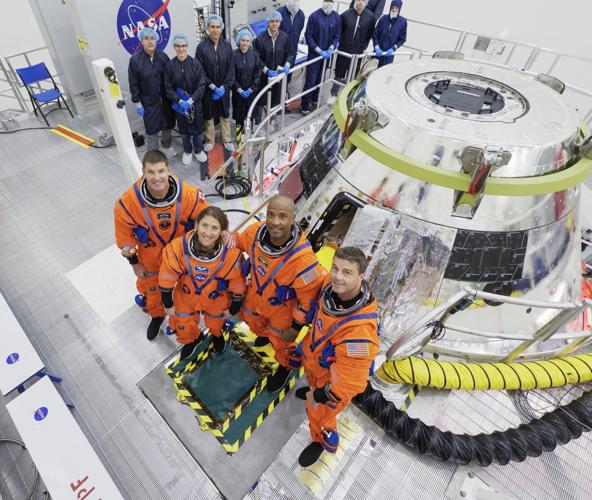
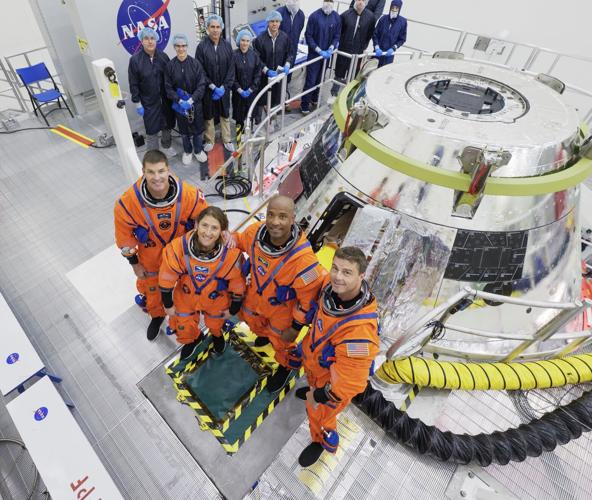
Flying the first mission to the moon in 53 years are Orion crewmembers (left to right) Canadian astronaut Jeremy Hansen, Mission Specialist Christina Koch, Pilot Victor Glover, and Commander Reid Wiseman. The crew was at Kennedy Space Center with a NASA team assembling their Orion capsule for the 2026 launch.
Courtesy photo, NASA/Rad Sinyak
It was 53 years ago that Apollo astronauts last flew a lunar mission, but a human return to the moon really is about to happen — maybe just six months from now, NASA and Lockheed Martin executives told a crowd at Denver Museum of Nature & Science Wednesday.
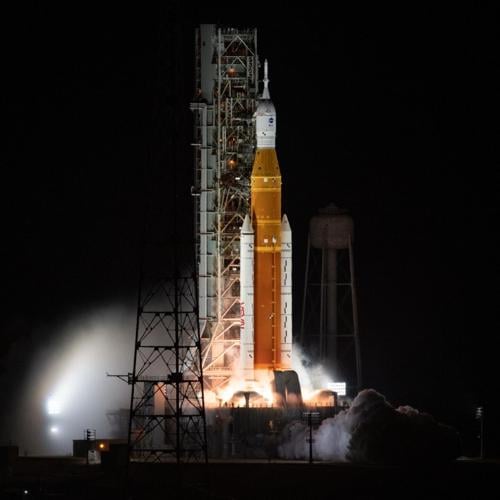
NASA’s Artemis II mission, with a crew of three Americans and a Canadian astronaut atop a rocket larger than Apollo’s Saturn V, could lift off as early as February for a trip around the moon and back. That’s according to the agency’s Orion Program manager Howard Hu, who briefed the audience at the museum’s monthly “60 Minutes in Space” night.
That flight would not land on the cratered orb, but would circumnavigate it during a 10-day mission, ending with a splashdown in the Pacific Ocean off San Diego.
Although April 2026 had been NASA’s announced flight date, Hu said February is the actual target for the Artemis launch. The Orion ship and its giant rocket, including many Colorado designed and tested components, would be ready to go, he added.
On board will be three Americans, Commander Reid Wiseman, Pilot Victor Glover and Mission Specialist Christina Koch, along with Canadian Mission Specialist Jeremy Hansen. According to Hu, the launch will likely be at night, followed by a 23-hour trip to a high orbit 46,000 miles above earth as the crew tests out their Orion capsule. Then they’ll fire the engines for the long trip out to the moon.
Doubts about 2027 landing
Although everything looks A-okay for that first crewed trip, there are doubts among space experts about whether the U.S. can pull off an actual landing on the moon the following year.
The United States flew its first lunar flight on Apollo 8 in December 1968, on a rushed timetable to beat the Soviet Union in making a manned lunar trip. The Apollo 11 flight that landed Astronauts Neil Armstrong and Buzz Aldrin in the Sea of Tranquility happened just six months after that first flight, after two additional missions that tested the lander and a dry-run descent at the moon.
The return to the moon has been less hurried. The Orion made an uncrewed test flight around the moon in 2022, including having fired its engines to slow into a lunar orbit before returning. The crewed Artemis II mission set for early next year will fly around the moon, but won’t fire its engines to slow down into a lunar orbit.
Now NASA is scheduling 2027 as when the next mission, the first actual Artemis landing, might happen — involving a linkup between an Orion crew and a SpaceX Starship craft in lunar orbit. Two of the Orion crew would climb aboard Human Landing System Starship for a descent to the surface, then return to Orion for a trip home.
Starship needed for landing
Despite its critical role in pulling off a moon landing, Starship had been plagued with explosions and other failures, but made a successful flight early this week.
Although the crewed mission timetable is less rushed and a little less ambitious than it was in 1968, officials at the space agency and at Lockheed Martin acknowledge that there is a sense of urgency in getting back to the moon. China, they told the audience, has announced it plans to land astronauts there by 2030.
Can a U.S. landing happen by 2027?
“I have high confidence that Orion will be ready,” Hu told The Denver Gazette. Capsules for Artemis III, IV and V landing missions were already at Kennedy Space Center for preparation and rocket assembly, he added.
But Hu noted that the Human Landing System components involving the SpaceX Starship were outside of the Orion program’s purvey.
Lander has work to be done
“They have a lot of work to be done,” Hu added. “We want to make sure we do our part.”
Orion is largely assembled at NASA’s Cape Canaveral, but with major parts and participation by engineers and support staff here in Colorado, according to Kirk Shireman, vice president of Human Space Exploration at Lockheed Martin.
Shireman told The Denver Gazette that some 600 Coloradans were working on Artemis II as well as on successive Artemis follow-up missions that would make actual landings, as steps to a more continuing lunar presence. Another 300 Colorado companies, he said, have already been involved in the program.
Orion’s heat shield, which has to withstand temperatures to 5,000 degrees Fahrenheit when the crew reenters the atmosphere, was designed and manufactured at Lockheed Martin’s Waterton Canyon plant in Jefferson County. And many of the craft’s electronic and avionic components are from the plant.
Circling the moon
The four Artemis II astronauts have visited the Waterton plant several times, to train with Orion’s hatch.
All of those Orion systems look “go” for launch, officials said. They added that now, even after the politics that had seemingly jeopardized the Artemis program, were looking favorable for the mission.
President Donald Trump had called out a future Mars mission as a priority during his inaugural address and had included $1 billion toward Mars preparations in his 2026 budget. But the incoming president and his appointees had been critical of elements of Artemis, including the cost effectiveness of parts of the program.
In July, Trump appointed Transportation Secretary Sean Duffy as interim NASA administrator, drawing a wave of protests from inside NASA.
But others inside the space community have seen Duffy as a supporter of the Artemis mission.
Lockheed Martin’s Shireman told reporters that he had personally taken Duffy through the Orion assembly building at the Cape.
“He seemed very engaged in what we’re doing,” he said.
Heading back
The crowd at the museum looked similarly excited about heading back to the moon after the long lapse. That included former astronaut Bob Behnken, who commanded the first flight of SpaceX’s Dragon craft out to the International Space Station and back. He is now Lockheed Martin’s vice president for mission strategy & advanced capabilities.
Asked if he’d like to go on an Artemis trip, Behnken replied: “absolutely.”
United Launch Alliance, with headquarters in Centennial, builds the upper stage of Orion’s SLS rocket launch system that will fire the critical trans-lunar insertion burn.