







Jeff Campbell invites you to join him on the dark side
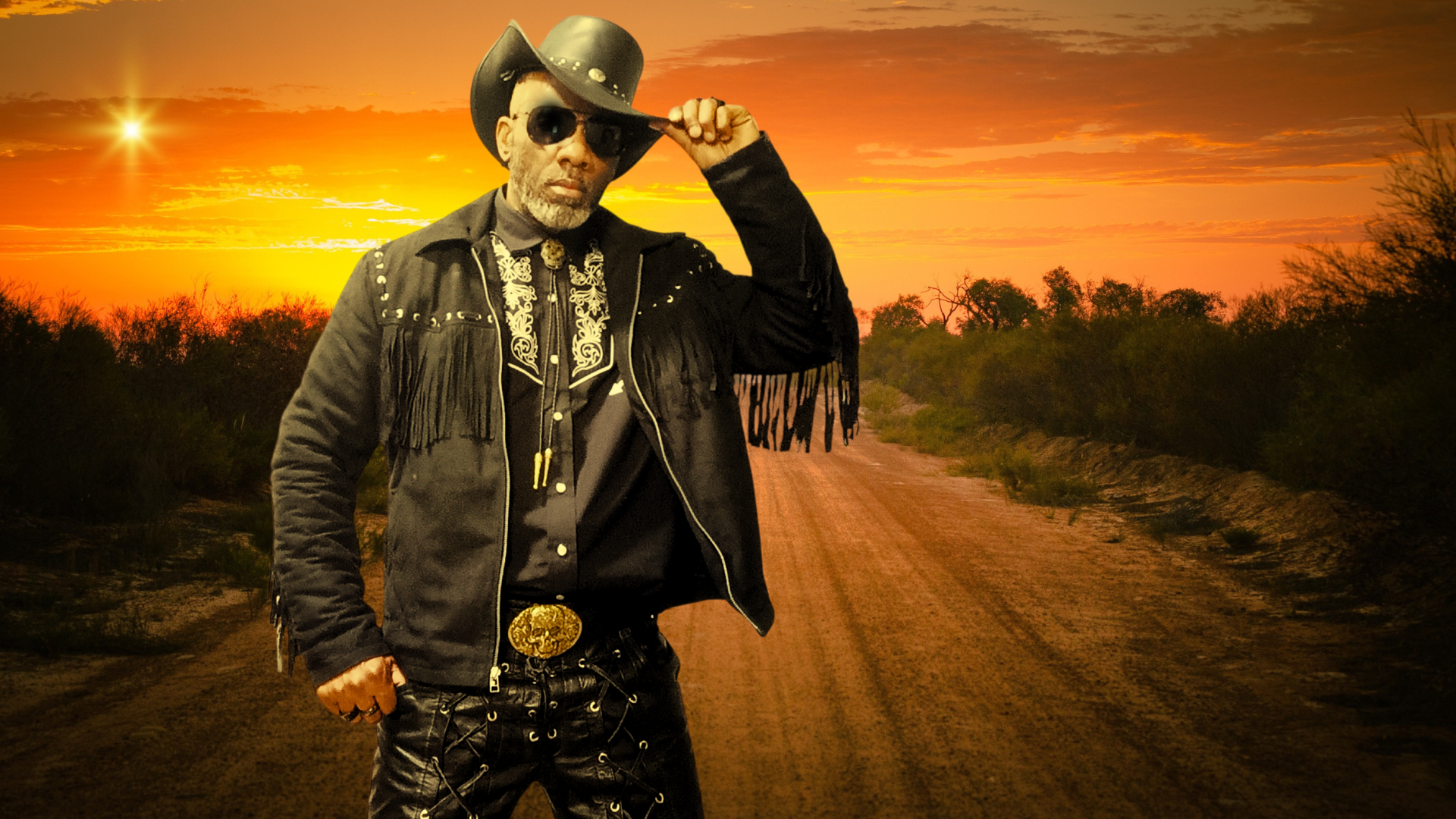
‘Jedidiah Blackstone’ will introduce a new kind of Jedi hero to audiences
Considerable Denver theatermaker Jeff Campbell knew exactly what he was doing when he teased his newest multidisciplinary project as “a walk on the dark side of the wild West.”
He’s playing with you.
Campbell knows what centuries of predominantly White pop culture have done to the color black, and our idea of lightness vs. darkness.
Going to the dark side is generally accepted to mean you are attracted to danger and driven by impulses like greed, anger or fear. (Darth Vader, anyone?) It means you have a touch of evil.
It’s also abjectly racist.
No coincidence (perhaps?) that Campbell’s newest theatrical adventure is called “Jedidiah Blackstone,” with the intentionally leading subtitle: “Origin Story of an Alter-Ego & The Untold Tales From the Dark Side of the West.”
I mean, it’s got “Jedi” right in the title! And what is a Jedi but a noble warrior trained to defend peace and justice by wielding The Force”? (Or maybe a gun.)
Meet your new white knight – and he’s a Black cowboy. (That’s the joke.) Campbell is embracing the whole “dark side” idea and owning it for his own power.
“Yeah, it’s definitely a double entendre,” he said with a laugh.
Jedidiah Blackstone is Campbell’s newest second self, a traveling cowboy poet with a spirit as vast as the western skies. And while this Jedi is fictional, the characters he encounters and amplifies along his stage journey were real, significant and largely hidden figures in Black history. Campbell-slash-Blackstone is here to reclaim their erased legacies.
“Uncle” Jeremiah Lee was a veteran of the Mexican-American War who became a prospector to raise $1,400 to buy the freedom of his sweetheart. He went on to become a wealthy silver mine owner in the mountains around Central City.

First came Apostle
Campbell has been a longtime fixture on the local hip-hop scene, first as the rapper Apostle, frontman of the electronic dub group Heavyweight Dub Champion. Then as founder of the youth-friendly Colorado Hip-Hop Coalition, which offered after-school classes in DJing, emceeing, breakdancing and graffiti art for Denver Public Schools students from 1997-2007.
“Jeff Campbell is not only an extremely gifted writer, he is an extremely gifted musician, and an extremely gifted spoken-word artist,” said the intentionally lower-cased donnie l. betts. “He is an activist and a teacher who will give you a history lesson – but he will entertain you as well.
“He is a force of nature, really,” said betts, a legendary creative himself who won an Emmy Award for “My Voice,” a documentary about Campbell and his work with the Colorado Hip Hop Coalition.
Not bad for a kid who grew up in Longmont and whose only local connection to his musical roots was watching Saturday morning episodes of “Soul Train.”
“I was never really into the cowboy culture or western anything growing up as a kid,” said Campbell, “even though by birth I’m as country as moonshine in a champagne flute.”
Lorenzo Bowman, who came to Gold Hill in 1859, was the first person to figure out how to smelt Georgetown’s unique silver ore. He was the superintendent of the Red, White and Blue Mining Association, a mill owned and operated exclusively by Black miners.

Colorado culture shock
Jeffrey Dante Campbell was born in Alabama in 1970. When he was 4 years old, his family moved to Longmont, which was effectively another planet.
“My father grew up in Alabama, and we would go back to Decatur every summer vacation,” Campbell said. “Whenever we would pull up to my auntie’s house, chickens would greet us all around our feet. That’s just how country it was.”
And when summer inevitably ended, “my parents would bring me back to Colorado kicking and screaming,” he said.
In Longmont, Campbell adopted the stock class-clown persona, he once told Westword, “because being a class clown was so much better than rocks and spit and fists.” Being the jester, he added, “kept people from calling me (the n-word).”
After graduating from Longmont’s Skyline High School, he was accepted into an arts college in Pasadena, California. He just couldn’t afford to attend. So he spent the next decade establishing himself in the hip-hop and rap communities, while navigating the many factions and contradictions within them.
But Campbell has never belonged to any one artistic discipline for long. As a storyteller, a musician, a community activist – and often a challenging thorn in the sides of city officials over septic issues like police brutality and mistreatment of the unhoused, he said, “I do seem to have these 10-year cycles.”
After 14 years singularly focused on music, “I felt like my value and my worth in that space was just really challenged,” he said. “And the same went for the Colorado Hip Hop Coalition. After about nine years of that, it got to a point where it was put up or shut up.”
Campbell is not one to shut up. But he was done spending an ever-increasing chunk of his waking life asking for money from wealthy people.
“I found that theater was the next evolutionary step that I needed to take,” he said. “Theater is so powerful to me because all of the elements are there – everything from visual art to dance and choreography to poetry to music. Theater is the progenitor of everything – the music industry, film and television. Theater is where you really get your chops.”

Campbell wrote his first play, “Who Killed Jigaboo Jones?” in 2013, and it changed his life – and not in the good way.
The one-man show, directed by betts, was a satirical murder mystery that explored the exploitation and commodification of hip-hop culture. The show was favorably reviewed but not altogether favorably received. The satire eluded some. Others, the title, which Campbell had intentionally chosen to draw attention to the dehumanization of Black people. He came to think of a jigaboo as his inner prostitute: The 8-year-old class clown who would make White kids laugh in the hope of their acceptance.
Maybe it was the promotional poster, which showed a Black man in black face, a noose around his neck and a pistol at his temple.
Some rappers wrongly assumed he was creating a new (and wholly incorrect) hip-hop persona. He was threatened with violence. Frustrated by all of it, Campbell moved to Georgia in 2016, seemingly leaving Colorado behind forever.
But he came back with renewed purpose in 2018 to found the provocatively titled Emancipation Theatre Company. He launched with “Honorable Disorder,” about the struggles of a Black veteran returning home to Five Points.
Emancipation, he vowed, would be a robust Black theater company for a rapidly gentrifying Denver neighborhood that had not had a viable theater since the closure of Crossroads Theatre in 2013. To many, what we think of as the Black theater community in Denver has been largely scattered since the sudden death of Shadow Theatre Company founder Jeffrey Nickelson in 2009.
“We have many great individual Black theatermakers in Denver,” said Campbell, listing bold-faced names Hugo Jon-Sayles, Jada Dixon and Kenya Mahogany Fashaw, among others. “But Jeffrey Nickelson’s absence created a huge void in the overall theater landscape of this town. And you don’t know how heavy that cross is until you try to bear it.
“But even though our numbers are small (the metro Black population is 6%), there is still a great need for a Black-owned (professional union) playhouse in Denver to tell our stories. I felt like that was a vitally missing piece.”
On that conundrum of operating a company dedicated to bringing Black history, past, present and future to life in a city that is so overwhelmingly White, I asked Campbell why he decided to come home and do it in Denver, with all its inherent box-office challenges.
“That’s exactly why I had to do it here,” he said. “There’s not enough stuff for Black folks to do here. Really, my first intention always was to put some Black actors on stage and for the Black community to be able to celebrate these stories with me.
“But this has been a real challenge. I have never wanted to be ‘the White educator’ to teach White folks why they need to learn this history. In fact, I am more interested in us – Black people – knowing our history better than anyone else.
“But at the end of the day, you really just have to let go of whatever expectation you have as a creator. You just have to offer your creative energy out to the community, and allow the universe to respond. Because if you don’t let that go, you’re going to torture yourself.”
Former slave Bass Reeves was among the first of 200 deputy U.S. marshals hired by the feds to sweep over the Oklahoma territory and arrest felons and fugitives. One report said he captured more than 3,000. Some say he was the real-life inspiration for “The Lone Ranger.”

Now, tell the story
The fictional Jedidiah Blackstone was born from Campbell’s discovery of actual, present-day cowboy storytellers. Seriously, there is even a convention for that.
“I had no idea that was real,” Campbell said with a laugh. “But when I learned about these White guys like Baxter Black, with their parody songs and their improvisational poems and their stories of saloons and shootouts and life on the ranch, I was like, ‘Man, that sounds just like gangster rap.’ I had this ‘Dolemite of the West’ idea swirling around in my head – and that became ‘Jedidiah Blackstone.’
“The core idea is that these characters are the Black versions of these cowboy storytellers.”
It’s a rabbit hole. There are stories to be told of Central City. Of Deerfield, Of Lincoln Hills (a once thriving Black community established in the Colorado mountains near Rollinsville in 1922), and many others. In fact, Campbell is bringing Blackstone to life during a surge of interest in black pioneering stories.
In January, the Denver Center Theatre Company will premiere a new play called “Godspeed,” the fictional story of a newly freed slave who has come to Texas with vengeance on her mind. Beyoncé, of course, has taken a strong interest in Black cowboys of the frontier through her “Cowboy Carter” album. And Taylor Sheridan’s interest in Bass Reeves led him to produce the 2023 Paramount+ series “Lawmen: Bass Reeves.”
“I think there is a newfound movement for the reclamation of Black Western history right now within our culture,” Campbell said. “I’m not one to bandwagon, though. For me, it was much more of a personal journey to reconnect to my own country roots. It’s just serendipity.”
“Jedidiah Blackstone,” running from Sept. 25 through Oct. 5 at the Early Learning Center on Martin Luther King Jr. Blvd., will have some extra performance juice because it includes four musical interludes performed by an impressive lineup including DeAndre Carroll, DJ Musa and local blues legend Erica Brown, winner of Colorado Blues Society’s Lifetime Achievement Award. That someone who has riffed with B.B. King and Al Green will be jamming for 10 performances just doesn’t happen. But, it is.
“Erica Brown is an extraordinary talent,” Campbell said, “and when someone like that wants to participate in something I am creating, I can’t be grateful enough.”
Clara Brown, Central City’s renowned humanitarian, was born into slavery and became the first Black woman to take part in the 1859 Gold Rush. She dedicated her life to aiding in the settlement of former slaves in Colorado, and reuniting post-slavery with her daughter.

Let’s have a talk
It should be noted that my conversation with Campbell took place on Wednesday, just as we both were processing the news that Charlie Kirk had been shot in Utah, and three high-school students in Evergreen. I asked Campbell if he had any immediate perspective on what is happening in our world.
“My gut is telling me that this polarization we are experiencing, with all the rhetoric back and forth demonizing one another on both sides … that just has to stop. To say that all the people on the left are bad and all the people on the right are bad … that just has to stop. To say that anyone is evil or that they’re not real Americans based on their political leanings … that just has to stop. And that starts at the top. … It is killing the soil. It’s killing all of us to the point where nothing will grow and nothing will live.”
In times of local and national tragedy, art has served a powerful role in providing a framework to at least start the essential conversations that need to happen. I asked Campbell if “Jedidiah Blackstone” could be part of that dialogue.
“We do grow up and we are shaped by our environments and our upbringing and our families and our experiences – and that calcifies our beliefs,” he said.
“But the power of storytelling enables us to gather within our community with folks who might not be like us, who might not have those same experiences, and to have a shared experience through this one story. And one thing I know is that a shared experience can either validate our beliefs, or it can challenge our beliefs. And when it’s able to do both of those things simultaneously, it can inspire us to think differently and to maybe move closer to the folks that we’re having that shared experience with.
“That is so much a part of my purpose here. The reason I am trying to celebrate these people and elevate these stories is so that folks can have an experience that can move their hearts to empathy.”
‘JEDIDIAH BLACKSTONE’
- Subtitled: ‘Origin Story of an Alter-Ego & The Untold Tales From the Dark Side of the West’
- Written by and starring: Jeff Campbell
- Presented by: Emancipation Theater Company
- When: Sept. 25-Oct. 5
- Where: Clayton Early Learning Center, 3801 Martin Luther King Jr. Blvd.
- Directed by Shayla Riggle
- Live music by: Jeff Campbell, DJ Musa, Erica Brown, Merrian Johnson, DeAndre Carroll and Lino Dupa
- Tickets: $30
- Info: 720-331-7977 or emancipationtheater.com
John Moore is The Denver Gazette’s senior arts journalist. Email him at [email protected]