







Johnston proposes a Denver budget that would ‘cut to the bone’
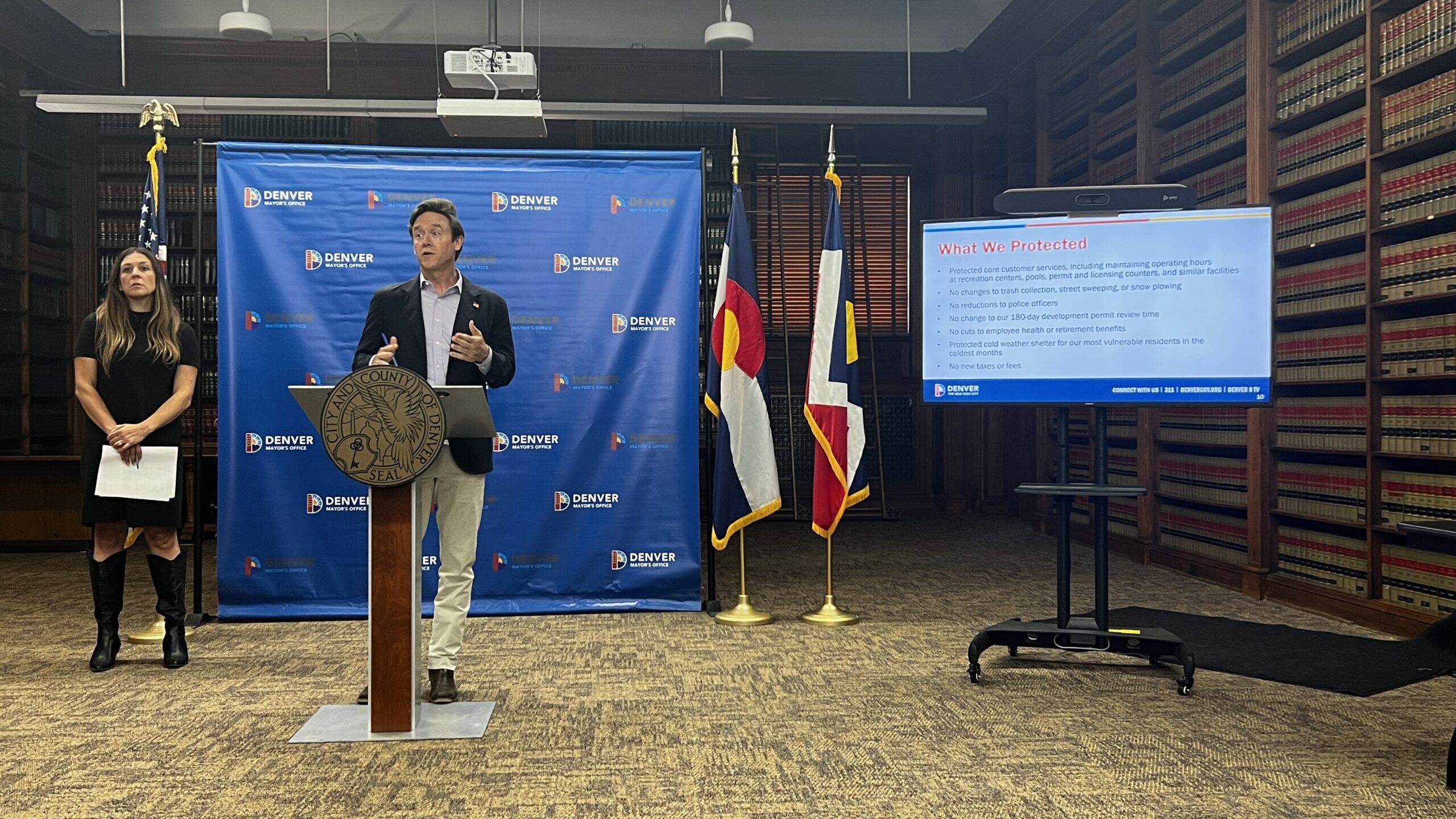
Denver Mayor Mike Johnston unveiled his proposal for the city and county’s 2026 budget during a news briefing on Monday, saying the $1.66 billion general fund budget would “cut to the bone.”
Johnston called the 5.8% reduction in spending, which aims to fill a $200 million gap, as the “most conservative” in 15 years.
The mayor insisted that, while significant budget cuts have been made across city departments, Denver residents would not see a cut in core services.
“If there are any amendments to the budget that add cuts to any of the departments,” Johnston cautioned, “those would directly either cut these core services or require more limits, because there is nothing left to cut in these departments…”
~ Denver Mayor Mike Johnston
Johnston said his budget proposal solves the city’s $200 million deficit via the following:
- $77 million in savings from services, supplies and internal transfers
- $118 million in personnel savings
- $5.7 million in revenue additions
The proposed budget now goes to members of the Denver City Council, who will review it and have the opportunity to propose amendments.
“If there are any amendments to the budget that add cuts to any of the departments,” Johnston cautioned, “those would directly either cut these core services because there is nothing left to cut in these departments from what has currently been done without affecting these core services or affecting layoffs, which is why we think it’s really critical for all the public to know about that in the process ahead.”
Along with hiring freezes and layoffs made earlier this year, Johnston said the city has identified close to $77 million in savings from services, supplies and contracts:
- $10 million savings in technology purchases, including reductions in spending on software applications, such as Adobe and Zoom
- $8 million in credit card processing costs
- Negotiating a 2.5% reduction in the city’s tech liability insurance premiums with no decrease in policy terms
- Switching to postcards, rather than letters for property tax notifications
- Reducing marketing campaigns for marijuana abuse prevention, Be a Smart Ash and job recruiting
- Reducing the number of concurrent neighborhood plans undertaken by city planning staff each year from three to two
Other savings will come from department consolidations, use of technology to increase efficiency and the closing of non-congregate housing sites, including the Comfort Inn and the conversion of the Monroe “micro-community” to workforce housing.
Johnston said general fund allocations for the city’s homelessness initiatives will remain flat, with the Office of Housing Stability (HOST) absorbing $33 million in reductions across multiple funds.
“For us, this is good progress in showing the system we had was working, which is when we first opened these hotels,” Johnston said. “The purpose was to meet the overflow needs of getting folks off the street into transitional housing. That means we get people moved out of transitional housing and permanent housing faster. That means we need fewer hotel sites to do that, and importantly, this will include closing all the hotels from which we are paying rent or leasing, like any family, you’d rather own than rent.”
While the city will not see a cut to the number of uniformed personnel, Johnston said public safety agencies have absorbed $27 million through vacancy savings and the elimination of one fire academy class, as the Denver Fire Department is currently at full-strength.
Several people criticized the cuts.
Denver Clerk and Recorder Paul López blasted Johnston following the mayor’s budget announcement.
“Mayor Johnston’s 2026 budget proposal seeks to underfund the Denver Clerk and Recorder’s office by the $4.5 million necessary to run our elections in 2026,” López said in a statement. “This proposal will decimate election operations in Denver by forcing the closure of polling centers and ballot drop boxes in every part of the city, jeopardizing voter turnout in what is expected to be a high-profile midterm election cycle.”
Johnston defended his proposed spending reductions.
“In the middle of cuts, we tried to work with them on making reductions in the budget,” Johnston said. “They weren’t willing to work together on those, and so we just had to allocate them the amount of dollars that they could have used with a 5% reduction, which was our ask.”
City officials have blamed flattening city revenues, driven — they said — by national economic uncertainty and rising costs for much of Denver’s fiscal woes. They argued that, with the early action to slow hiring in 2024, reduce the size of government in the 2025 budget and freeze hiring this year, the city managed to minimize the impact to employees and public services significantly.
The full budget book and today’s presentation are available online at denvergov.org/budget.

Capitol M: Olympic version | Week of Feb. 7, 2026
Marianne Goodland
marianne-goodland@denvergazette.com
Updated 3 days ago
The lighter side of the state Capitol, usually. Sen. Byron Pelton, R-Sterling, who turns 50 this year, is sporting eyeglasses for the first time. He blames the lege. “With 700 bills to read a year, my eyes are failing me,”...

Marianne Goodland
Reporter

Denver City Council to consider dragon boat storage, $11M to deep clean tunnels
Deborah Grigsby
deborah.smith@denvergazette.com
Updated 2 days ago
The Denver City Council will have a short but interesting agenda before them on Monday, as they weigh items from long-term storage of Dragon Boats to an $11 million contract to deep clean tunnels at Denver International Airport. Just in...
Deborah Grigsby
Reporter
As federal vaccine guidance shifts, Colorado Senate backs recommendations from pediatric groups
Marianne Goodland
marianne-goodland@denvergazette.com
Updated 3 days ago
At least 20 states have said they are using guidance from the American Academy of Pediatrics and other medical associations when setting vaccine policies and immunization schedules, in some cases supplementing or diverging from recommendations issued by the Trump administration...
Marianne Goodland
Reporter

PUC approves scaled-back Xcel renewable push amid ratepayer cost worries
Scott Weiser
scott-weiser@denvergazette.com
Updated 2 days ago
The Colorado agency that regulates public utilities approved wind, solar and battery storage projects for the state’s largest energy provider under an expedited near-term procurement process at a recent meeting. The decision by the Public Utilities Commission allows Xcel Energy...

Scott Weiser
Reporter
Federal Heights starts audit of fire, police departments
Sage Kelley
sage.kelley@denvergazette.com
Updated 3 days ago
Finger pointing continues in Federal Heights. After a Federal Heights City Council executive session Tuesday evening, the council decided to start a financial audit of the city’s fire and police departments — just two weeks after unions representing the departments...

Sage Kelley
Reporter
Proposal targets dual office-holding by Colorado legislators | Bills in brief
Marianne Goodland
marianne-goodland@denvergazette.com
Updated 3 days ago
Colorado lawmakers introduce hundreds of bills each year. Bills in Brief cuts through the noise by explaining which proposals matter, what’s at stake, and how decisions at the Capitol could affect everyday life across the state. A bill set for...
Marianne Goodland
Reporter

Denver 911 wants upgrade to $24M dispatch system
Deborah Grigsby
deborah.smith@denvergazette.com
Updated 3 days ago
After 23 years on the job and millions of calls, Denver 911 hopes to retire its aging dispatch system in favor of a new $24 million computer-aided dispatch system from Motorola. The system, sometimes referred to as CAD, documents all...
Deborah Grigsby
Reporter

Buc-ee’s withdraws Palmer Lake application
Savannah Eller
savannah-eller@denvergazette.com
Updated 4 days ago
DECK: Spokesman says company still wants to build a travel center in region The long battle in Palmer Lake over supersized travel center Buc-ee’s may be over. The town confirmed Wednesday that the contentious annexation application by Buc-ee’s developers has...

Savannah Eller
Reporter
Buc-ee’s withdraws Palmer Lake application
Savannah Eller
savannah-eller@denvergazette.com
Updated 4 days ago
DECK: Spokesman says company still wants to build a travel center in region The long battle in Palmer Lake over supersized travel center Buc-ee’s may be over. The town confirmed Wednesday that the contentious annexation application by Buc-ee’s developers has...
Savannah Eller
Reporter

Arapahoe County adopts new approach to opioid abatement funding, invests $4M in service building
Kyla Pearce
kyla-pearce@denvergazette.com
Updated 4 days ago
Arapahoe County officials are investing more than $4 million in opioid harm reduction programs, with the latest phase of funding taking a new approach, according to a news release. Normally, county officials seek out fully built programs to fund through...

Kyla Pearce
Reporter
PREV
PREVIOUS

Colorado State University emphasizes security for Charlie Kirk vigil Thursday night
Colorado State University officials moved Thursday’s Charlie Kirk vigil to a new on-campus location to better prioritize security measures, the university said Tuesday. The announcement comes less than a week after Kirk, the founder of conservative advocacy group Turning Point USA, was fatally shot during an event at Utah Valley University. Kirk was originally slated […]

Denver moves forward with composting and recycling enforcement
More than two years after Denver voters approved a ballot initiative aimed at increasing recycling and composting across the city’s businesses, residential buildings, and construction sites, the city will now finalize implementation and enforcement. Denver City Council members voted 10 to 2 to approve Council Bill 25-0628, which amends the city code related to the […]