







Remembering Colorado’s Flight 629

Half-a-century before 9/11 and decades prior to the explosion of Pan Am Flight 103 over Lockerbie, Scotland, there was United Airlines Flight 629.
The sabotage of The Denver Mainliner was America’s first confirmed targeting of a civilian aircraft and it happened over a southwestern Weld County sugar beet field.
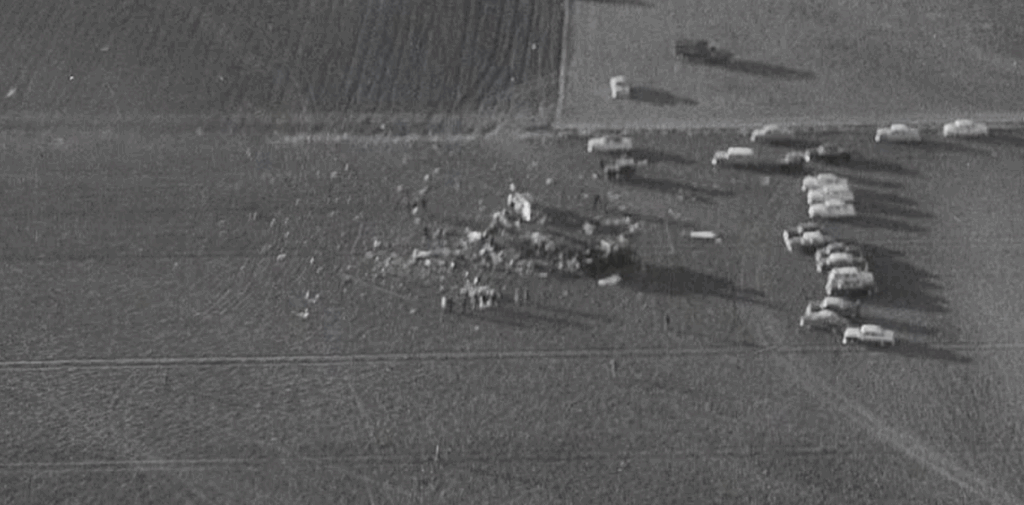
The six square miles of farmland where airplane parts and the bodies of 44 passengers and crew were scattered on Nov. 1, 1955, were cleaned up by Christmas. That Spring, farmers planted their crops on the land as if nothing ever happened.
One of them was so spooked by the horror of the lost souls on his land that he never again ventured near the site after dark.
Because Flight 629 originated in New York and had several stops across the country, the travelers were from all over and mourners stayed put.
Not a wreath, a plaque or a prayer
The death of their parents felt as if “the bombing was our own private event,” for 12-year-old Susan Morgan and her teenaged sister, who ended up as wards of the state because of family complications.
Saturday, Morgan will be among 100 relatives who will gather to pay tribute to a memorial dedicated to the victims of Flight 629 at the FlyteCo Tower, the air traffic control tower building at the former Stapleton International Airport site in Denver’s Central Park neighborhood.
“All of these people have never met each other and they don’t have anything in common other than this horrible thing,” said Mike Hess, with the Denver Police Museum, one of several volunteers who spent the last three years finding families and drumming up awareness. History Colorado is hosting a special display.
The dedication, which starts at 11 a.m. Saturday at the former airport tower where the doomed flight began on Nov. 1, 1955, is open to the public.
Flight 629 originated in New York, made a stop in Chicago, hopped into Denver and was eventually headed for Anchorage, Alaska, via Portland and Seattle. This was post-World War II and among the passengers was a veteran who was shot down over France and rescued, an aide to President Dwight Eisenhower and a young boy.
In Anchorage, a soldier who had been stationed in Japan waited anxiously to meet his 14-month-old baby for the first time. One of the passengers had recently learned she was pregnant.
“These families were torn apart and none of them have even seen where it happened,” said Conrad Hopp, who was fresh out of high school and first on the scene when the fireball came roaring toward his house. It was such a horror show, the father of four could not talk about the bodies that fell from the sky in the seasons after the crash. “I was haunted by it for years.”
‘SOMETHING TERRIBLE HAS HAPPENED’
People driving on unlit rural roads east of Longmont, Colorado say the explosion of Flight 629 was so bright, it illuminated the sky — first a white blaze and then yellow. It was just after 7 p.m. Nov. 1, 1955. The “Denver Mainliner” had taken off from Stapleton International Airport at 6:52 p.m. and it’s last transmission occurred four minutes later.
From six miles away, five-year-old Philip Bearly — riding in the back seat of his parents’ car on the way to a birthday party — thought the explosion was a meteor.
“But then we watched the flames melting down the sky. It was a ball of fire,” Bearly, now 75, remembered. “My dad immediately said ‘Something terrible has happened. They’re going to need help out there.’”
The family car tore through the countryside and ended up in a field where remnants of the plane lay scattered and burning, some of it embedded by the impact 30 feet into the recently-harvested soil.
Townsfolk who saw the flash in the sky began to show up too, some curious and others in a mad rush to steal watches and wallets, or pieces of the plane. Bearly, 75, remembered that the location was so remote, a lone police officer gave his dad a gun and asked him to shoot on site.
Right off, Conrad Hopp suspected the explosion was no accident. He smelled dynamite, familiar because he used the sticks to get rid of unwanted trees on the family property.
Hopp’s sense of smell was right on.
The bombing, which killed 39 passengers and five crew members was later determined to have been caused by dynamite planted in a piece of luggage. The bomb was hidden in a suitcase which belonged to the bomber’s mother and disguised as a gift which he told his mother was a sea shell polisher.
Investigators said John Gilbert Graham planted the dynamite and a timer in order to collect insurance money.
He watched from 30 feet away as his mother, Daisie King, paid extra for her heavy Samsonite suitcase at the United Airlines counter, bought a quick insurance policy on her life at the airport and took his family to breakfast.
SABATOGE AT 10,000 FEET
The Douglas DC 6B was in perfect mechanical shape upon its last inspection and terrorism of this kind was so farfetched in 1955 that there were no laws on the books that made it a crime to blow up an aircraft.
Former FBI Director J. Edgar Hoover told investigators to inspect every piece of luggage for evidence; however, only King’s was blown to bits. In King’s handbag they found a newspaper article that said her son was wanted for forgery. FBI investigators soon found out that Graham, 23, was seething with rage over her childhood rejection of him. When King gave birth out of wedlock in 1932, she gave him to an orphanage, but he often ran away to be with her, only to be sent back.
In total, he took out four insurance policies on King worth more than $37,000.
The coincidences were enough that the FBI asked him to come in to identify the contents of his mother’s luggage and he said that he would be happy to help.
In the early morning hours of Nov. 14, after 15 hours of intense interrogation in which he was caught in conflicting statements, the bomber signed a written confession.
“I placed in the trunk of my 1951 Plymouth Sedan twenty-five sticks of dynamite, 40-60 per cent, a timing device, and an Ever Ready six-volt dry cell Hotshot battery and two dynamite caps with about eight feet of wire attached to the caps. All of this was placed in a cardboard box…” he said. He told agents that he spent $20 dollars on the timer, $14 for the dynamite, $1.50 for the primer caps and a few dollars for the battery.
Later he would recant his confession but the evidence was too overwhelming to make a difference.
The defendant was charged a single count of first-degree murder of his mother in a trial which would be the most sensational Colorado had ever seen and was the state’s first ever to allow cameras in the courtroom.
The case was tried in Denver District Court because the crime occurred at the city’s airport where the bomber transferred the deadly suitcase to his mother.
On Jan. 11, 1957, just over a year after the bombing, the 44-time murderer was executed by gas chamber.
In 1955, there was no federal law which prohibited targeting a civilian aircraft. The demise of the Denver Mainliner led to changes in aviation safety and investigative techniques, according to an FBI proclamation honoring the two agents who led the investigation.
One of them, former Marine Roy Moore, was assigned to Birmingham in 1964 to solve the Mississippi Burning case which was depicted in the movie of the same name.
President Dwight D. Eisenhower was recovering from a heart attack in Denver when the explosion happened and he was particularly consumed with the crime. In July 1956 he signed a bill which made the intentional bombing of a commercial airline illegal.
UNSUNG HEROES
From one of Colorado’s worst moments sprang home-town kindness. Philip Bearly owns a note from a Colorado State Patrolman thanking his father Clayton, the longtime manager of Johnson’s Corner, for the coffee which kept his insides warm while hauling wreckage on those cold November nights.
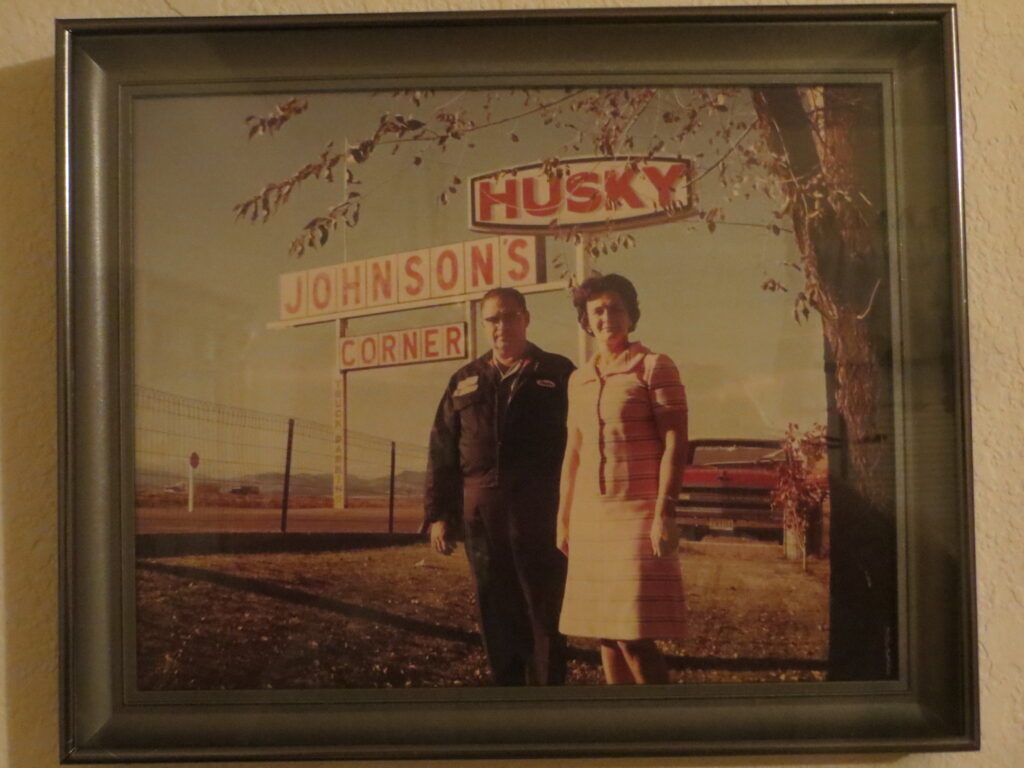
“Dad called out off-duty cooks, waitresses and food suppliers out of bed to make coffee, bacon, eggs and bread. He told the coffee supplier to bring the biggest urns they had,” said Bearly. “I remember him pulling away with those urns in the back of his pickup.”
The multi-pronged law enforcement operation investigated by Denver and Longmont police, Weld County Sheriff’s Office, the Civil Aeronautics Board and the FBI.
For years, crops would not grow where the bodies fell.
Choked to silence for years, Hopp now speak up for the victims whose memories were all but erased. His aim now is to fund a memorial on the site, which is now dotted with new houses and streets. When he went to the Weld County Commissioners for funding, none of them had heard of Flight 629.
“It’s an important part of our state’s history and people need to be aware of it,” said Hopp. After 70 years, sleep comes easier to him. “Folks finally grabbed the bull by the horns. To me it’s like a dream come true.”