







Taken to (art) school by a couple of kids
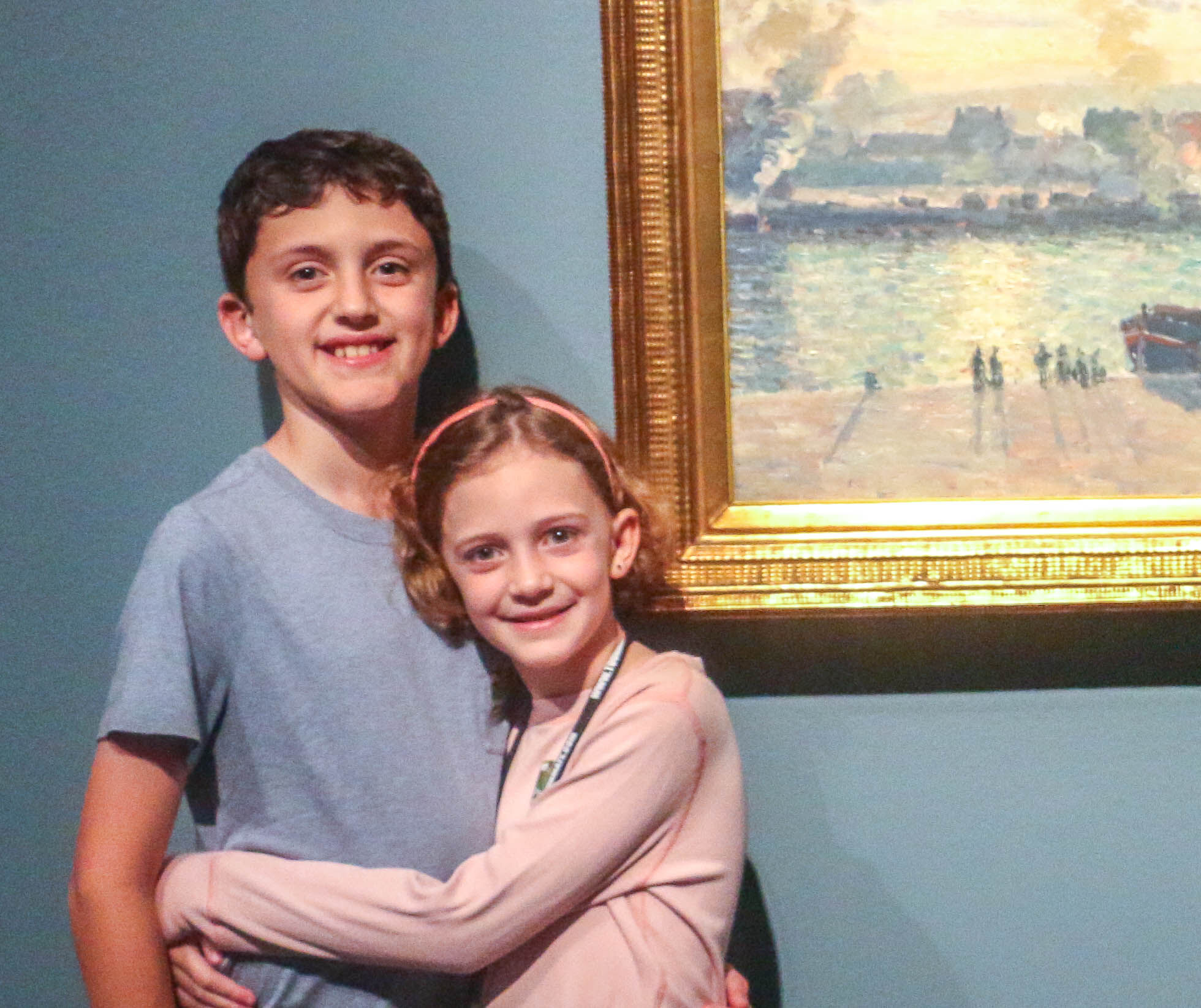
Siblings, ages 9 and 10, unlock the mysteries of French Impressionist Camille Pissarro, subject of a major exhibit the Denver Art Museum
When it comes to the artist Camille Pissarro, I am not smarter than a fifth grader. But I am smart enough to ask a fifth grader.
I’m not going to lie: When I first heard the Denver Art Museum was opening a blockbuster new Pissarro exhibit, I wondered how anyone could so badly misspell “Picasso.”
We all have our strengths. As a journalist, mine are in 25 years of covering the performing arts. The visual arts? Not so much. So, when I was invited to observe the opening of the first major Pissarro retrospective in 40 years, faking my way through was not an option. That’s a ticking time bomb that’s bound to go off like a dye pack in a stolen bag of cash. (Now there’s a visual. Talk about art!)

No, if I was going to do this thing, I was going to do the smart thing by admitting how dumb I am.
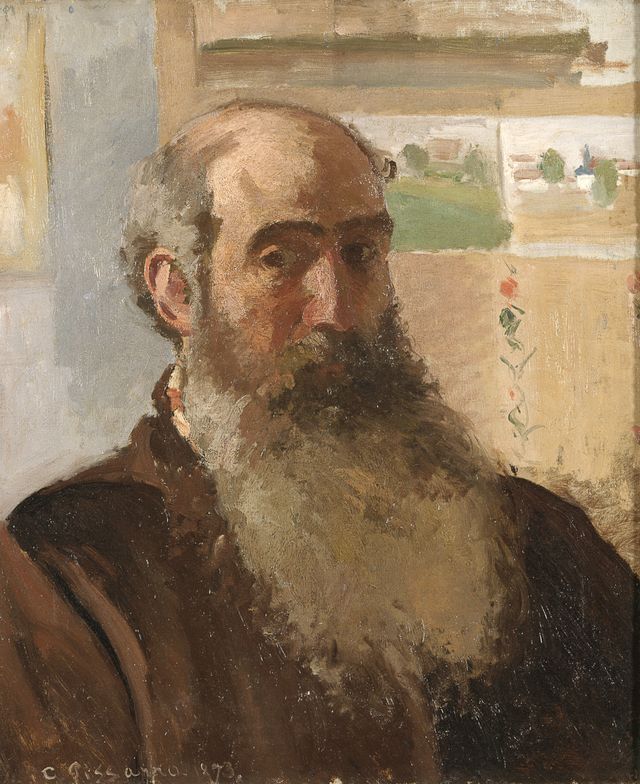
Ironically, this exhibit is called “The Honest Eye: Camille Pissarro’s Impressionism,” and if you ask me, when it comes to art, the most honest eyes are those attached to children. So, with the help of DAM Media Relations Senior Manager Andy Sinclair, I set out to find a kid (or two) to school me on Pissarro.
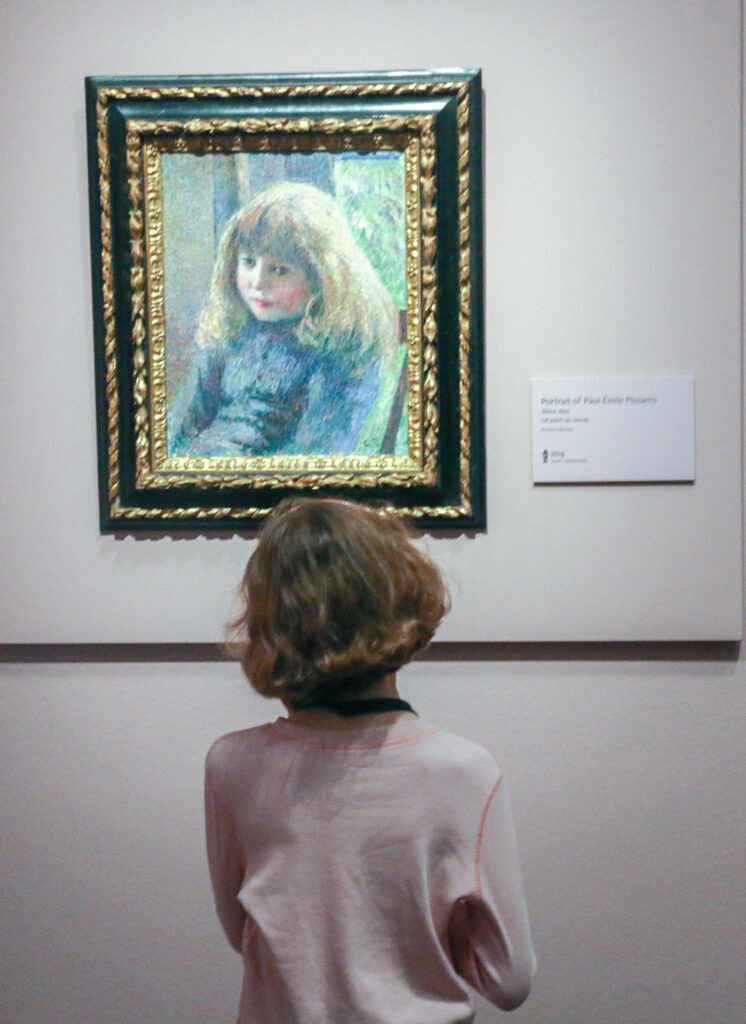
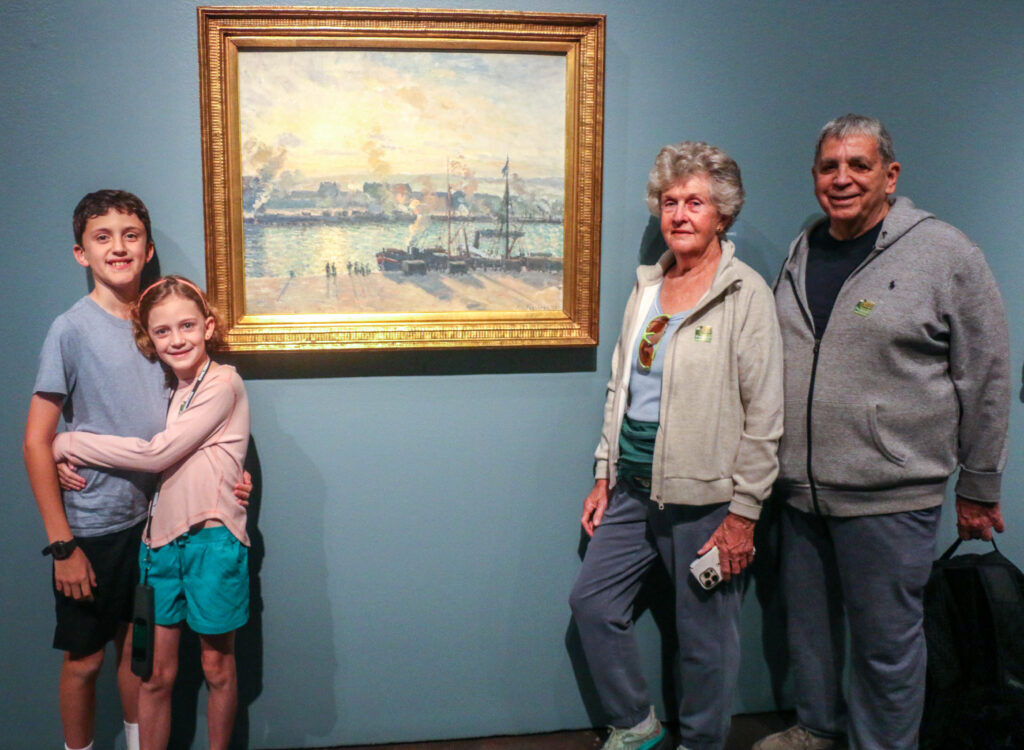
Then, as if ordered out of an art catalog, they appeared before me on the canvas of real life: First, we noticed young Aila Fordham, age 9, gazing intently into a portrait of Paul-Émile Pissarro, the artist’s son, as a 6-year-old boy. She was soon joined by her 10-year-old brother Roan (“no w”!), who already has since turned 11. They were enjoying a Friday morning outing at the museum with their grandparents, Mary Pat McFadyen and Roderick Nasbe, who do this sort of thing with their grandkids, they say, three or four times a year.
They moved to Denver from Charlottesville Va., five years ago, in fact, just to have family days like today.
These kids seem different to me. They’re siblings who are polite, thoughtful and kind – even to each other. And, it turns out, wicked smart. This family would be the perfect subjects for a Rembrandt portrait.
My first question for them, naturally, was: “It’s a Friday. What are you doing out of school?” (It was a joke.) I mean, seriously, what better field trip could any kid take than to an art exhibit with their grandparents?
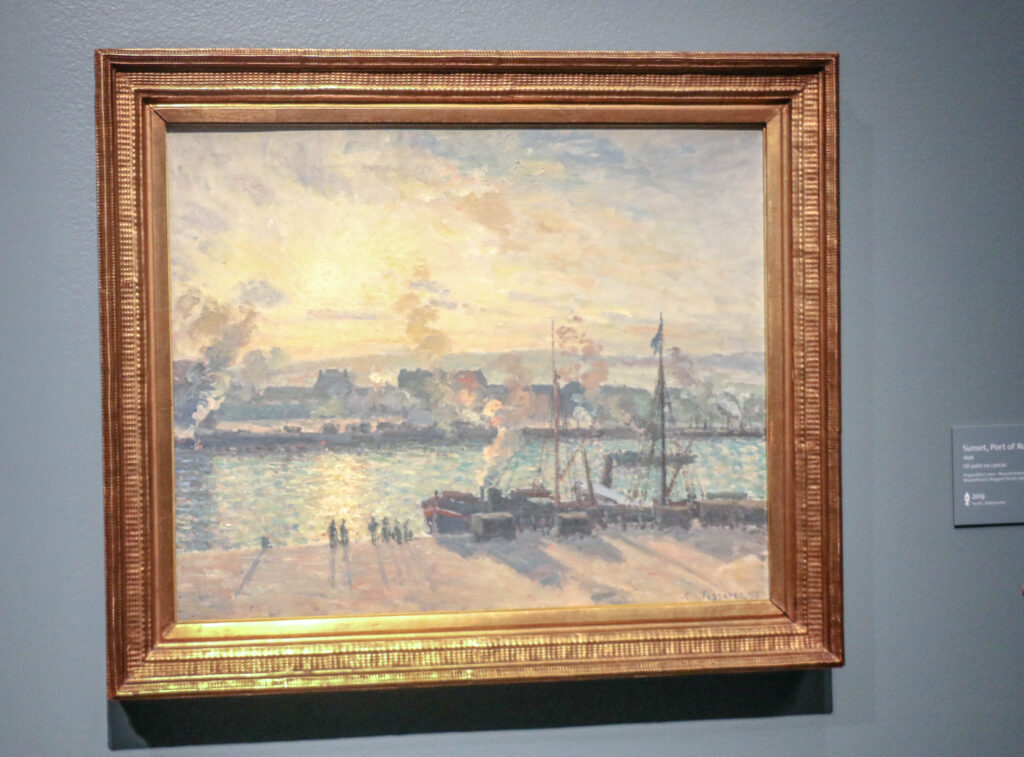
I asked the sibs to look around at the more than 100 Pissarro paintings presently hanging on the DAM walls (through Feb. 8) and pick one for us to chat about. They gravitated to an intriguing, intimidating, dreamlike painting called “Sunset, the Port of Rouen (Steamboats).”
It was painted in 1898 and depicts a bustling industrial port in Rouen, France. It shows steamboats, industrial smoke and harbor buildings against a setting sun. It is considered a tour de force painting for the way it captures and contrasts light and atmosphere, for its dynamic composition, and for how it blends urban industry with nature by using vibrant, broken brushstrokes. I know this because it says so on the wall next to the painting.
Read more: ‘Pissarro was a cool guy,’ says DAM director Christoph Heinrich
The artist apparently painted this masterpiece from a window in the nearby Hôtel de l’Angleterre overlooking the Seine River. It usually lives at the National Museum Cardiff in Wales.
I asked Roan what struck him about it. “Just the way he made the smoke coming off of the ships,” the boy told me, “and the way he did the sunset reflecting on the water.”
He told me that this painting perfectly demonstrates the artist’s overall Impressionistic style.
There was that word I kept hearing.
“OK, I am just going to come clean here,” I told my art mentors. “I know that Pissarro is considered the first Impressionist. I know this because it says so in the press release.
“So. Impressionism. … What does that even mean?”
I went to the right teachers.
“To me, impressionism is when you’re not trying to make everything look perfect and get all the details just right,” Aila told me. “And yet, you can still look at this painting and say, ‘Hey, that’s a ship. That’s smoke. That’s a sunrise.’”
I thought, woah. I actually understand what she said. Thanks, 9-year-old.
Then Roan actively demonstrated a rather effective active teaching technique.
“One of the cool things I have noticed about Impressionism is that if you move right up close like this, the paint just looks like a bunch of splotches,” he said. “But when you step back, the picture makes more literal sense. The farther away you get, the more specific it looks.”
I never would’ve picked up on that. Thanks, soon-to-be-11-year-old.
Aila then pointed out to me that Pissarro produced several paintings from pretty much this same vantage point. The one hanging right next to our chosen painting, for example, looked strikingly similar to me, even redundant. Why would they put two such similar paintings right next to each other, when the wall space here is so valuable?
“Because they want us to compare,” Aila said. There are important differences – and she showed me how to look for them.
“The paintings are essentially the same,” she said. “But this one’s really cold, and it looks like it might be snowing. While this one looks like it’s summer.”
This is clearly Aila’s jam.
“I like noticing how the paintings look different depending on what angle you are looking at, and what time of year it is,” she said.
She went on to inform me that, as Pissarro got older, he couldn’t physically move very far from his room to paint, so he kept returning to favorite places that were near to him. Like this port.
What do you know? Pissarro wasn’t all that different from any of us taking multiple photos of the same thing with our iPhones. But what we were looking at here was no snapshot. It was art.
“Now, if this were a photograph, I might be like, ‘Oh, those are just boats,’” Aila said. ”But because I’m seeing it in a painting, I can see how he made the smoke that’s coming out of the ships. How the sunrise struck the clouds of smoke. How he made the clouds kind of colorful.”
Just in case I forgot to point this out – she’s 9. And she was just getting started. Aila finds it interesting, she said, that Pissarro was the only major Impressionist painter to experiment with Pointillism, and the freedom that came with that.
“He didn’t use Pointillism the way that everybody else thought Pointillism was,” Aila said. “He used his own method of Pointillism, with little tiny brushstrokes. I feel like I like his way better than the others because his way is more Impressionistic.”
I am so out of my depth. “OK, so how long have you known about Pointillism?” I asked.
“Oh, about the last 20 minutes,” her brother teased, which drew a swift rebuke.
“No, I learned about Pointillism a long time ago,” she insisted. “Like, when I was 5ish.”
Safe to say: Longer than I have.
For the record, I did ask one person over the age of 11 to also help me to help you to understand why this exhibit is a big deal. I met Clarisse Fava-Piz, who has a job title so long Pissarro would never be able to fit it on a single canvas. (She is the Denver Art Museum’s former Assistant Curator of European and American Art Before 1900.)
I asked her the same thing I ask any live theater director who stages a 400-year-old Shakespeare play: What is the urgency for this exhibit now, in 2025? Why should someone who knows nothing about Pissarro want to come down and check this exhibit out?
“I think people will like getting to know Pissarro because he’s both an insider and outsider – and you cannot put him in a box,” she said. “I think people will be surprised to learn that he was very much a modern man of his time and a contemporary artist who was considered a bit of a rebel because he depicted the ordinary people around him – and that was considered very political for that time.”
He was also impossible to pin down. While Claude Monet was painting water lilies and Edgar Degas was painting ballet dancers, Pissarro was painting landscapes. Portraits. Cityscapes. He was an experimenter who changed styles throughout his life. “That’s part of what made Pissarro an anarchist with an artist’s sympathies for the common man,” said Fava-Piz, “and I think people will find that to be still very much relevant to a lot of contemporary artists today. I think Pissarro’s life and his art tells us all that political art is not something new.”

As I started to say goodbye to the Fordham-McFadyen-Nabe family, I asked the grandparents why it was so important for them to expose Roan and Aila to art – and art history – from their earliest ages.
“Well, I’m a bit of an artist myself, and they are now junior artists as well,” said Rod. “We try to be as creative as we can be in all kinds of ways.”
This conversation was taking place on Oct. 24, so you know what that means: Halloween pumpkin carving.
“I’m making a bat, which is really hard,” said Aila. And her brother? “I went for the classic triangular eyes, triangular nose and a smiley mouth,” he said. “And then on the other side of the pumpkin, it just says, “Spooky.’”
But their medium of choice, make no mistake, is not pumpkin but watercolor. “Tell him about your project at school,” Grandpa told Aila. (That would be the Denver International School.)
“Oh, yes,” she said. “So we have an ‘I Can Do Hard Things Project’ – and you can do whatever you want, as long as it is hard for you. I picked painting. So I have to do 30 paintings in 30 days. And it’s really fun.”
Clear some wall space, Denver Art Museum.
I asked Aila: ‘What’s your style? Are you an Impressionist, too?”
“Sometimes,” she said. “I like to paint real things.”
Her grandmother interjected: “I would call her an experimenter.”
Of course. Just like Pissarro.
‘The Honest Eye: Camille Pissarro’s Impressionism’
• What: The first major U.S.museum retrospective of Camille Pissarro’s oeuvre in more than four decades.
• When: Through Feb. 8
• Where: Denver Art Museum, 100 W. 14th Avenue Parkway
• Tickets: $5-$35 at denverartmuseum.org