





Disaster drill tests Denver’s response to widespread power outage
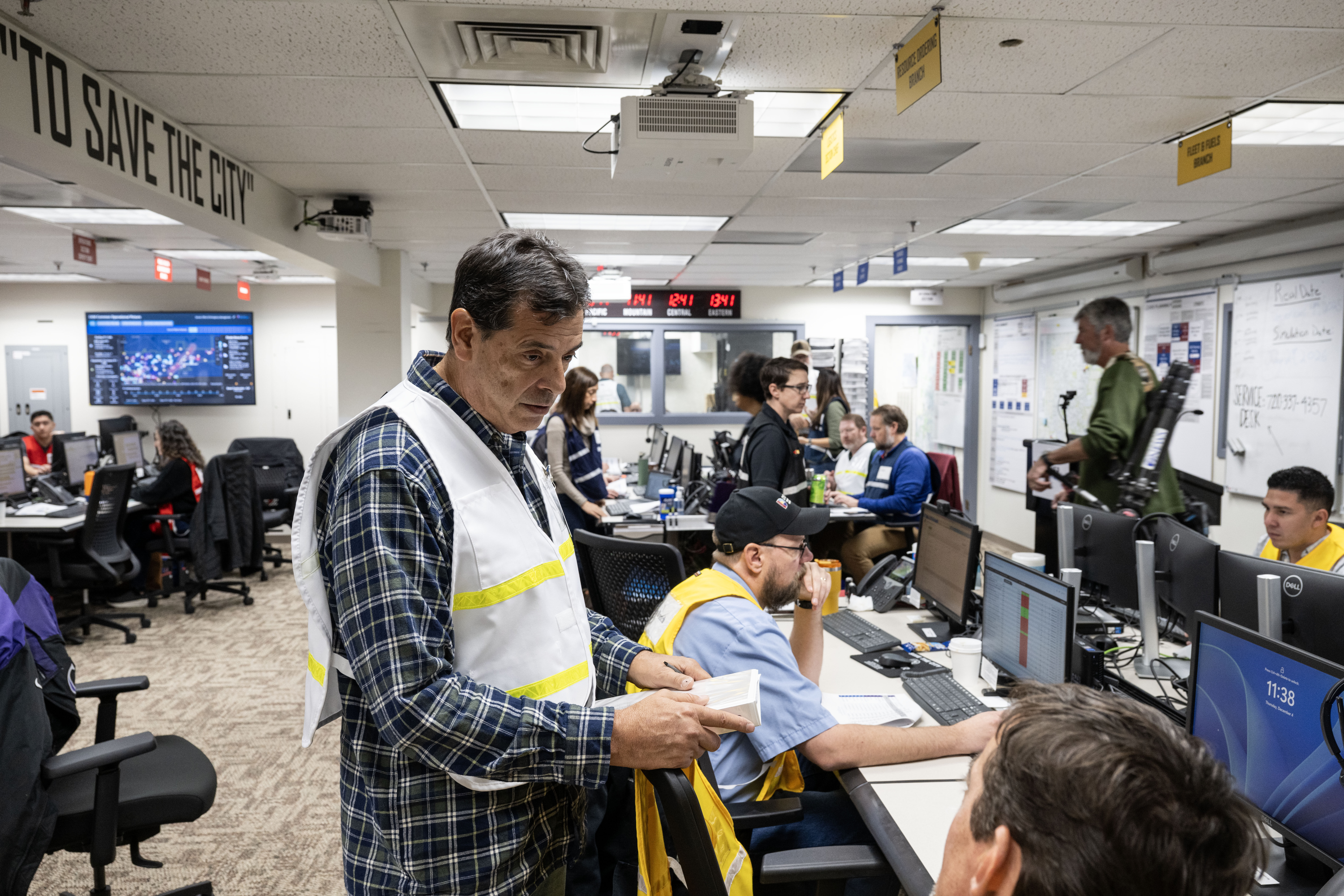
What if, on a hot summer morning, a powerful tornado were to touch down in central Denver, leaving a widespread path of damage, creating a prolonged power outage across most of the city, and possibly the airport?
That’s exactly what the city’s Office of Emergency Management, along with close to 140 participants and agency representatives, aimed to find out on Thursday as “Denver Mile High Ready 2025” got underway deep in the basement of the city government building.
Denver’s emergency management experts and city partners gather regularly to study, test, and evaluate how the city — and its available resources — would respond to a large-scale disaster.
“One of the things that I wanted to get out of this particular exercise, because it’s a growing concern of mine, is (response to) a long-term widespread power outage,” Denver Emergency Management Executive Director Matt Mueller said.

Nestled inside the city’s Emergency Operations Center, exercise participants from law enforcement, transportation and infrastructure, weather, housing, medical and other organizations work amid computers and phones to handle the simulated disaster.
While many of the simulated problems “injected” into the training scenario may seem far-fetched given the compressed seven-hour timeframe, they are designed to challenge the present and refine the future.
Such exercises are often required for the city to maintain accreditations and meet various government and grant requirements, but they also offer essential, localized benefits.
Exercises provide an opportunity for the city to strengthen coordination between agencies, test new processes and identify gaps, said Loa Esquilin-Garcia, communications manager for the Denver Department of Emergency Management.
Those gaps can range from communication between public and private sector partners to resource shortages to missing or insufficient elements in responder training.
The city’s coordinated response to local news media is also put to the test.
For Xcel Energy, the event offered the opportunity to improve awareness and coordination with the city.
“The scenario simulated today is that a tornado touches down in unincorporated Adams County, in the far northeast corner of the city, which impacts our equipment,” Grace López Ramírez, Xcel’s senior manager of government affairs, told The Denver Gazette. “This would impact our (electric) transmission and distribution lines … a transmission line that goes down 56th Avenue from east to west, and then a substation.”
Such an event, López Ramírez estimates, could take anywhere from three to seven days to restore power, depending on the severity of the damage.
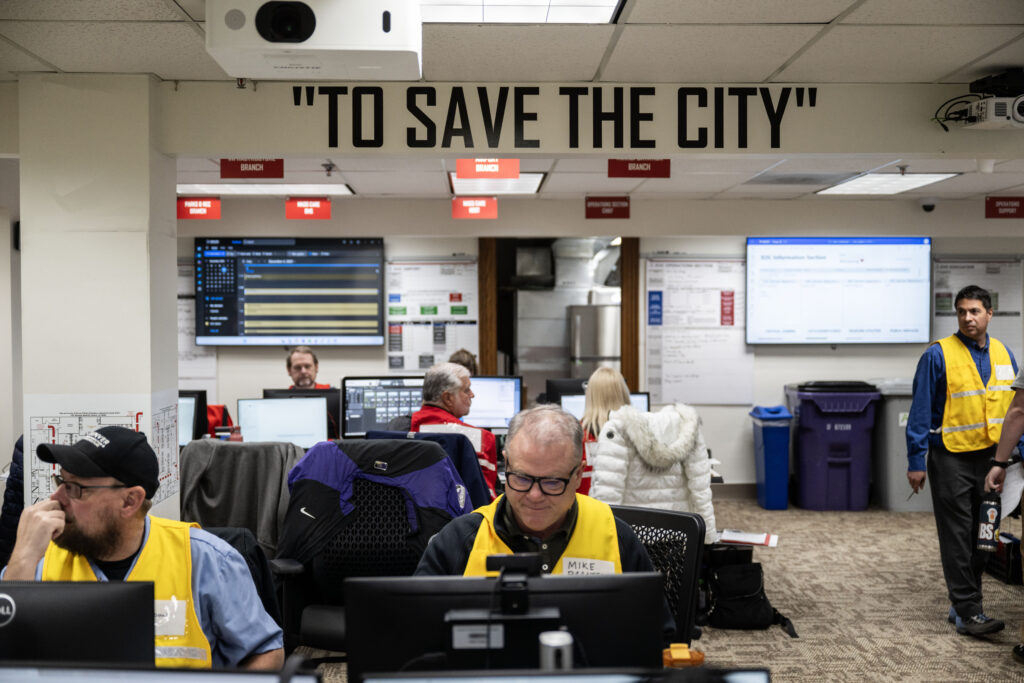
“Exercises, like today, help us identify any gaps in the coordination and planning to ensure that we are able to energize that critical infrastructure that the city needs, not just for traffic control, for, you know, critical entities like local hospitals, and rec centers that might be being used for unification,” she said. “So what Xcel is doing in this particular exercise is looking at how to most safely and efficiently bring assets back online in a coordinated effort that benefits all of the stakeholders.”
Elsewhere, at the joint information center, public information and media relations personnel from different agencies vetted and coordinated the release of information to the public and simulated media outlets.
Major agencies participating in the exercise include the Denver Department of Public Health and Environment, Xcel Energy and the American Red Cross.
A lot of planning and effort goes into a functional exercise, such as this, Mueller said, with exercise designers creating detailed scripts with a specific sequence of events to test responses.
Funding for exercises is included in OEM’s annual budget.
So, how did the city do?
That will come later, Mueller said.
“We will have a better answer to that in a few weeks once we get all of the feedback,” he said. “We take all of that, we roll it up, and we create an after-action report which identifies some of those gaps and things we need to get better at.
“This is why we practice, so we make the mistakes now and not when the real thing happens.”


Judge denies motion from Gov. Jared Polis to dismiss ICE lawsuit from former state employee
Marianne Goodland
marianne-goodland@denvergazette.com
Updated 21 minutes ago
A Denver District Court judge has denied a request by Gov. Jared Polis to dismiss a lawsuit filed by a former state employee over disclosure of information to federal immigration authorities. The lawsuit filed against the governor by Scott Moss,...

Marianne Goodland
Reporter

Once a step ahead, Colorado’s economy cools, burdened by rising costs and regulations | FISCAL ROCKIES
Thelma Grimes
thelma.grimes@coloradopolitics.com
Updated 4 hours ago
Editor’s Note: Once among the nation’s fastest-growing economies, Colorado today confronts mounting challenges that threaten its momentum. This series reveals how a state once defined by prosperity is navigating economic cliffs and ridges. We explore the impact of increased regulations, tariffs,...

Thelma Grimes
Reporter

Council will consider $27M contract for Denver police body cameras, tasers
Deborah Grigsby
deborah.smith@denvergazette.com
Updated 6 hours ago
It’s been close to 10 years since the Denver Police Department first donned body-worn cameras in January 2016, and technology has advanced since then. The Department of Public Safety is asking the City Council to approve a new five-year, $27...
Deborah Grigsby
Reporter

Income tax overhaul in Colorado clears first hurdle, as revised estimate puts tax hike at $4 billion
Marianne Goodland
marianne-goodland@denvergazette.com
Updated 22 hours ago
A state panel on Wednesday gave the go-ahead to a ballot measure that seeks to change Colorado’s flat rate of 4.41% to a graduated income tax, beginning in 2027, and raise billions dollars in new revenue. Now the proponents of...
Marianne Goodland
Reporter

Colorado Higher Education Director Angie Paccione to step down
Marianne Goodland
marianne-goodland@denvergazette.com
Updated 2 days ago
Angie Paccione, who has led the Colorado Department of Higher Education since 2019, is returning to the private sector, Gov. Jared Polis said. Paccione’s last day is Jan. 9. The governor’s office said Gov. Jared Polis would decide on the...
Marianne Goodland
Reporter

Trump administration says it will withhold SNAP from Democrat-led states if they don’t provide data
Darlene Superville
darlene.superville@associatedpress.com
Updated 1 day ago
WASHINGTON (AP) — President Donald Trump’s administration said Tuesday that it will move to withhold SNAP food aid from recipients in most Democratic-controlled states starting next week unless those states provide information about those receiving the assistance. Agriculture Secretary Brooke...

Darlene Superville
Reporter

Colorado title board to review graduated income tax proposal for 2026 election
Marianne Goodland
marianne-goodland@denvergazette.com
Updated 2 days ago
The Secretary of State’s title board on Wednesday will review another attempt at a graduated income tax ballot measure for the 2026 general election. In October, the title board had rejected two proposals submitted by the Bell Policy Center because...
Marianne Goodland
Reporter

Denver City Council approves $600 million for DOTI on-call services
Deborah Grigsby
deborah.smith@denvergazette.com
Updated 2 days ago
A cluster of close to 55 resolutions – totaling $600 million for contracts to provide on-call services for the city’s Department of Transportation and Infrastructure won council approval Monday. However, two resolutions tied to the city’s homeless operation were tabled...
Deborah Grigsby
Reporter

Funeral for Sen. Faith Winter will be held Friday at the Colorado Capitol
Marianne Goodland
marianne-goodland@denvergazette.com
Updated 1 day ago
Colorado Sen. Faith Winter will be remembered on Dec. 5 at 2 p.m. in a funeral service on the state Capitol’s west steps. A celebration of life reception will follow. Winter died on Wednesday, Nov. 26, in a three-vehicle accident...
Marianne Goodland
Reporter

Dean alleges firing over opposition to book ban in Elizabeth School District
Deborah Grigsby
deborah.smith@denvergazette.com
Updated 1 day ago
A former Elizabeth Middle School dean of students has filed a lawsuit in federal court alleging she was terminated because of her opposition to the district’s book ban policy and her advocacy against “racism” in the school. On Nov. 30,...
Deborah Grigsby
Reporter
