








COLUMN: Turning Aurora’s strength into jobs, growth

Ask a typical voter what “economic development” means and you’ll often get the same answer: a vague sense of backroom deals, developers in suits, and politicians cutting ribbons in front of buildings most residents will never walk into. It’s easy, in that fog, to assume the winners are always the “big guys” and the losers are ordinary taxpayers.
Spend an hour with the Aurora Economic Development Council, and that picture changes.
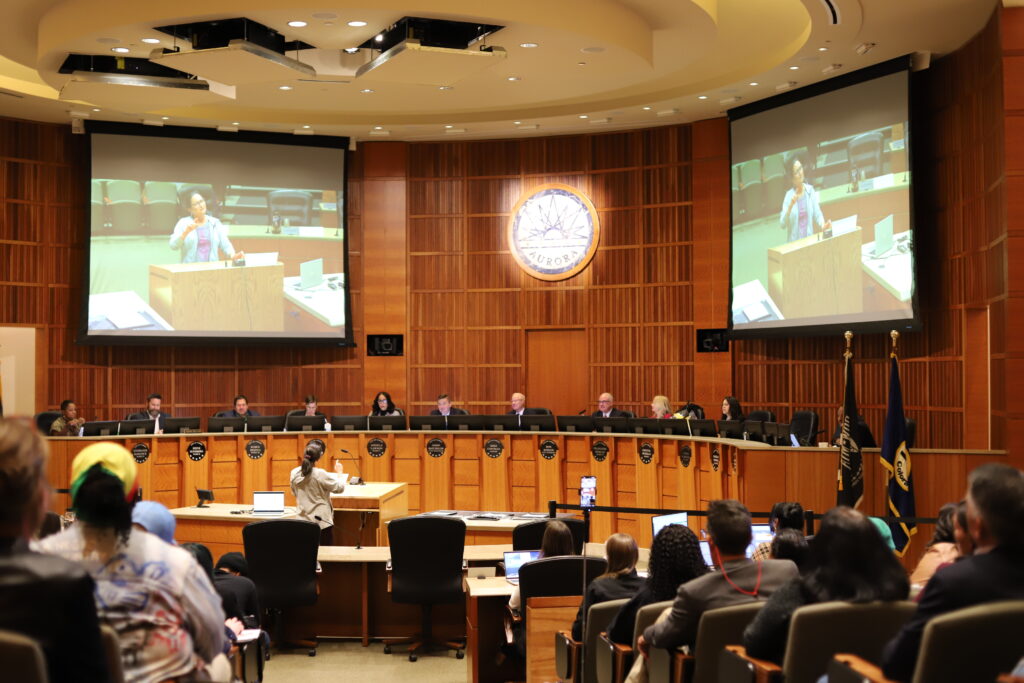
Wendy Mitchell, the AEDC’s president and CEO, starts with a deceptively simple sentence: “We bring jobs to Aurora.” Not shoppers. Not boutique restaurants that shuffle dollars around Havana or Colfax. Jobs. Primary employers. As one of her colleagues put it, a primary employer is a company that brings at least half its income into the community from the outside. They expand the economic pie instead of just slicing it differently.
That distinction matters. Retail and service businesses are vital to daily life, but they largely circulate money that’s already here. A data center, a defense contractor, a manufacturer shipping product across the country — those are the firms that pull new income into Aurora, support families, and broaden the tax base that pays for roads, police, and parks.
Aurora happens to have three assets that make that job possible: land, a generally business-friendly local government, and an economic development shop that has learned how to move faster than its competitors. “We have available land, we have a business-friendly government, and we will work harder and faster than any other group out there,” Mitchell told me. In the world of site selection, that last phrase — harder and faster — is not a slogan. It’s the scoreboard.
Companies making location decisions don’t live in a world of abstractions. They live in the world of calendars and cash flow. They want to know whether they can be from dirt to doors-open by a specific date. Aurora’s pitch is simple: Tell us when you need to be open, and we’ll back into a timeline, coordinate the moving parts, and hit it. Time to market becomes our incentive.
That approach helped Aurora beat one of the most aggressive competitors in the country. When Philip Morris International chose to build a large manufacturing facility here, Florida was a primary rival — and, in Mitchell’s words, “they backed up the money truck.”
Colorado can’t and doesn’t try to compete on raw subsidy. Instead, AEDC offered certainty: power delivered, permits secured, workforce partners at the table, and support from groundbreaking through opening and expansion. PMI chose Aurora. Incentives matter, but confidence counts more.
This is where the quiet word “concierge” comes in. For a company that knows no one in Colorado, the maze of agencies, utilities, school districts, and training providers is daunting. AEDC’s six-person team functions as a single front door. They help navigate state job credits and workforce training funds, coordinate with utilities, shepherd projects through planning and permitting, and even help plan the ribbon-cutting and media.
None of this happens in a vacuum. AEDC’s “most important relationships,” she emphasized, are with the City of Aurora and the two counties it serves, Arapahoe and Adams. Without those partners, AEDC can’t do much more than make introductions. With them, the council can align planning, infrastructure, public safety, and incentives around a common goal: get the project in on time, under budget, open and paying taxes.
That partnership runs deeper than City Hall. AEDC works with the Aurora Chamber, workforce centers like Arapahoe/Douglas Works and Adams County Workforce, the Community College of Aurora, Pickens Technical College, and the Fitzsimons Innovation Community, among others. When PMI identified a gap between the workers it needed and the workers available, AEDC and its partners didn’t shrug — they helped design a training program to close the gap.
Not every job in Aurora will be at a Raytheon or a major medical campus, nor should it be. Mitchell is clear about the importance of a diversified economy. High-wage jobs in aerospace, defense, and corporate headquarters are crucial, but “not everybody can work at Raytheon. Not everyone has a PhD and can get security clearance.” A healthy city also needs manufacturing, logistics, and entry-level jobs that allow residents to get a foothold, learn on the job, and move up.
Mitchell has been at this since 2001. AEDC has been at it since 1976. In that span, Aurora has gone from a city without the Anschutz medical campus; without the E-470 corridor development; without the emerging Aerotropolis, to a city increasingly on the radar for aerospace, health care, logistics, and advanced manufacturing.
Aurora’s future doesn’t hinge on clever slogans or feel-good resolutions. It hinges on whether we keep doing the hard, unglamorous work of recruiting primary employers, delivering on our promises, and leveraging public dollars through private initiative. Or, as Mitchell put it in one neat sentence:
“Aurora succeeds when the city and AEDC work together.”
Michael A. Hancock is a retired high-tech business executive and a Coloradan since 1973. Originally from Texas, he is a musician, composer, software engineer and U.S. Air Force veteran whose wide-ranging interests — from science and religion to politics, the arts and philosophy — shape his perspective on culture, innovation and what it means to be a Coloradan.

COLUMN: Tackling insurance costs will require political courage
Mark Hillman
mark-hillman@denvergazette.com
Updated 19 hours ago
Frustrated by rising insurance premiums, Colorado drivers and homeowners are giving state lawmakers an earful. Home insurance rates in our state have grown faster since 2020 than anywhere else in the nation, according to the Wall Street Journal. With full...

Mark Hillman
Reporter

Gender debate takes a turn toward reality | Jimmy Sengenberger
Jimmy Sengenberger
jimmy-sengenberger@denvergazette.com
Updated 4 days ago
In recent years, governments and social institutions have embraced a single narrative: transgender- and nonbinary-identifying youths must be automatically and fully affirmed — no questions asked. This ideology now permits biological males to compete in girls’ and women’s sports. But...

Jimmy Sengenberger
Reporter

Dear Abby: A better answer to your question
Eric Sondermann
eric-sondermann@denvergazette.com
Updated 4 days ago
It was the beginning of October. I had been invited to speak to a class on Political Journalism at Colorado College, my old alma mater. The class was taught by none other than Vince Bzdek, the editor-in-chief of this paper...

Eric Sondermann
Reporter

Ag industry can’t surrender the keys to the Kingdom
Rachel Gabel
rachel-gabel@denvergazette.com
Updated 7 days ago
Animal agriculture, ranching, hunting, and farming are not dying ways of life. The cowboy is not about to ride off into the sunset and certain extinction. Beef is not going to be replaced by cultured meat, any variety of bugs,...

Rachel Gabel
Reporter

Perspective: Closing the hemp loophole
Diane Carlson
diane-carlson@denvergazette.com
Updated 1 week ago
For years, gas stations, convenience stores, and online shops advertised “hemp” or “CBD” candies and vapes packaged in rainbow colors and marketed with words like “calming” and “natural.” They looked harmless — even healthy — and were readily available to...

Diane Carlson
Reporter

Colorado’s Public Utilities Commission votes to suspend reality | CALDARA
Jon Caldara
jon-caldara@denvergazette.com
Updated 4 days ago
Colorado’s Public Utilities Commission has done it again — proving when regulators get together, they can create a fantasyland so detached from reality it makes Disneyland look like a documentary. Colorado’s Public Utilities Commission just adopted a new rule ordering...

Jon Caldara
Reporter
Get ready for Colorado utility bills to surge | Jimmy Sengenberger
Jimmy Sengenberger
jimmy-sengenberger@denvergazette.com
Updated 7 days ago
Gasoline may finally be hovering above $2 a gallon, but for many Coloradans, times are tough and money is tight. The holidays are a reminder of how steep groceries and basic goods are, just as winter reminds us how expensive...
Jimmy Sengenberger
Reporter

Rebutting the left’s open borders agenda | Mike Rosen
Mike Rosen
mike-rosen@denvergazette.com
Updated 1 week ago
The real, but unspoken, primary motivation of the Democrats’ Open Borders agenda, especially as it applies to Central and South America, has been to import millions of Latinos who will return the favor by voting for Democrats in the future....

Mike Rosen
Reporter

Colorado Lottery’s mega-bad idea
By ERIC SONDERMANN
by-eric-sondermann@denvergazette.com
Updated 2 weeks ago
There are plenty of lousy, miserable, misguided whims out there. Then, every so often, you come across a notion so wrong-headed that it qualifies as phenomenally bad. Or in words the marketing whizzes at the Colorado Lottery might understand, let’s...

By ERIC SONDERMANN
Reporter
New DougCo school board is off to a bad start | Jimmy Sengenberger
Jimmy Sengenberger
jimmy-sengenberger@denvergazette.com
Updated 2 weeks ago
When a new school board takes over, the handoff is usually simple: outgoing members say their goodbyes, newcomers raise their right hands, and the work begins. But in Douglas County Schools, where liberals regained the majority in November, the transition...
Jimmy Sengenberger
Reporter
PREV
PREVIOUS

EDITORIAL: More school data to inform Coloradans’ concerns
What ails public education in our state? A lot of things, say Coloradans recently surveyed on the subject — but the upshot is a general sense that our schools are on the wrong track. In fact, most of the 1,000-plus respondents to the statewide survey conducted by respected pollster Magellan Strategies said just that. As […]
EDITORIAL: Bigger name, broader mission for energy lab
When President George H.W. Bush renamed the Solar Energy Research Institute (SERI) the National Renewable Energy Laboratory (NREL) in 1991, he touted the “outstanding progress” accomplished at the Golden, Colorado facility. Bush noted the redesignation as a national lab reflected a “commitment to finding new ways to produce and use energy that is cleaner, more […]