








Rocky Mountain National Park at ‘tipping point’ with moose, embarks on plan
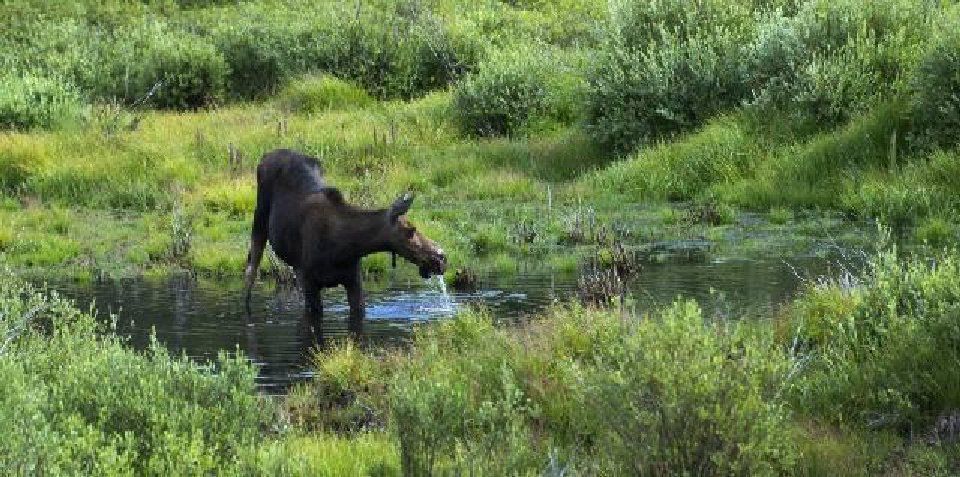
Moose’s impact on one of Colorado’s most cherished landscapes has been a concern over the years.
Now Rocky Mountain National Park officials are launching an effort to address it.
A recent webinar marked “the very beginning of this planning process,” the park’s large mammal ecologist, Will Deacy, emphasized to the virtual audience. This was in prefacing a Q and A session that would “focus on overall context and key issues rather than specific management actions,” he said.
But a plan for moose might recall specifics from the national park’s previous plan for elk, whose similarly rising numbers were found to be eating away tall willows and wiping out wetland habitat.
Most controversially, the Elk and Vegetation Management Plan resulted in sharpshooters killing 130 cow elk between 2009 and 2011, as reported during the recent webinar. That plan also resulted in fencing to block elk from some willow and other ongoing efforts to ultimately foster “a more natural migration pattern” and spread out browsing, Deacy explained during the webinar.
He presented data suggesting success in that regard, with fewer elk munching in the park year-round “while maintaining viewing for visitors.” But overall, Deacy said, the elk plan has not succeeded in recovering wetlands.
These were “biodiversity hot spots” hosting an array of birds, bugs and animals big and small, Deacy noted. And the benefits went beyond wildlife, he said, describing wetlands’ role as a “filter” for water quality and as a “sponge” guarding against flooding.
“And really importantly, they act as a firebreak,” Deacy continued.
He showed side-by-side pictures depicting a lush area from the 1960s and an altered habitat, something more like a grassland, in more recent years. “The East Troublesome fire in 2020 flew straight through this area because it was a degraded wetland,” Deacy said.
On the west side of Rocky Mountain National Park, research has determined a 98% loss of historic wetlands. That’s the side closer to North Park, where moose were delivered by helicopter in 1978 and began to spread in Colorado — including to the national park.
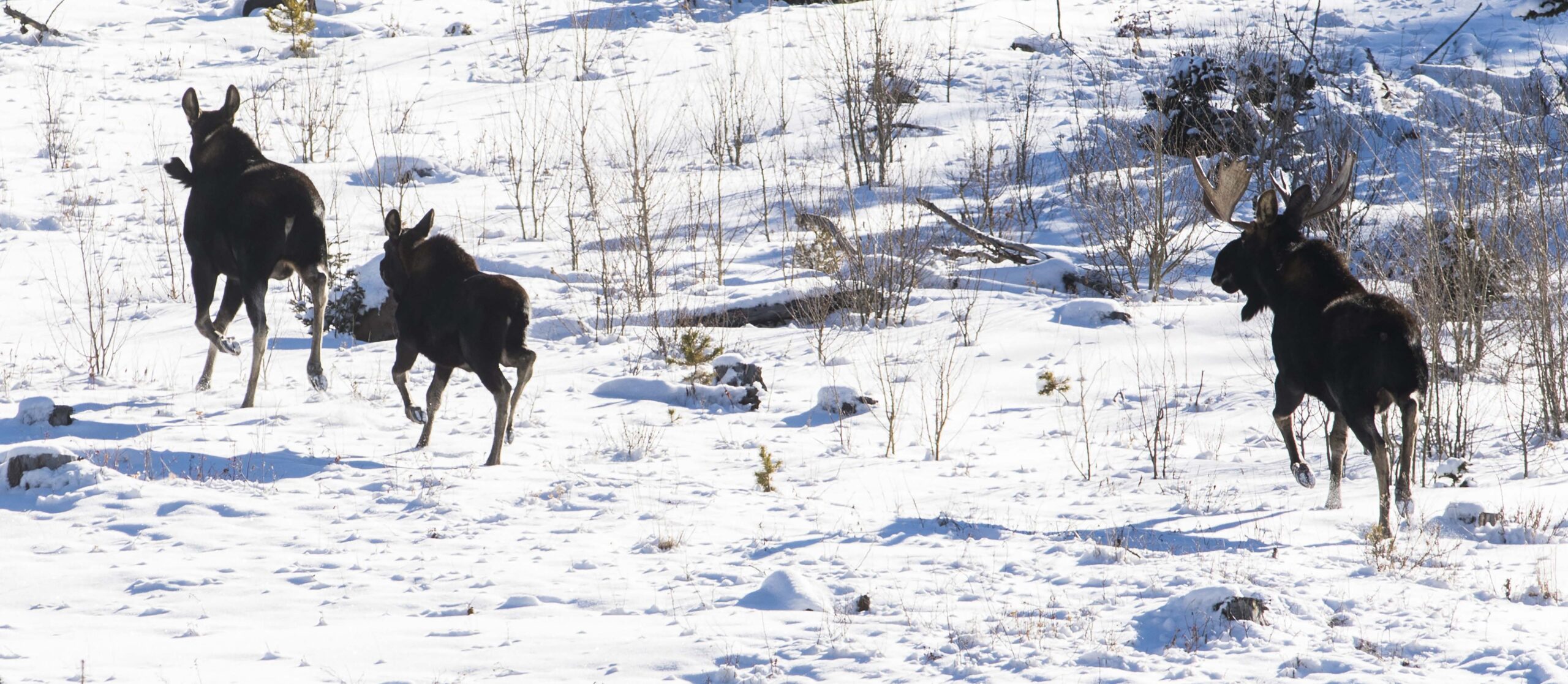
“We don’t think it’s a coincidence that willow declines have been really dramatic in the west (side of the park) where moose have been established the longest,” Deacy said. “And we are concerned that the same declines could be coming for some of the patches of healthy willow on the east side of the park and other areas of the park.”
On that east side closer to Estes Park, historic wetland loss has been tracked around 55%. That’s while the national park’s moose density has increased by 49% in the past five years, according to data presented by Deacy, who implied that increase had no signs of slowing in a place where hunting is not allowed and where the ungulate’s natural predators were extirpated long ago.
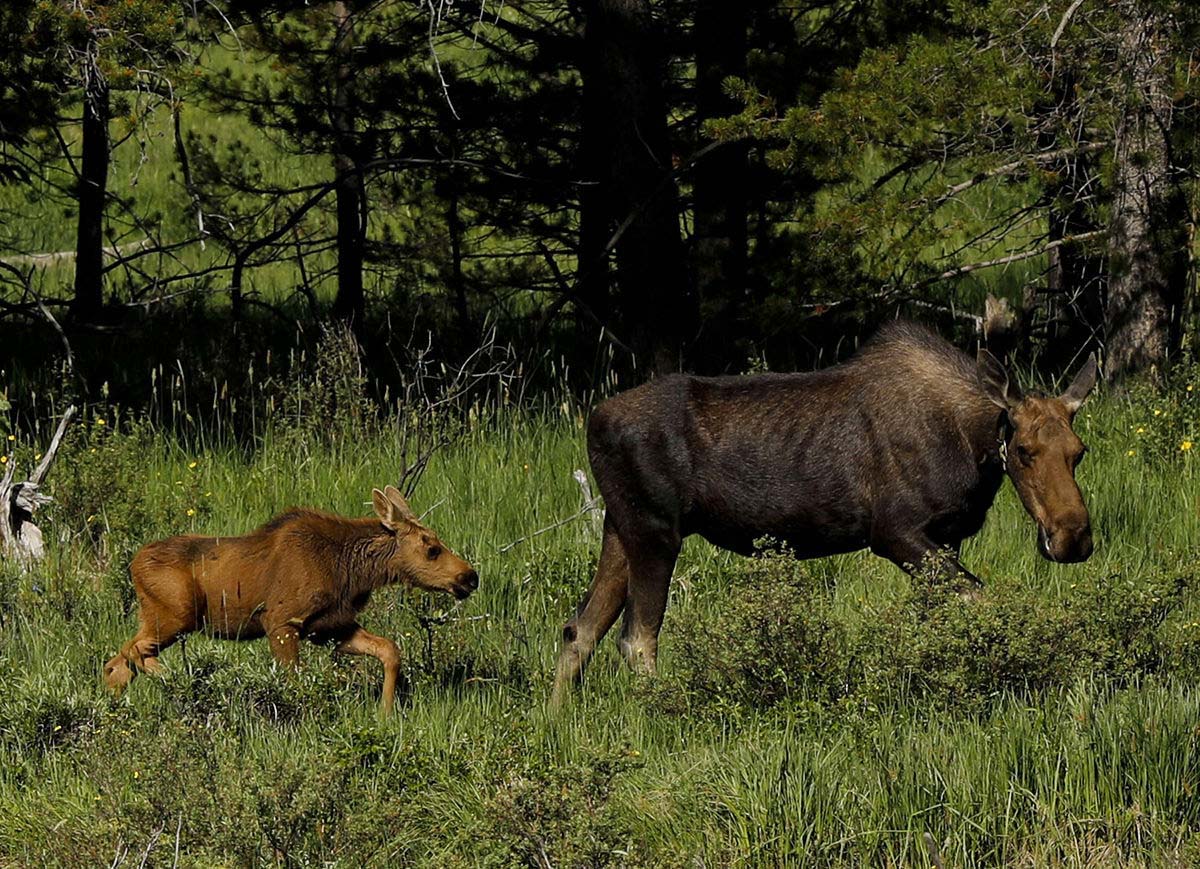
He said the park’s moose population was estimated around 240 — equaling closer to 3,600 elk in terms of willow consumption. One moose is thought to eat willow at the rate of 15 elk, research has suggested. (Ahead of the Elk and Vegetation Management Plan, the east side of the park’s overwintering population was estimated between 1,000 and 1,500.)
During the webinar, Deacy showed a visual of a threshold depicting wetland and altered grassland. “What we think has happened is we’ve gone over a tipping point,” he said.
Said park Superintendent Gary Ingram: “While moose are loved by many visitors, their increased numbers are making it infeasible to protect and restore these sensitive areas.”
The areas were once home to beavers. Counts in the 1940s found 945 of them in certain areas of the national park. More recent counts have found 12 in those areas.
“These situations are complex, but this strongly suggests that competition with elk and moose continue to limit beaver populations,” Deacy said.
The loss of beavers and their dams goes hand in hand with wetland loss; the dams keep water and thus green up valleys, and in thinning the woods for building material, beavers are credited for maintaining healthy growth. This is explained in Colorado Parks and Wildlife’s recently drafted Beaver Conservation and Management Strategy, which aims to boost populations statewide more than a century after they were decimated by fur trapping.
That draft strategy calls for translocating beavers in some parts of the state. Could that happen in Rocky Mountain National Park? It’s a common question, Deacy said in a previous Gazette interview.
“We can’t just have beavers show up, because there’s nothing to eat,” he said, alluding to that competition with moose and elk.
In the park’s western Kawuneeche Valley, attempts have been made to mimic beavers with dam-like structures. That’s while elk- and moose-blocking fences have been installed around wetlands, native vegetation has been planted and exotic species removed, Public Affairs Officer Kyle Patterson told the recent webinar viewers.
“All focused in small areas,” she said. “This management plan that we’re talking about tonight would be the first to address wetland restoration on a park-wide scale.”
And the first to address moose.
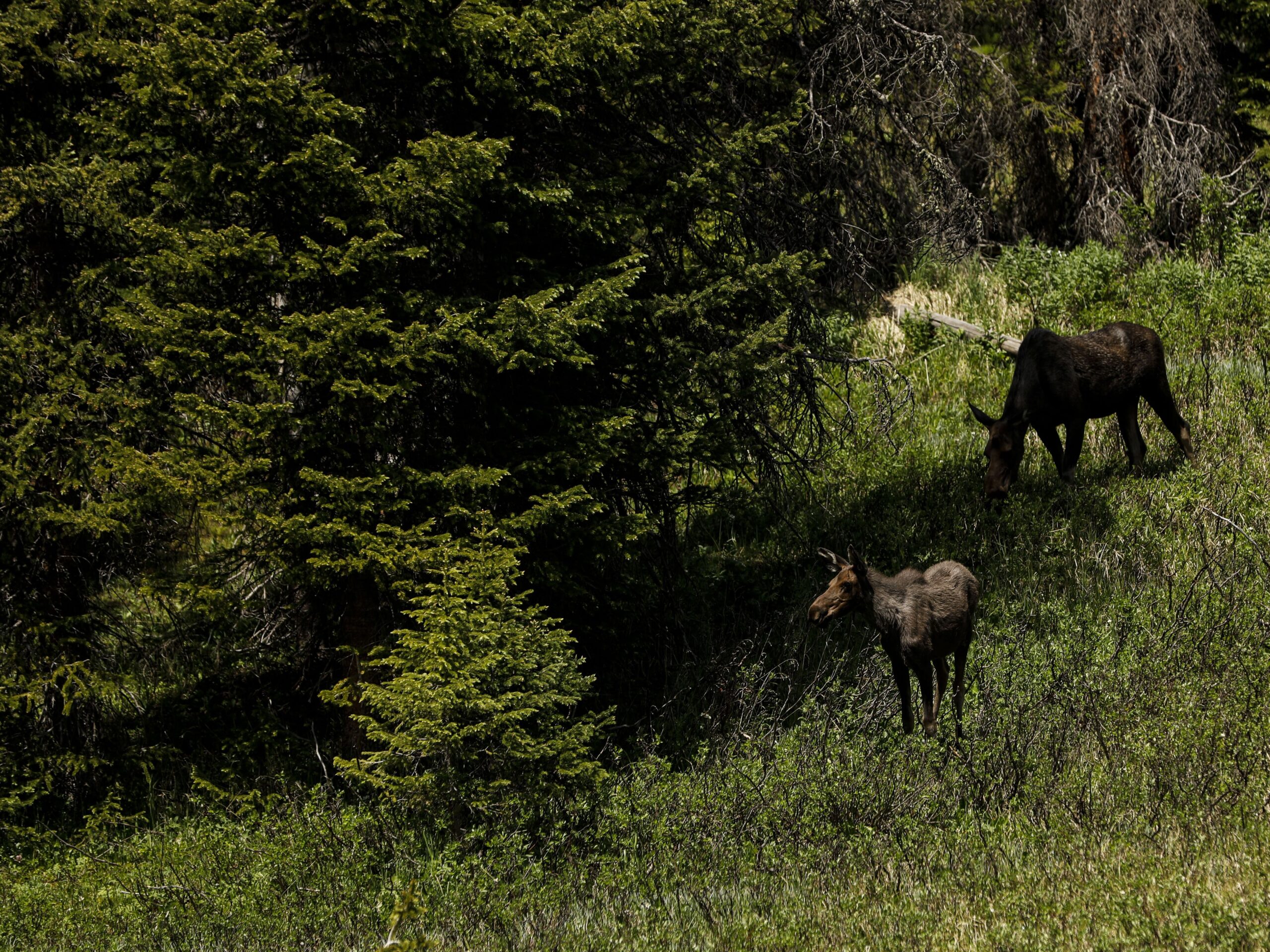
It’s another common question Deacy has heard: “Why are we meddling in these systems? Why don’t we let nature take its course? And I always reply, ‘This is not a natural situation we are in,'” he said, mentioning the extirpation of predators and agricultural ditching that also diminished the park’s historic wetlands.
“All these steps were human-caused,” Deacy said while showing that visual of a threshold between wetland and transformed grassland, “and unfortunately we are in a situation where it’s likely gonna take human action to return to this side of the threshold and let wetlands be restored.”
Human intervention has been met with pushback in other national park plans for wildlife deemed troublesome, Frank Buono said in a previous Gazette interview. He is a former National Park Service manager and contractor specializing in law and policy.
“There’s a lot of emotional affection for moose. They are magnificent, beautiful animals,” he said. “And they’re big, and they’re difficult to catch.”
Meaning roundups would be difficult — as other wildlife plans have preferred, Buono noted. Other plans have called for culling, including Rocky Mountain National Park’s 2008 elk plan, which was challenged in court by an environmental group.
Another group, Defenders of Wildlife, challenged the idea of a “moose problem” in a previous statement to The Gazette: “To the extent that Rocky Mountain National Park has issues with herbivores overbrowsing willows, young aspens, etc., that’s a ‘lack of native predators’ problem. And that problem has an obvious and natural solution — allow Colorado’s gray wolf population to recover.”
It would not be so simple even if the state’s struggling reintroduction effort proved successful in years to come, Joel Berger said in a previous interview. The Colorado State University professor has studied the return of wolves in Yellowstone while also analyzing the wetland loss in Rocky Mountain National Park, which he sees as “probably too small to even sustain the movement of one wolf pack.”
And wolves would prefer the park’s abundant elk over bigger, aggressive moose, Berger added. “And so wolves, for a lot of different reasons, are not gonna be the panacea that some people might be waiting for.”
While predicting controversy, Berger suggested it was best for Rocky Mountain National Park to not wait on a plan for moose: “What will happen is moose will eat themselves out of a home.”
During the recent webinar, the park’s superintendent insisted no specifics had been determined. “We are in the early stages of planning,” Ingram said, “and your input throughout this process will help shape effective management strategies.”
The park is taking written input through a project webpage until Jan. 8: tinyurl.com/yc3nwns5

Colorado unemployment fell to 4.1% in September, delayed data shows
Bernadette Berdychowski
bernadette.berdychowski@denvergazette.com
Updated 33 minutes ago
Colorado’s unemployment rate is improving, according to the Colorado Department of Labor and Employment. The state recorded 134,000 unemployed people in September, 4,800 fewer people compared to August. The state’s unemployment rate fell from 4.2% to 4.1%. The national unemployment...

Bernadette Berdychowski
Reporter
Pete Coors named Grand Marshal for National Western Stock Show Parade
Deborah Grigsby
deborah.smith@denvergazette.com
Updated 45 minutes ago
When the Longhorn cattle begin to mosey through downtown Denver on Jan. 8 for the National Western Stock Show Kick-Off Parade, this year’s Grand Marshal Pete Coors will ride at the center of a community to which he has devoted...

Deborah Grigsby
Reporter

Movie rundown for the weekend through Dec. 14: ‘Ella McCay’ opens
Carlotta Olson
carlotta-olson@denvergazette.com
Updated 3 hours ago
OPENING “Christina Aguilera: Christmas in Paris” — (Music, not rated, 85 minutes). To celebrate 25 years of “My Kind of Christmas,” Christina Aguilera performs a live show in Paris. “The Cure: The Show of a Lost World” — (Music, not...

Carlotta Olson
Reporter

1 dead, 1 hospitalized after Westminster residential fire Wednesday
Michael Braithwaite
michael.braithwaite@gazette.com
Updated 5 hours ago
One person died and another was hospitalized with non-life-threatening injuries after a residential fire near Sheridan Boulevard in Westminster. Additionally, three Westminster Police Department officers were evaluated on-scene for smoke inhalation, according to a WPD social media post Wednesday evening....

Michael Braithwaite
Reporter
Denver weather: Highs Thursday could be 20 degrees above average
Jonathan Ingraham
jonathan.ingraham@denvergazette.com
Updated 8 hours ago
Denver won’t near a record high temperature for today’s date on Thursday, however, it will be well above the seasonal average by nearly 20 degrees. The average high temperature for Dec. 11 is 46 degrees. Denver residents can expect partly...

Jonathan Ingraham
Reporter

Husbands and wives keep the home fire burning on stage
John Moore
john.moore@denvergazette.com
Updated 4 hours ago
2025 DENVER GAZETTE TRUE WEST AWARDS: DAY 11 Married couple Marco and Adriane Robinson were romantically paired three times in 2025, while Shakespeare duo’s love was in full Boulder bloom Is there anything more irresistible than for a romantic leading...

John Moore
Reporter
Weekend Things to do Around Denver and Beyond: Governor’s Residence Tour and more
Linda Navarro
linda-navarro@denvergazette.com
Updated 1 day ago
FRIDAY-SATURDAY The historic 1904 Boettcher Mansion Governor’s Residence, 400 E. 8th Ave., is beautifully decorated and Governor Polis invites Coloradans to take holiday tours of “Colorado’s Home,” from 10 a.m. to 2 p.m. Friday and Saturday. Free guided tours of...

Linda Navarro
Reporter

Plan to buy Denver Summit FC stadium land moves step forward amid mounting pressure
Bernadette Berdychowski
bernadette.berdychowski@denvergazette.com
Updated 20 hours ago
After Denver City councilmembers added a period of stoppage time to get more financial details regarding the women’s soccer stadium, a panel pushed forward a $70 million agreement one step closer toward the goal line. The South Platte River Committee —...
Bernadette Berdychowski
Reporter

Family files lawsuit over 2023 Jeffco inmate death
Sage Kelley
sage-kelley@denvergazette.com
Updated 1 hour ago
The family of 27-year-old Ashley Jo Raisbeck filed a lawsuit against the Jefferson County Sheriff’s Office nearly two years after the woman died in their custody. Jaime Raisbeck, Ashley’s mother, stood outside of the Alfred A. Arraj Courthouse Wednesday morning,...

Sage Kelley
Reporter

Professional baseball might again be in Colorado Springs’ future with new team eyeing the city
Brent Briggeman
brent-briggeman@denvergazette.com
Updated 18 hours ago
The next iteration of professional baseball in Colorado Springs might be making its way to the on-deck circle. The Colorado Springs Sports Corp. revealed Wednesday that it is in discussions with an ownership group tied to the American Association of...

Brent Briggeman
Reporter
PREV
PREVIOUS

Movie rundown for the weekend through Dec. 14: 'Ella McCay' opens
OPENING “Christina Aguilera: Christmas in Paris” — (Music, not rated, 85 minutes). To celebrate 25 years of “My Kind of Christmas,” Christina Aguilera performs a live show in Paris. “The Cure: The Show of a Lost World” — (Music, not rated, 167 minutes). Features 31 remixed and remastered songs of the rock band The Cure. […]
Pete Coors named Grand Marshal for National Western Stock Show Parade
When the Longhorn cattle begin to mosey through downtown Denver on Jan. 8 for the National Western Stock Show Kick-Off Parade, this year’s Grand Marshal Pete Coors will ride at the center of a community to which he has devoted much of his life. Coors, director emeritus of Molson Coors Beverage Company, will guide the […]