







Artist Edward Aldrich: Wild for Colorado wildlife

Denver set a record for the most days without snowfall, but in a menagerie of paintings by Edward (Ned) Aldrich, Colorado wildlife lives forever surrounded by the white stuff.
Aldrich paints owls, wolves, pronghorn antelope, bighorn sheep, rabbits and other North American species in heart-warming wintry scenes widely celebrated and collected.
“Painting snow offers lots of challenges,” Aldrich said. “Being white, snow has no inherent color, so the color is entirely dependent on the colors around it that it reflects. The cool blues of the sky, the warm tones of fur or rocks subtly influence the color of snow.”
Aldrich added that spending time outdoors in the snow is critical to the success of his winter wildlife compositions.
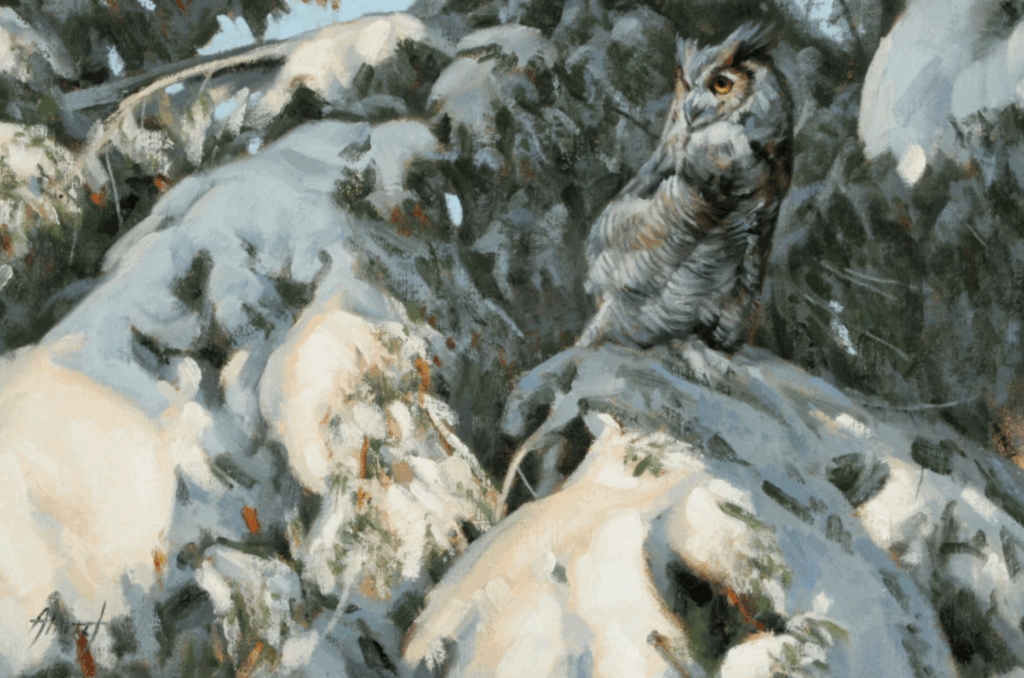
“The subtleties of snow are very hard for a camera to pick up, so the blues are often overstated, and the white is overblown. Direct observation and documentation are key to gather the more accurate information on the varying tones and subtleties of snow,” he said. “An artist becomes aware of just how little pure white or pure blues are used painting snow.”
Painting wildlife is equally tricky given the intricacies of feather and fur coupled with the fact that the artist first must capture reference photographs of camera-shy animals. And though his works convey realistically the essence of animals in the wild, Aldrick isn’t aiming for photorealism.
“To have things look just like photographs is limiting. The art starts where the reference photo leaves off,” Aldrich said. “I’m very conscious not just of photographic representation, but of something more: emotion. The hand of the artist is not a literal translation. I soften edges, warm things up and shift things in a composition. If I’m just translating a reference, that’s not art.”
A PAINTER CELEBRATED LOCALLY AND NATIONALLY
A longtime favorite represented locally at Saks Galleries of Cherry Creek North, Aldrich started off 2025 by winning two prestigious honors at the widely respected Coors Art Exhibit & Sale in January.
Aldrich took home both the Artist’s Choice award and the Art of the West award. Across Colorado, he’s represented by galleries in Steamboat Springs, Durango and Estes Park.
His artistic reputation extends to galleries in Texas, New Mexico, Arizona, Wyoming and Utah. And Aldrich’s artistic status is longstanding. He won his first major painting award in 1986. In 2016, Aldrich won the People’s Choice award at the Western Visions show staged by the National Museum of Wildlife Art in Jackson, Wyo.

A TRANSPLANT FROM MANHATTAN
The artist paints in oils on board or a variety of canvases, but he trained in illustration.
As an undergraduate student at the Rhode Island School of Design (RISD), one of the nation’s finest design schools, he opted out of painting and into illustration.
He credits his intense illustration studies for his refined sense of composition and his keen ability to render almost lifelike details using paints and brushes.
“At that time at RISD, the painting was all abstract. If you didn’t throw paint at a canvas, it was not appropriate,” he said. “I was interested more in representational art. I’d been interested in animals ever since grade school when I did my own little, tiny paintings, tracing and filling in color — an elk in front of aspen trees, a bighorn portrait. It was in my blood since, and I knew it was, and I still love to do this work.”
FROM MANHATTAN TO GOLDEN
Colorado is across the country and worlds apart culturally from the artist’s hometown of Manhattan. Aldrich said he spent the first five years of his life surrounded by concrete until his family moved to upstate New York.
“I got a taste of the outdoors there,” Aldrich said.
His love of nature took root.
Aldrich recalled a grade-school assignment to pick one of the United States and write a report on the state. Presciently, Aldrich chose Colorado.
His dream of living in the American West came true at age 10 when he found himself transplanted to a cabin near Nederland, a small town above Boulder. There, the artist’s respect for wildlife took wing and his affinity for art blossomed in the foothills and forests of the Centennial State.
“I was running around the woods and drawing,” said Aldrich. “I felt so at home there.”
Home now is in Golden. As for his art studies in Denver, Aldrich gave a shout-out to the painter Mark Daily, now mostly retired.
“I took ongoing classes with him,” said Aldrich of Daily. “Mark’s vision, the way he sees things, his choices in art astounded me. He had a different vision than most and a different work ethic than most. He doesn’t take a picture and come back and paint. He experiences what he paints and puts everything into his paintings. More than any other artist, I’m indebted to Mark.”
INSPIRED BY WILD ANIMALS
Aldrich also nods to the animals as his inspiration.
“The spirit of the animal is in the eyes,” he said. “I don’t single out the eyes as something to paint differently, but for some reason people who know my art keep telling me there’s something in the eyes. I think there’s a connection there that I’m riveted to. The truth is, I don’t know what that is, that sense of life and expression in the eyes, but I respect that in all animals.”
Aldrich consistently refreshes his artistic talents and techniques.
“What I’m painting and going for right now is an ongoing exploration of what’s possible in painting,” he said. “Whether painting on boards with a smooth surface or linen or extremely rough canvas, I’m also translating my use of paint itself. In glazing or using impasto thick paint, I’m seeing what effects I can create. I’m always looking at the effect of lighting and composition — where the eye should be drawn to. It’s fun to explore.”
PRAISE FROM AN ARTIST NEXT DOOR
Prolific, Aldrich completes an average of 75 paintings a year. His neighbor for nearly 20 years, the sculptor Patty Stajcar said: “His work ethic is phenomenal. I can see his studio window from my house, and I’ll see his light on at 2 o’clock in the morning. One thing about a very good artist is they can work quickly. I’ve been on a lot of ‘quick draws’ with Ned, and we have an hour and a half to put a piece together. His look like he’s spent two weeks on them.”
Stajcar, also profoundly inspired by nature, added: “He is really inspiring the way he captures the essence of the animal he’s doing whether the strength of bull or serene moment of wolf or a bird in flight. He makes the moment feel larger than life, even if in a little 8” x 10” painting. His work is so dramatic that you feel like you’re right there in the painting with him.”
WILDLIFE CLOSE TO HOME
Aldrich finds wildlife as subject matter close to home.
“Around Denver, one would be amazed how many species of wildlife are close by. Yes, it is not far to travel for elk, bighorn, coyote and many other species by just visiting Rocky Mountain National Park, but much closer to Denver, there are great places for wildlife,” he said.
“Right in the foothills, where I live, there are elk, deer, red fox, turkey and lots of bird life,” Aldrich added. “I have produced many paintings of these subjects from photos taken within walking distance of my home. Bighorns can be seen up Waterton Canyon. Bald eagles can be seen at a number of lakes up and down the Front Range, and owls’ nests are more prevalent than one would think. Birds of all kinds appear seasonally all around the Denver area. There is wildlife all around us if we just stop and observe and do a little research.”
Aldrich said: “Scientists and people who go out and study creatures all know, because it’s so apparent that each animal has their own personality and traits. It’s wonderful! They’re not just automatons with antlers or horns. They’re total individuals.”
“It’s so fascinating watching groups of animals, bighorn or elk or wolves or fox, how individual they are. People tend to think elk is an elk is an elk, but they’re so completely different in their attitudes and aggressions or shyness, even how they look,” the painter said. “The shapes of their faces have such diversity — just as much diversity as human beings how we look and how we act.”
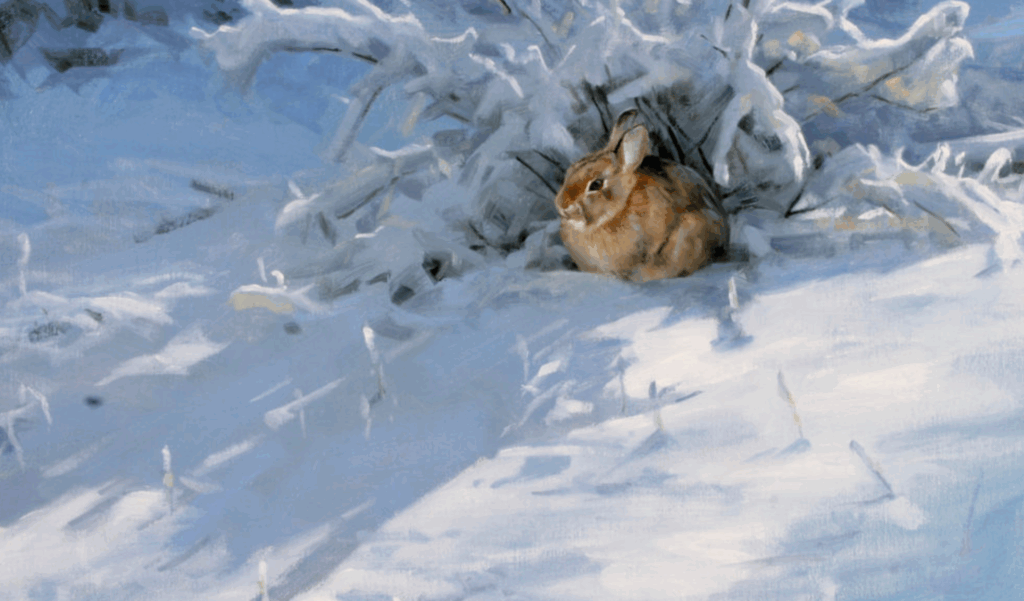
For Aldrich, the outdoors is the way into his creativity.
“On so many different levels, it’s apparent that being out in nature in a forest in a field or what have you gives very tangible benefits to us as human beings,” said Aldrich. “It’s a busy life, a busy world, and everyone is up to all these different things. When we stop and connect with the very base things of Earth and nature and wildlife — at least for me — there’s such joy and grounding.”
As for the ground, Aldrich bemoans the loss of open spaces and the all-too-common lack of reverence for or awareness of our natural world.
“It’s a dwindling resource at this point, and that’s very sad to me and something I hope with my paintings I’m able to somehow rekindle care and inspire people’s connections with nature and remind people of the amazing, gorgeous creatures in our habitats declining almost daily, something that should be around for the future,” Aldrich said. “If we lost these places and these creatures, it’s a true loss to all of us.”