








Denver International Airport neighbors renew pushback on energy expansion plans

Residents of Montbello and Green Valley Ranch living near Denver International Airport voiced concerns at a community meeting about the airport’s request for information for long-term power planning, reviving tensions from an earlier controversy that forced officials to shelve a nuclear-focused study.
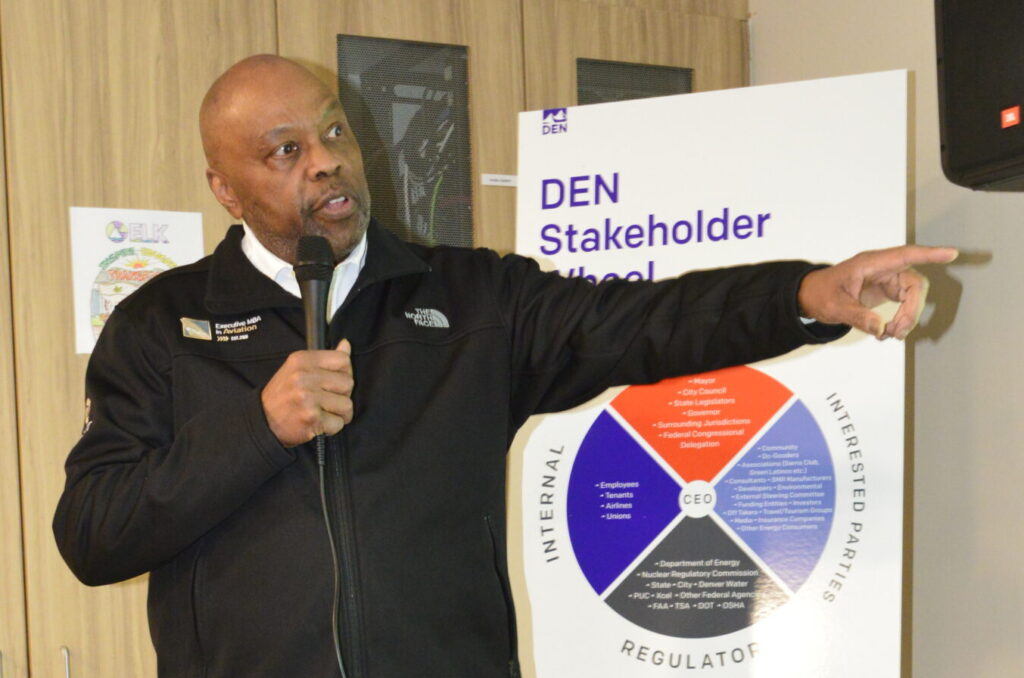
Airport CEO Phil Washington faced questions during the fifth community outreach session at the Environmental Learning for Kids education center, 12680 Albrook Drive in Denver. He described the upcoming request for information as a broad, non-binding effort to gather global ideas for providing reliable energy to serve the airport’s rapid growth.
The airport spans 53 square miles — the largest site in North America — with the main terminal typically 5 to 12 miles from Green Valley Ranch subdivisions to the south and southeast, and 10 to 12 miles from Montbello to the southwest.
This vast property provides room for expansion far from residential neighborhoods. It replaced Stapleton Airport, built in 1930, which was surrounded by a creeping tide of residential neighborhoods over the years, resulting in noise complaints and limits on expansion.
Denver International Airport started construction in 1989 and opened for service on Feb. 28, 1995. It is intentionally located far from existing neighborhoods and is permanently buffered from residential development by the expanse of Adams County land annexed by Denver in 1989.
The airport handled 82.3 million passengers last year, far exceeding its original 50 million passenger capacity design from five decades ago. Officials project 100 million passengers in three to five years and 120 million by 2045.
These projections are driving major expansions, including additions to the north terminal, a consolidated rental car facility that alone needs 40 megawatts of electricity to serve the expected expansion of the EV rental fleet, and new concourse gates. Current power demand stands at 45 megawatts. Washington said it plans to acquire 400 megawatts of capacity by 2050.
Washington said avoiding power outages like those seen at airports in Madrid, London and Atlanta is critically important, which is one reason on-site power generation is under consideration.
In August, airport officials announced a $1.25 million feasibility study for small modular reactors. The proposal sparked immediate backlash, including from Denver City Councilmember Stacy Gilmore, who criticized lack of prior community or council consultation and raised questions about water, waste and safety.
Within days, the airport delayed the request for proposals and effectively withdrew it.
Some attendees demanded exclusion of nuclear options, citing health risks, uranium mining impacts on indigenous communities and limited global supplies.
Gilmore attended the meeting and has led opposition to nuclear. She repeatedly highlighted water usage as a primary concern, questioning potential strains on local resources, limited supply of nuclear fuel and impacts on nearby neighborhoods.
“I would just ask respectfully that you remove the small modular nuclear reactors because, honestly, we haven’t talked about anything about nature,” said Gilmore. “We haven’t talked about anything about the health discrepancies, the health concerns that we already have in our communities.”
Washington flatly refused to take small modular reactors off the table but pledged to share all responses publicly before any blueprint for power development advances. He noted that this is just the beginning of the process and that there will be many meetings and approvals by the City Council before any final decisions are made.
“I’m not taking it off the list, because we do not want to limit the private sector,” Washington said. “We may end up taking it off the list once we get a recommendation and we figure out that it’s too much of a risk to the community. We may take it off the list, but I’m not taking it off the list now.”
Several speakers urged expanded use of renewables, noting the airport’s existing, largest-in-nation solar array. Washington highlighted sustainability efforts but insisted on exploring all paths to create long-term energy resilience.
Washington stressed that no commitments exist yet and that industry responses will guide a multi-decade roadmap that he said will be developed with further public input.
He emphasized that the airport is entirely self-funded through airline fees, parking, and concessions, and collects no sales tax.
Outreach shortcomings drew criticism again.
“Our community has the right to accessible, timely information about projects that you’re doing. Our health and our safety is important now as it will be in 2045 and beyond,” said one unnamed community member. “We are asking Denver to demonstrate that it is committed to the community by having a community agreement that is investing in this community through transparency, shared knowledge, and true collaboration.”
Washington closed the meeting by reaffirming his commitment to transparency and additional meetings to review findings.


Jeffco restaurants face big losses during power outage
Sage Kelley
sage-kelley@denvergazette.com
Updated 8 hours ago
The ongoing Public Safety Power Shutoff (PSPS) by Xcel Energy has caused vexation for businesses still wondering when power will be fully restored. The Evergreen Bread Lounge, nestled off Bergen Parkway, was closed Wednesday and Thursday. General Manager Tyler Butler...

Sage Kelley
Reporter
Colorado defense company wins huge incentives to stay in state for expansion
Bernadette Berdychowski
bernadette.berdychowski@denvergazette.com
Updated 12 hours ago
The Colorado Economic Development Commission awarded more than $58 million in incentives to a growing aerospace and defense company in order to keep a majority of its operations within the state. The unnamed company dubbed “Project Ladybug” plans to make...

Bernadette Berdychowski
Reporter

What’s inside Denver Summit’s community benefits agreement
Bernadette Berdychowski
bernadette.berdychowski@denvergazette.com
Updated 1 day ago
After months of private discussions with neighborhood leaders representing regions around Santa Fe Yards, Denver Summit FC released its community benefits agreement this week. The contract details the team’s negotiations to bring an all-electric women’s soccer stadium, more tree coverage,...
Bernadette Berdychowski
Reporter
Tatiana Bailey: Is the labor market softening?
TATIANA BAILEY Special to The Gazette
tatiana-bailey-special-to-the-gazette@denvergazette.com
Updated 1 day ago
Major economic data points are now trickling in and one of the most important relates to the jobs market. The recent employment report showed modest job growth in November of 64,000 jobs, which is significantly lower than the pre-pandemic historical...


High winds revive memories of Boulder’s historic Chinook storms
Scott Weiser
scott-weiser@denvergazette.com
Updated 1 day ago
With gusts in Boulder peaking at more than 100 mph Wednesday and Xcel Energy shutting down power lines to at least 50,000 people along the Front Range as part of its Public Safety Power Shutoff procedure, it’s worth noting that...
Scott Weiser
Reporter

Holiday events to do in northern Colorado
Shen Wu Tan Special to The Denver Gazette
shen-wu-tan-special-to-the-denver-gazette@denvergazette.com
Updated 15 hours ago
A list of local activities to celebrate the holiday season and New Year ‘Tis the time of the year to celebrate the holiday season with loved ones and to welcome in the New Year! As 2025 wraps up, there are...


Warner Bros Discovery board rejects rival bid from Paramount
Reuters
reuters@denvergazette.com
Updated 1 day ago
LOS ANGELES – Warner Bros. Discovery’s board spurned Paramount Skydance’s $108.4 billion hostile takeover bid on Wednesday, calling the offer “illusory” as it accused the studio giant of misleading shareholders about its financing. Paramount has been in a race with...

Reuters
Reporter

Spirit Airlines eyes merger with Frontier amid restructuring
Bloomberg
bloomberg@gazette.com
Updated 1 day ago
Bankrupt Spirit Aviation Holdings Inc. is in discussions to merge with Frontier Group Holdings, people familiar with the matter said. A transaction could be announced as soon as this month, said the people, who asked not to be identified because the matter is...

Bloomberg
Reporter

Finance chiefs see U.S. prices rising next year, tariffs still a top concern
Reuters
reuters@denvergazette.com
Updated 1 day ago
WASHINGTON – U.S. corporate finance chiefs continue to cite tariffs as a top concern and on average see prices rising more than 4% next year, according to a survey released on Wednesday that may add to Federal Reserve concerns that...
Reuters
Reporter

Medline rises in Nasdaq debut, tops 2025 IPOs
Reuters
reuters@denvergazette.com
Updated 1 day ago
Medline shares rose 20.7% in their hotly anticipated New York debut on Wednesday, valuing the medical supply giant at $46 billion in the largest U.S. initial public offering since Rivian’s 2021 listing, capping a strong year for new listings and...
Reuters
Reporter
PREV
PREVIOUS

Jeffco restaurants face big losses during power outage
The ongoing Public Safety Power Shutoff (PSPS) by Xcel Energy has caused vexation for businesses still wondering when power will be fully restored. The Evergreen Bread Lounge, nestled off Bergen Parkway, was closed Wednesday and Thursday. General Manager Tyler Butler walked into the business Thursday to find a majority of his products wasted, despite being […]

US House passes Colorado Rep. Lauren Boebert's bill to remove gray wolves from endangered species list
A bill sponsored by U.S. Rep. Lauren Boebert of Colorado to delist the gray wolf from federal protections for endangered species cleared the U.S. House late on Thursday, setting up a fight in the U.S. Senate over a measure supporters say would return wildlife management to the states and critics call politically motivated. The measure, […]