Trump stress-tests Thune’s Senate majority with record-breaking year
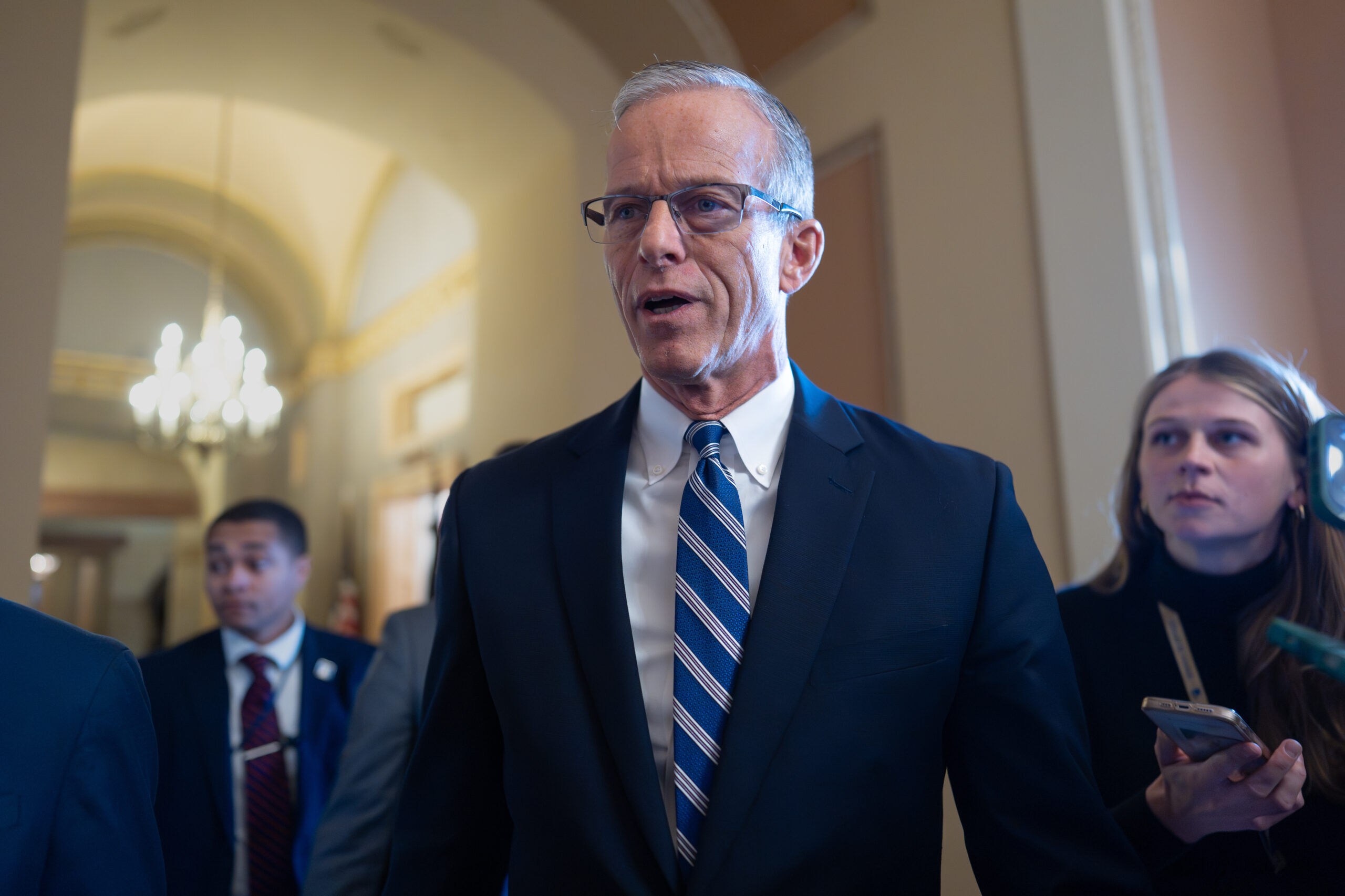
EXCLUSIVE — Senate Majority Leader John Thune (R-SD) is highlighting the raw numbers that made 2025 a uniquely grueling year to argue that Republicans were historically productive in passing President Donald Trump’s agenda.
The Senate cast 659 votes this year, Thune noted in an interview with the Washington Examiner — a number so high, he joked, that you’d have to go back to Sen. Chuck Grassley’s (R-IA) second year in Congress, 1976, to find a bigger total. (Grassley, at 92, is the longest-serving Republican in Senate history.)
In terms of nominees, Thune pointed out that Republicans ended 2025 with well over 400 confirmed, more than any president’s first year since Barack Obama in 2009.
Thune, who became majority leader this past January, readily acknowledges that busyness is not the same as productivity and that the meat of Republicans’ year-end accomplishments can be found in the tax bill they passed by July. But the statistics, and others like it, have become a badge of honor for Thune and something of a shorthand to convey just how demanding the year has been.
It took hundreds of roll-call votes to overcome a Democratic blockade on Trump’s nominees, and several overnight voting sessions to get his legislative agenda signed into law. By the time lawmakers left for the Christmas break, Thune had kept the Senate in session for nearly 180 days.
“It’s been really, really busy, and I think people are ready for a break, obviously, and hopefully next year perhaps maybe not quite as rigorous a schedule in terms of just the amount of days that we’re here, but I do think it’s translated into a lot of good outcomes,” Thune said.
He mentioned the tax cuts in Trump’s megabill, plus its defense funding and expansion of “movement priorities” such as school choice, as some of Republicans’ biggest accomplishments.
“I mean, there were so many things that we did in the One Big, Beautiful Bill that I think are going to have long-term positive consequences, beneficial consequences for people in the country,” Thune added.
There are some outright records Thune can lay claim to — between the House and Senate, Republicans repealed 22 Biden-era rules this year, marking a dramatic expansion of the regulation-ending Congressional Review Act.
In other cases, Thune is sending an unmistakable signal to the White House that, although the Senate is traditionally slow and cumbersome, it’s not an obstacle to Trump’s agenda.
Thune made a point to get Trump’s Cabinet in place within a couple of months of his inauguration, and when Democrats threw up procedural hurdles to delay the confirmation of lower-level nominees, Republicans went “nuclear” and changed Senate rules so that dozens could be approved in a single batch.
“I think we’re doing everything we can to get the team in place, give them the tools they need to do the job that they were elected to do, and the president the agenda the president ran on,” Thune said.
That emphasis on speed and sheer volume hasn’t been enough to satisfy Trump, who has repeatedly demanded that the Senate weaken or suspend its constitutional role of advice and consent. But it has served as a pressure release valve of sorts that allows Thune to end the year touting that his nominee backlog is virtually clear.
On their final day in session, Senate Republicans approved almost 100 nominees in a single vote.
The flip side to that level of productivity is exhaustion. Before Republicans changed Senate rules to confirm nominees more quickly, Thune had to plow through procedural votes that the minority party typically waives in a spirit of bipartisanship.
Republicans also had to endure repeated “vote-a-ramas,” including a record-setting marathon that stretched across more than 24 hours and ultimately cleared the way for the megabill to become law.
It was Democrats forcing those voting marathons, largely to protest Republicans’ cuts to Medicaid, but Trump also frustrated Thune’s colleagues by insisting on a pressure-cooker deadline of July 4 to get the bill passed.
Earlier this month, Sen. Cynthia Lummis (R-WY), 71, announced she would not run for a second term due to how taxing 2025 had been.
“I am a devout legislator, but I feel like a sprinter in a marathon. The energy required doesn’t match up,” Lummis said in announcing her retirement.
Looking ahead, 2026 will be lighter for the Senate simply by virtue of it being an election year. Lawmakers traditionally take the month of October off to campaign in their home states, and Thune won’t need so heavy a schedule at the beginning of the year with Trump’s appointees already in place.
The president also appears satisfied that the megabill encapsulated most of his agenda and does not want another big lift next year.
Still, Thune predicted that Republicans would be able to overcome midterm politics to pass substantive, if less sweeping, pieces of legislation.
The first obstacle will be avoiding another government shutdown in late January, with Thune hoping to jump-start progress on five more full-year spending bills in the new year. Washington will also quickly find out if there’s the appetite for a bipartisan deal to revive premium Obamacare subsidies that expire in a few days.
On the policy front, Thune sees bipartisan opportunities beyond healthcare, naming bills on cryptocurrency, permitting reform, and housing that have momentum in both the House and Senate.
“People will go to their respective corners and towel off and get ready to duke it out for the fall elections, but I still think there are some things that are clearly, hugely bipartisan,” Thune said.


Trump’s affordability conundrum
W. James Antle III, Washington Examiner
w.james.antle.iii.washington.examiner@gazetteedit.wpenginepowered.com
Updated 4 hours ago
President Donald Trump has belatedly recognized the threat the lingering aftershocks of inflation pose to his second term and Republican congressional majorities, but it won’t be easy to wrest control of the affordability narrative back from the Democrats. Trump devoted...


Netanyahu goes to Mar-a-Lago as Trump ups pressure for Gaza peace deal progress
NAOMI LIM Washington Examiner
naomi-lim-washington-examiner@denvergazette.com
Updated 4 hours ago
TEL AVIV, Israel — President Donald Trump and Israeli Prime Minister Benjamin Netanyahu are set to meet at a crucial moment for the ceasefire in Gaza, with Trump poised to push Netanyahu to prepare for Phase 2 of his 20-point...

NAOMI LIM Washington Examiner
Reporter

Patel surging FBI resources to ‘dismantle’ Minnesota fraud schemes
Zach LaChance, Washington Examiner
zach.lachance.washington.examiner@gazetteedit.wpenginepowered.com
Updated 4 hours ago
FBI Director Kash Patel announced that he is surging federal agents and “investigative resources” to Minnesota as a fraud scandal mostly involving Somali immigrants continues to grip the state. In a update on Sunday, Patel said the bureau’s investigation will...

Zach LaChance, Washington Examiner
Reporter

Trump lauds peace talks with Zelensky at Mar-a-Lago, deal is ‘very close’
Zach LaChance, Washington Examiner
zach.lachance.washington.examiner@gazetteedit.wpenginepowered.com
Updated 4 hours ago
President Donald Trump said a peace deal to end the Russia-Ukraine war is “very close” to being reached following his meeting with Ukrainian President Volodymyr Zelensky at Mar-a-Lago on Sunday. Trump met with Zelensky for the first time since October...
Zach LaChance, Washington Examiner
Reporter

Iranian media walk back claim about missile testing ahead of Trump-Netanyahu meeting
Nico Brambila
nico-brambila@denvergazette.com
Updated 4 hours ago
Iranian media sent out mixed signals last week concerning the country’s ballistic missile testing. The confusion comes before President Donald Trump and Israeli Prime Minister Benjamin Netanyahu are set to meet on Monday. Israel and the United States are viewed...

Nico Brambila
Reporter

US pledges $2 billion toward UN humanitarian aid
Nico Brambila
nico-brambila@denvergazette.com
Updated 4 hours ago
The United States pledged $2 billion Monday toward United Nations humanitarian aid. The move comes as the administration remains averse to foreign aid and has warned U.N. agencies to “adapt, shrink or die” in the wake of lost funding. President...
Nico Brambila
Reporter

Trump administration awards rural health ‘transformation’ grants to all 50 states
Christian Datoc, Washington Examiner
christian.datoc.washington.examiner@gazetteedit.wpenginepowered.com
Updated 4 hours ago
The Trump administration announced hundreds of millions of dollars in new healthcare grants for all 50 states on Monday as part of a program launched by President Donald Trump’s One Big Beautiful Bill Act over the summer. The law allocated...

Christian Datoc, Washington Examiner
Reporter

Trump and Netanyahu are to meet in Florida at a crucial moment for the US-backed Gaza ceasefire
Samy Magdy
samy.magdy@associatedpress.com
Updated 5 hours ago
PALM BEACH, Fla. (AP) — President Donald Trump is scheduled to meet with Israeli Prime Minister Benjamin Netanyahu on Monday, as Washington looks to create fresh momentum for a U.S.-brokered ceasefire in Gaza that could be in danger of stalling...

Samy Magdy
Reporter

Former heavyweight champion Anthony Joshua involved in a car accident in Nigeria
Associated Press
associated-press@denvergazette.com
Updated 5 hours ago
LAGOS, Nigeria (AP) — Anthony Joshua, the Nigerian-British boxer and former world heavyweight champion, was involved in a car accident that killed two other passengers in Nigeria on Monday. The Lagos state commissioner for information, Gbenga Omotoso, confirmed the accident...

Associated Press
Reporter
From Pope Francis to Charlie Kirk, many deaths in 2025 had a wide impact
Bernard Mcghee
bernard.mcghee@associatedpress.com
Updated 5 hours ago
The death of Pope Francis brought change to the Catholic Church, which counts 1.4 billion adherents and is now led — for the first time — by an American pope. The fatal shooting of conservative activist Charlie Kirk as he...

Bernard Mcghee
Reporter