







EDITORIAL: Restore Colorado water project ASAP
Without getting into the political intrigue that typically underlies any face-off between the White House and other elected officials in either party — let’s just say President Trump was wrong on Tuesday to jettison legislation for a pivotal water project in rural southeastern Colorado.
And Colorado’s 4th Congressional District U.S. Rep. Lauren Boebert is right to call on Congress to override the president’s veto. Boebert also would support rolling the bill into other legislation and passing it that way. Either way, Congress must act to restore the project.
Whatever else may be brewing under the surface between the president and Colorado is beside the point here. Work on the long-promised, extensively planned and badly needed Arkansas Valley Conduit has to move forward toward completion. Trump’s rejection this week of the bill that would see to it makes no sense on its merits.
H.R. 131 had unanimous, bipartisan support — meaning no opposition from any ruling U.S. House Republicans — as the GOP’s Boebert noted in a report this week by Colorado Politics. Half of the project is located in Boebert’s congressional district and the other half in Republican U.S. Rep. Jeff Hurd’s 3rd Congressional District; Hurd also is a co-sponsor of H.R. 131.
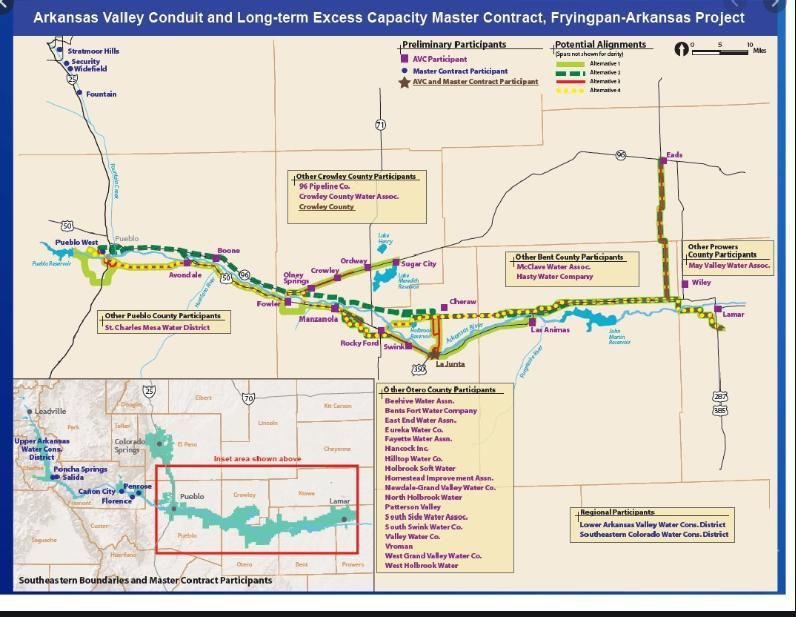
The Arkansas Valley Conduit is a 130-mile-long pipeline that will run from Pueblo Reservoir to Lamar on the Eastern Plains. It will provide clean drinking water to some 50,000 Coloradans in 39 communities in the lower Arkansas Valley, where groundwater is contaminated with unhealthily high levels of naturally occurring selenium.
The veto has upended an epic effort. The conduit first was approved by President John F. Kennedy in 1962 as part of the Frying Pan-Arkansas Project. The original estimated cost was $600 million, but it never got underway because the rural communities in the valley couldn’t afford it by themselves.
In 2009, Congress approved a cost share, with the federal government paying 65% and the state and rural water providers 35%. It was the only realistic way to bring an essential public health service to the region, and that legislation also had bipartisan support with the help of then-Republican U.S. Sen. Cory Gardner and Democratic U.S. Sen. Michael Bennet. The federal government has contributed more than $500 million since then. The state appropriated $100 million — $90 million in loans, $10 million in grants — in 2020.
To help the rural water providers who must repay some of the balance on the loans, Boebert and Bennet also introduced legislation in Congress to spread out the payments. Under the “Finish the Arkansas Valley Conduit Act,” interest would be waived on the loans, and the repayment schedule would be extended to 100 years from its current 50-year term.
All of which was brought to a halt by the veto. All members of Colorado’s Washington delegation are right to object.
The administration’s claim that the project is fiscally unviable — and that it should be paid for exclusively by those who will be served by it — ignores reality. Such a water project, almost my definition, cannot “pay for itself.” It provides a basic, vital human service that requires and warrants broader coordination and support.
This is, of course, a nonpartisan matter; Colorado’s entire D.C. delegation must take action, ASAP. They must see to it the derailed effort gets back on track.