







To add a lane or not: I-270 proposal receives support, pushback

Traffic on Interstate 270, which connects U.S. Highway 36 and Interstate 70 in north Denver, often sits at a standstill. It doesn’t matter if its 10 p.m. on a Monday, 11 a.m. on a Wednesday or 2 p.m. on a Saturday.
Almost no time of day or night gives reprieve from the traffic congestion to commuters and Commerce City residents along the highway, which was built in the late 1960s for travel to and from Denver’s original airport.
June Younger, who has lived in Commerce City her entire life, has seen the highway congestion get worse and worse over the years.
“What used to be gridlock during rush hour traffic has now turned into an almost all-day occurrence,” Younger said.
The Colorado Department of Transportation knows all about the I-270 congestion.
CDOT officials, who have spent years assessing the corridor’s challenges, are trying to find a solution for a highway that handles more traffic than it was built to accommodate, along with its aging and deteriorating infrastructure.
In November, CDOT finally released an Environmental Impact Statement (EIS) outlining the issues, along with proposed solutions. They recommended adding a toll lane to the two-lane highway.
Some residents and area officials agree with the recommendation, saying it may not fix the congestion but it will help, and it is a necessary change for the increasingly slow and dangerous stretch of the highway.

Others, such as environmental advocacy group GreenLatinos, argued that studies show lane additions don’t reduce traffic congestion and they will only cause more health concerns for people who live in the already-air polluted communities of north Denver.
CDOT is hosting three in-person public hearings and two informational webinars in January.
Webinars will take place from 5 p.m. to 6 p.m. on Wednesday, Jan. 7 and from 5 p.m. to 6 p.m. Thursday, Jan. 15.
The dates and times for in-person meetings are as follows. They will be held at Adams City High School, 7200 Quebec Parkway, Commerce City.
•Thursday, Jan. 8 from 5 p.m. to 8 p.m.
•Saturday, Jan. 10 from 9 a.m. to noon
•Tuesday, Jan. 13 from 5 p.m. to 8 p.m.
The public has until Jan. 20 to comment on the recommendation through CDOT’s website.
THE INTERSTATE’S ROOTS
I-270 runs from the U.S. 36 interchange to I-70 in north Denver and has two lanes in each direction, with interchanges at Interstate 76, York Street, Vasquez Boulevard and Quebec Street. The posted speed limit is 55 mph.
I-270 started construction in the late 1960s, with the 3-mile section from I-70 to Vasquez Boulevard opening in 1968, according to CDOT. The addition of the highway was meant to help connect metro area residents to Stapleton International Airport, which opened in 1929 and was replaced by Denver International Airport in 1995.
When it was built, the I-270 project cost $1.4 million for structures and $1.3 million for paving.

The highway corridor now handles more than 100,000 vehicles every day, with up to 17% of those vehicles being freight trucks.
CDOT began looking into options in 2020 to fix a variety of challenges on I-270, which, officials acknowledged, carries “far more traffic than it was designed for.”
“The pavement and bridges are stressed by the traffic loads, and emergency repairs are needed regularly,” CDOT said of the interstate. “The corridor also lacks safe and efficient walking, cycling, and public transportation options for residents and businesses near the highway.”
SAFETY WORRIES
The freeway averages about 42 crashes per mile per year, about 40% more than other similar freeways in Colorado, the CDOT report said.

Between 2014 and 2022, more than 3,000 crashes were reported on I-270, with almost 1,000 reported injuries and 14 reported deaths.
The most frequent crash types were rear-end collisions, sideswipes, and fixed-object crashes, according to the report.

HIGHWAY CONGESTION
The highway often operates at or over capacity, the report said, with more vehicles trying to use it than it is meant to accommodate.
At its posted speed limit, it should take up to eight minutes to drive from end-to-end. It typically takes more than twice that long in the morning and up to 25 minutes in the afternoon, according to data cited by the CDOT report.
Without improvements, peak hour travel times on I-270 are projected to more than double by 2050, according to the report.
Public transit also faces delays on I-270, the report said.
The Regional Transportation District operates a bus route, the Flatiron Flyer 5, connecting downtown Boulder to the Anschutz Medical Campus in Aurora.
RTD data shows that the FF5 operates at average speeds below 35 mph, despite being a freeway route with limited stops. The bus arrives on time less than half of the time going westbound, with the segment of the route along I-270 the primary cause of delays.
In contrast, the report said, the same bus along U.S. 36 uses express lanes and has more dependable travel times on that stretch of the route.
Congestion on I-270 has forced FF5 bus operators to adopt a formal diversion route using I-70 and I-25. In 2023, RTD dispatch reported drivers using the route daily.
DETERIORATING INFRASTRUCTURE
Other issues along the corridor include deteriorating pavement, tight interchange ramps, narrow shoulders and short merge areas.
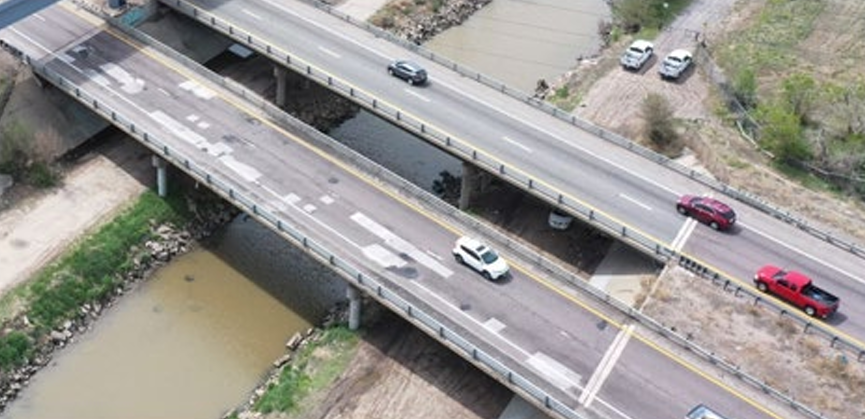
The corridor includes 19 existing bridge structures that were designed to last 50 years, the report said.
Twelve of the 19 are reaching the end of their useful life, requiring much more maintenance.
Over the past decade, CDOT has performed 160 planned and 65 emergency repairs along the interstate, many of which have required peak-hour lane closures.
The infrastructure created for bicycles and pedestrians was limited to begin with, the report said.
I-270 has fewer than two pedestrian crossings per mile, as compared to the metro area’s average of eight sidewalk-connected roadways per mile, according to the report.
FREIGHT CHALLENGES
I-270 is also a critical freight corridor, with no viable alternate routes for many high-priority shipments, including both for regional commerce and national defense, according to the report.
The corridor is designated for nuclear, hazardous and oversized loads that are prohibited from using I-70 or I-25 through Denver.
Colorado’s petroleum fuel supply chain relies on I-270, with more than half of fuel freight trips originating from six fuel racks near I-270 in Adams County. Delays and disruptions on the corridor directly impact fuel delivery across the state.
PATH TO IMPROVEMENT
CDOT and the Federal Highway Administration first planned to prepare an environmental assessment for the interstate. In 2023, CDOT determined that the project was complex enough that it warranted a more detailed review. The process of creating an Environmental Impact Statement started in August 2024.
Their team released the completed EIS in late November, outlining a series of issues and eight possible solutions, recommending the option that would add a toll lane.

A second option would add a general use lane in each direction. The EIS also looked at a no-action alternative to compare benefits and impacts.
Throughout the EIS process, CDOT held meetings for communities to learn about and comment on the project.
The report also highlighted issues with the freeway and the pros and cons of the two different widening project options.
The full report is available on CDOT’s website.
There are several similarities between the two recommendations. Both would add one new travel lane in each direction and reconstruct infrastructure along the freeway, such as shoulders and ramps, to accommodate the additions.
Both plans would also improve and add interchanges and bridges, add new pedestrian and bicycle infrastructure, improve safety for key trails in the area, and upgrade public transit along the corridor.
The major difference between the two options is in how the new travel lane would operate.

Adding a general use lane in each direction would cost $789 million, and adding an express lane in each direction would cost about $806 million.
The latter would bring in revenue from tolls to help fund construction and ongoing operations.
Funding sources would include the Colorado Senate Bill 1 strategic project funds, federal discretionary grants, statewide bridge and tunnel enterprise monies and the Colorado Transportation Investment Office.
ADDING LANES WON’T HELP, CRITICS SAY
Environmental Advocacy group GreenLatinos has been fighting the proposal to widen I-270, saying it would not solve congestion, cost much more than necessary and not prioritize the community and environment around it.
Ean Tafoya with GreenLatinos said there are options that would be better for the community than a widening project, pointing to a lack of multimodal transit information in the EIS and air quality and health worries in the surrounding communities.
“We can do more with this money to generally serve the community than just add another lane that will just add cost in the future,” Tafoya said.
Communities in the area surrounding I-270 are already facing some of the highest pollution burdens in Colorado, Tafoya said, and adding a lane to I-270 would exacerbate traffic and pollution, increase health risks for nearby families and, in the end, likely not fix the congestion in the long term.
Alex Schluntz with EarthJustice, an environmental law firm, told transportation commissioners in a late November meeting that adding lanes would make health concerns and air quality worse, as well as congestion problems.
“Everyone here agrees that congestion is a problem, but decades of science and experience have shown that adding lanes to urban corridors like this one only increases the number of vehicles using the highway, taking us right back to the same congestion without fixing the problem,” Schluntz said.

Some academics back that claim. Others argue that lane expansions would add more carbon emissions.
Susan Handy, a professor of science and policy at UC Davis, who has done extensive research into transportation and lane additions, has published a research study and a book saying adding lanes to a highway is not a solution to congestion.
Numerous studies have examined the effectiveness of adding lanes and consistently show that it does not alleviate congestion long-term because it increases traffic on that roadway, Handy wrote.
Renee Larrarte with Conservation Colorado spoke to transportation commissioners, as well, saying Colorado “urgently” needs transportation investments.
“I’m concerned that CDOT continues to prioritize costly and high-emission highway expansions on I-25 and I-270 instead of investing in sustainable multimodal options communities are asking for,” Larrarte said.
She pointed to the Winter Park express and Bustang public transit lines that have both seen significant increases in ridership over the past year.
“Adding lanes are just going to worsen environmental and health burdens and move Colorado further from our greenhouse gas reduction goals,” Larrarte said.
Nina Marti lives near I-270 and worries about air quality impacts from any highway project, citing an EPA study.
The study found north Denver residents face higher levels of health concerns due to pollution, Marti said, and members of her community suffer from chronic conditions, such as heart and lung disease, at higher rates than those in other areas of Denver.
“In a time where we’re experiencing significant budget pressures, I just have to urge CDOT to consider whether this is the best use of our funds to expand a project that will not reduce congestion and will create harmful impacts on health for the north Denver community,” she said.

A 2025 health study of north Denver neighborhoods co-led by Colorado State University showed that neighborhoods near industrial sites in north Denver have a higher death rate than the Denver average.
Rates of adult asthma hospitalizations, gestational diabetes and other health issues were also higher in the neighborhoods in north Denver near the I-270 corridor.
AN ALTERNATIVE PROPOSAL
Tafoya said GreenLatinos offered an alternative plan to CDOT for consideration.
Called the Healthy Communities No-Widening Alternative, the plan proposes a three-part solution to issues on the interstate.
The plan outlines a differential tolling program that prioritizes transit, trucks and local residents, increased transit capacity on and near the interstate and public health and safety improvements like green buffer spaces, air monitoring tools and enhanced connectivity.

It would use automated license plate readers that distinguish between users, and add tolls to manage congestion, the proposal said.
Money from the tolls would go toward projects along the corridor, including improved transit, safer streets and improved bike and pedestrian infrastructure. The approach could be paired with speed sensors and other safety infrastructure to help keep trucks and commuter traffic of the local street network safe, the proposal said.
CDOT officials are taking the proposal “seriously and treating it as part of the formal environmental review process,” CDOT spokesperson Stacia Sellers said.
‘YES’ TO AN ADDITIONAL LANE
There is always congestion on I-270, at-large Commerce City Councilmember Craig Kim told The Denver Gazette, adding that there are times he would much rather take side streets than use the interstate.
“I believe that this project is needed,” Kim said of adding a lane in each direction. “There’s been a lot of safety and congestion concerns, bridges that are falling apart. It wasn’t meant for the amount of traffic we have today, so the fact that CDOT is moving forward with this project is definitely warranted.”
Kim said adding a toll lane is a good solution, but with a caveat.
In order to make an added toll lane work for residents and businesses in Commerce City, there needs to be a discounted program for people who live and work there, he said.
The southern part of Commerce City is a lower-income area, Kim said. Many of the people who live there would not be able to afford to use the toll lane.
“I’d like to see a form of discounted program for Commerce City residents,” Kim said. “We need an approach where we can make sure it is affordable for residents of the area.”
At-large Councilmember Charles Dukes also agreed that a solution for I-270 congestion is needed. He said he trusts CDOT officials and their data to determine which solution is best.
Dukes also said toll lanes would need to come with a discount program for people who live and work in Commerce City.
Along with changes to the interstate itself, Dukes said he wants to see improvements to walkability and public transit along the corridor.
“There’s excitement about this level of investment in Commerce City,” Dukes said. “The fact that we’re on the priority list is a big win for the city.”
A new general use lane would be a better option than a toll lane, said Younger, who represents the city’s Chamber of Commerce, adding that other improvements would need to happen in tandem. CDOT has included those improvements in both plan options.
“The corridor does need widening,” Younger said. “I am not saying it will solve every issue, but it will improve it.”
New on and off ramps that include continuous lanes from Vasquez to York would make getting on and off the highway much easier and safer, she said.
CDOT also needs to build new bridges “instead of patching holes” and widen the shoulders on the highway for emergency vehicles and drivers with car problems, she added.
“The repairs (to bridges from Vasquez to York) have been like Band-Aids and never really get rid of the problem,” Younger said. “As soon as one pothole on the bridge is fixed, another appears.”
CDOT has engaged the community in meetings throughout the process, ensuring their voices are heard, Younger added.
Julie Duran Mullica, an Adams County commissioner, spoke to Colorado’s Transportation Commission Board at a meeting in November, saying she left her dream job after a little over a year “not because I didn’t love the work” but because the I-270 “made it unsustainable for my family.”
“I believe deeply in multi-modal transportation,” Duran Mullica said. “But here’s the reality. In most of Adams County, transit access barely exists. For many of our residents, transit isn’t an option.”
Brandi Valdez, who has lived in Commerce City most of her life and she sat on the stakeholder committee for I-270, said something needs to happen. Even if adding a lane increases demand, there is already more demand than the highway can accommodate, she said.
“We’re already growing. We already have the congestion,” Valdez said. “It’s a nightmare and it’s a danger. We need another lane. People who oppose it say, ‘If you build it they will come.’ Well, they’re already coming.”