








Denver advances bill to dissolve Office of Special Events

A plan to consolidate the city’s Office of Special Events into Denver Arts and Venues will be advanced to the City Council for consideration.
Members of the Parks, Art and Culture Committee approved a proposed bill on Tuesday that would repeal parts of the city’s municipal code, dissolving the OSE as a standalone agency.
City officials said the move is “largely administrative” and will create annual savings of $1.1 million, increase efficiency and improve service delivery.
The OSE permits and regulates larger public events held on public property, such as festivals, fairs and parades, coordinating with police, fire, emergency services and traffic control.
The office also oversees permits for commercial film and photography on city-owned property.
Annually, the office supports close to 700 authorized event days on public property and provides event consultation for some of Denver’s most recognizable happenings.
“We support city-hosted events like the (holiday) lights, we produce the State of the City and inaugurations, things of that nature, we issue approximately 350 event permits annually, and 250 film permits annually,” said Rose Watts, former OSE deputy director, now director of administration at Denver Arts and Venues. “We coordinate with 20 different city agencies and other city stakeholders, both internal and external.”
The consolidation will not affect staffing, but seeks to revise the definition of a special event to enable better discretion based on event risk and impact.
Specifically, the bill would change the term “special event” to “public permitted event” and update the language to clarify the definition.
“Essentially, the previous definition (of special event) was ‘two or more city agencies,’” Watts said. “It was fairly prescriptive and didn’t allow for discretion when either an event was complex enough to need oversight or simple enough not to.”
Public permitted event, as proposed, will mean “a temporary, pre-planned gathering held on public property owned by the City and County, open to the public, involving permitting by and coordination of multiple city agencies.”
The new definition, as explained by Watts, would exclude passive or continuous use of public space, including programs operated by Denver and expansions of established business operations, such as patio dining or sidewalk sales, and any other uses deemed by the executive director not to be a permitted public event.
Among the bill’s goals is to reduce the administrative burden on smaller community events and to lessen the workload for city staff.
For example, a Denver Arts and Venues permit would no longer be required for small, low-impact events, such as those fully contained within a park, with fewer than 350 participants, with no drones or fireworks.
Other permits, such as park permits, may still apply.
City Council President Amanda Sandoval lauded the consolidation, noting that her office had, in some cases, intentionally kept event numbers low to avoid administrative challenges.
“I’ve had events where I’ve kept them below the number,” Sandoval said. “I didn’t want them (events) to get too big because of the nuance of having to get the office of special events involved.”
The bill is expected to appear before the council very soon, with Denver Arts and Venues anticipating the announcement of the change in early February.


House rejects effort to override presidential veto for Colorado Water Project
Marianne Goodland
marianne-goodland@denvergazette.com
Updated 19 minutes ago
The U.S. House of Representatives on Thursday rejected a Colorado-led effort to override a Dec. 30 presidential veto of a measure that would have helped finance the Arkansas Valley conduit. The measure, known as H.R. 131 and sponsored by U.S....

Marianne Goodland
Reporter

Denver may revise animal bite penalties to consider criminal intent
Deborah Grigsby
deborah.smith@denvergazette.com
Updated 7 hours ago
Denver pet owners are responsible for bites and injuries caused by their animals, facing both civil penalties and criminal charges of up to $999 and 300 days in jail. However, some city officials have suggested that the city consider revisions...
Deborah Grigsby
Reporter
Douglas County commissioners ponder revisiting ‘home rule’ proposal after last year’s failure
Noah Festenstein
noah-festenstein@denvergazette.com
Updated 45 minutes ago
The future of Douglas County chasing “home rule” status may not be in the hands of commissioners, but instead by residents who are considering placing the issue back on the ballot, according to one commissioner. Last March, Douglas County commissioners...

Noah Festenstein
Reporter

Douglas County expects busy year for public safety, business growth, school changes
Noah Festenstein
noah-festenstein@denvergazette.com
Updated 9 hours ago
Douglas County officials made their 2026 goals clear: to maintain a wealthy, healthy and safe environment for the more than 400,000 residents who call the affluent county south of Denver home. From government, law enforcement, business and education officials —...
Noah Festenstein
Reporter

CDOT opens public comment on express lane plan for congested I-270 corridor
Scott Weiser
scott-weiser@denvergazette.com
Updated 9 hours ago
The Colorado Department of Transportation has opened public comment on proposed improvements to the congested Interstate 270 corridor, where heavy traffic, unreliable travel times and aging infrastructure create daily headaches for commuters and freight haulers. The department identified a preferred...

Scott Weiser
Reporter
Former Colorado wildlife director heads to Wyoming
Marianne Goodland
marianne-goodland@denvergazette.com
Updated 2 days ago
Jeff Davis, the former director of Colorado Parks and Wildlife who oversaw the introduction of wolves in Colorado, is headed to Wyoming, where he will take on a new job as deputy director for that state’s game and fish agency....
Marianne Goodland
Reporter
Former Rep. Rose Pugliese vies for Mesa County Treasurer
Marianne Goodland
marianne-goodland@denvergazette.com
Updated 1 day ago
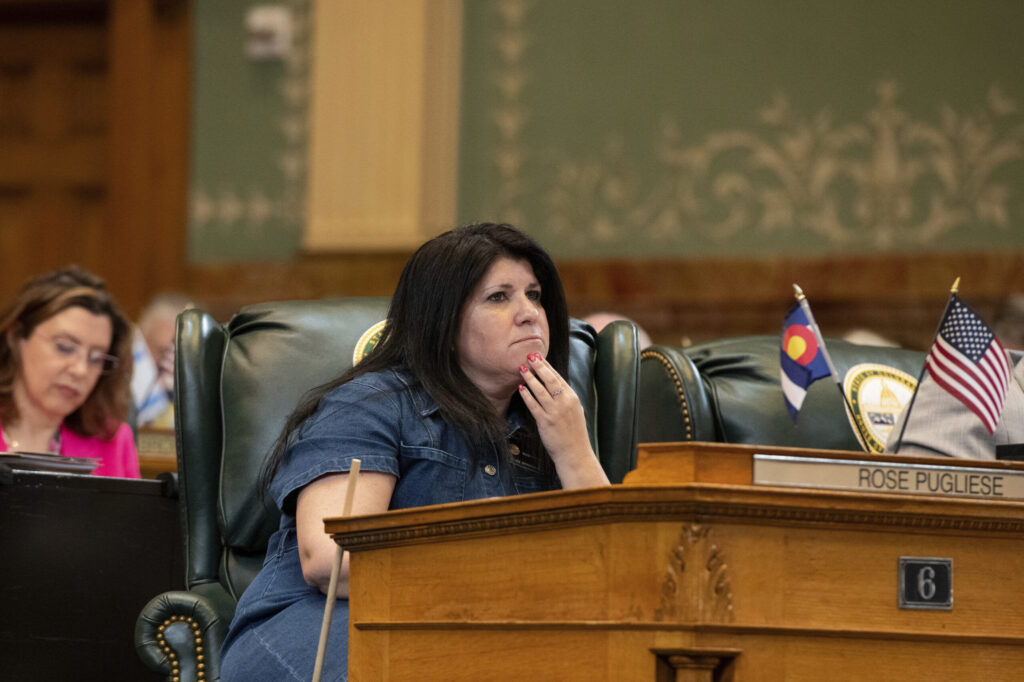
Former Republican Leader Rose Pugliese has jumped into the 2026 primary for Mesa County Treasurer. Pugliese moved to Grand Junction after resigning from the Colorado House in September, citing a “collapse of integrity” within the Colorado House. She previously served...
Marianne Goodland
Reporter

Denver council chambers to get $1.5 million remodel
Deborah Grigsby
deborah.smith@denvergazette.com
Updated 1 day ago
Denver’s historic City Council Chambers is getting a makeover that will bring the space, including the dais where councilmembers sit, into compliance with the Americans with Disabilities Act. The cost of the six–month renovation project is approximately $1.5 million, aimed...
Deborah Grigsby
Reporter

U.S. House weighs override of Trump veto on Colorado water project
Marianne Goodland
marianne-goodland@denvergazette.com
Updated 1 day ago
The U.S. House is expected to consider on Thursday whether to override President Donald Trump’s veto of a bill aimed at helping finance a water pipeline in Colorado. Should it happen, it would be the first attempt at an override...
Marianne Goodland
Reporter

Aurora City Council Q&A: affordable housing
Kyla Pearce
kyla-pearce@denvergazette.com
Updated 31 minutes ago
In November’s election, Aurora voters flipped what was previously a seven-to-three conservative majority on the City Council to a six-to-four progressive majority. With the significant shift of the council’s political leaning could come policy changes and reversals. The Denver Gazette...

Kyla Pearce
Reporter
PREV
PREVIOUS

Aurora Immigrant Affairs Office to host Hispanic-focused business conference
The city of Aurora’s Office of International and Immigrant Affairs is hosting the city’s first Hispanic-focused business conference Saturday. The conference, called “Innovation Unlimited 2026,” will take place from 8:30 a.m. to 3 p.m. on Jan. 10 at the Aurora Public Schools Professional Learning and Conference Center, 15771 E. 1st Ave., Aurora, according to a […]

Former Arvada teacher arrested for allegedly creating child sex exploitation material
Boulder police arrested a former Arvada high school teacher for allegedly filming sexual exploitation videos of juveniles and distributing them on various websites. The Boulder County Sheriff’s Office arrested 39-year-old Patricio Alejandro Illanes after a four-month investigation by Boulder County Digital Forensics Lab detectives and members of the Internet Crimes Against Children (ICAC) Task Force, […]