







Colorado graduation and dropout rates improve as student enrollment continues to slide

Colorado’s graduation and dropout rates continue to go up while its overall enrollment continues to go down, according to new data released Tuesday morning.
The Colorado Department of Education released student graduation data from the 2024-25 school year, with the state’s four-year graduation rate increasing by 1.4 percentage points to 85.6% – the highest in more than a decade.
The statewide dropout rate also improved, declining by 0.3 percentage points to 1.6%, which is the lowest rate in the state’s history.
Since 2016, graduation rates increased from 78.9% to 85.6% in 2025, with 2021 being the only year the rate decreased.
“Colorado’s graduation and dropout data show encouraging progress, with more students earning their diplomas and fewer leaving school before graduation,” said Education Commissioner Susana Córdova in a statement. “We also have work to do to continue closing gaps for students of color, students with disabilities, students experiencing homelessness, economically disadvantaged students, and multilingual learners.
“We need to keep a continued focus on engagement, relevance, and the supports students need to stay connected to school and graduate prepared for their futures.”
A total of 60,387 Colorado students graduated in four years in the 2024-25 school year, an increase of 2,069 students compared to the prior year. At the same time, 1,413 fewer students left school than the previous year.
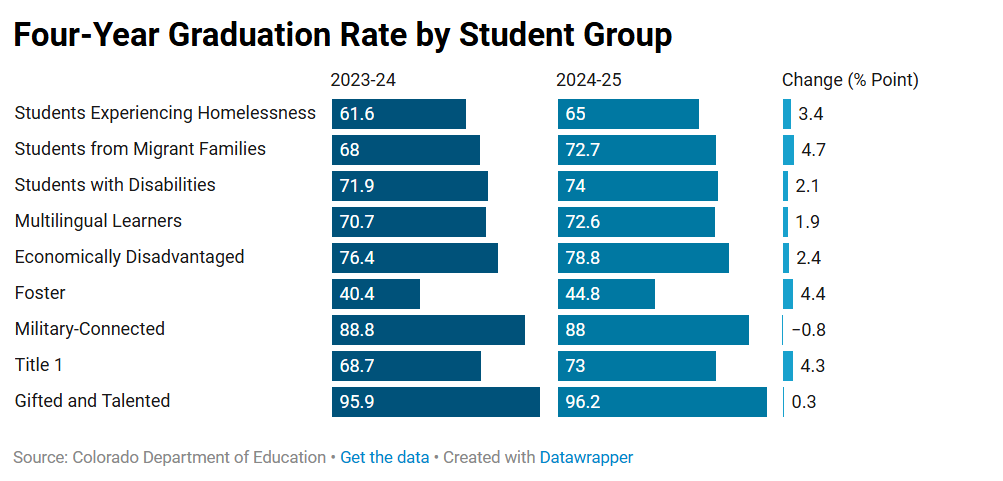
Concurrent enrollment in local universities, expanded career pathways and the opportunity for students to earn workforce credentials and college credits were cited as contributing factors for this continued progress.
Among the districts that experienced gains was the Boulder Valley School District, whose four-year graduation rate increased to 93.3% in 2025 from 92.3% in 2024. The state average graduation rate for spring 2025 was 85.6%.
“As part of our differentiated funding models developed in alignment with the All Together for All Students Strategic Plan, we have surged resources where they are needed most, and thus increased the number of caring adults whose goal is to make sure that every student has the opportunity to succeed,” said Boulder Valley Deputy Superintendent Lora de la Cruz in a statement.
“From our principals to teachers to counselors to dedicated attendance and engagement specialists, our goal is to ensure that students not only earn their diploma, but they are well-positioned for whatever they choose to pursue after graduation.”
Enrollment continues to drop
CDE also reported a total of 870,793 pre-K-12th-grade students enrolled in Colorado schools from its annual October count for the 2025-26 school year. The total marks a decrease of over 10,200 from fall 2024.
“Colorado continues to experience enrollment trends shaped by a declining school-aged population, increasing racial and ethnic diversity, and shifts toward part-time and online learning,” Córdova said in a statement.
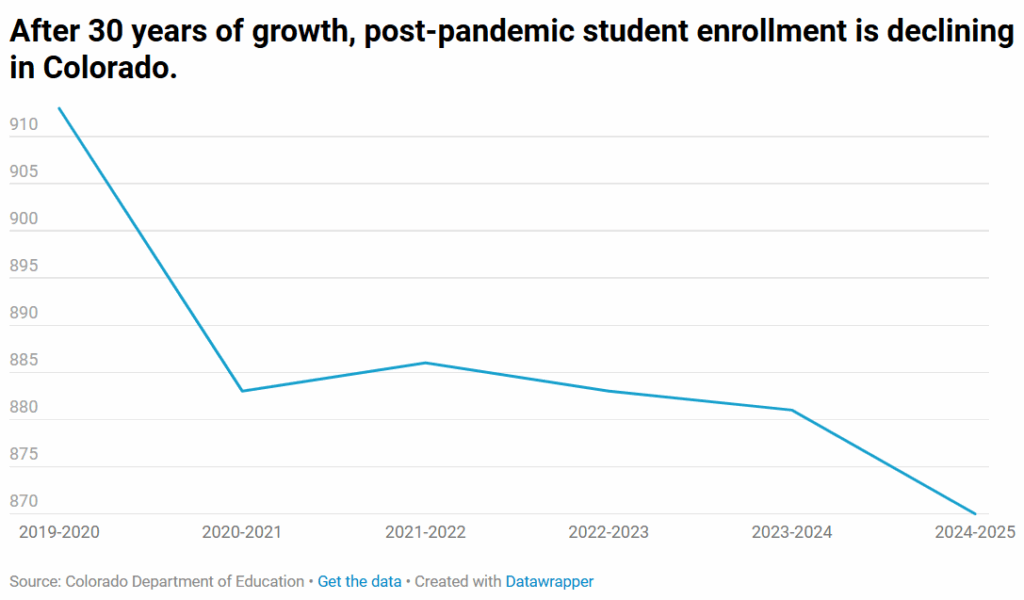
Among the trends contributing to these losses highlighted by the CDE include an increase in homeschooled students and online school enrollment, while data from the Colorado State Demography Office shows a declining number of births statewide across the last two decades and population declines in 30% of Colorado counties over the past 10 years.
CDE reported that, since 2022, online learners increased by 12.4% to over 34,600 students while part-time homeschoolers increased 51.2% to 18,740 and full-time homeschoolers 19.5% to approximately 10,350.
The fall count also reported enrollment declines in nine out of 13 grade levels, while enrollment increased by nearly 4,300 students in pre-kindergarten and the fourth, sixth and 12th grades.
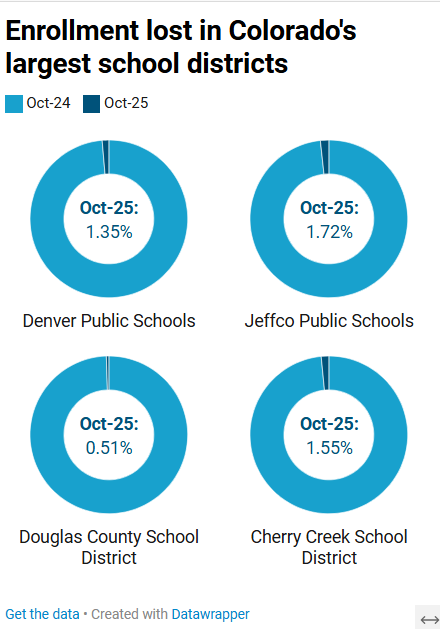
Colorado’s largest school districts all reported decreases in enrollment from the previous year. Denver Public Schools’ enrollment decreased from 90,450 down to 89,210, while Jefferson County R-1 decreased from 79,495 to 74,177 with losses below 2% of their total enrollment.
Experiencing slightly greater losses, Aurora Public Schools reported 1,616 fewer students for a fall total of 38,197, while Adams 12 Five Star Schools lost 1,427 students for a total of 33,039. Both cases marked a 4.1% decrease in enrollment.
Another notable shift in this fall’s data is the total number of Hispanic students enrolled. Colorado reported just over 317,000 this past fall, following a year when they saw significant growth. From fall 2023 to fall 2024, Colorado increased from 312,687 Hispanic students to 321,409.
While officials from CDE didn’t tie decreases to one specific reason during a media call, they suggested that it likely reflects an adjustment following unusually high enrollment from the previous year. Cordova also noted that recent federal policies and the climate surrounding them over the past year may have also contributed to some of these losses.
Other student groups to lose enrollment were white students by 7,318, or 1.7%, and American Indian/Alaskan Native students by 116, or 2.3%.


Denver’s venerable Florence Crittenton school: A goal of healthy, self-sufficient futures
HAP FRY Special to The Gazette
hap-fry-special-to-the-gazette@denvergazette.com
Updated 19 hours ago
By HAP FRY For a first-time visitor, there is a lot to process at 96 South Zuni Street in Denver. The seemingly omnipresent kinetic energy and stimulation can best be described as electric. On this particular mid-December Thursday, there are...

HAP FRY Special to The Gazette
Reporter
Reclamation of historic Pikeview Quarry complete: ‘A great day for Colorado Springs’
Seth Boster
seth-boster@denvergazette.com
Updated 17 hours ago
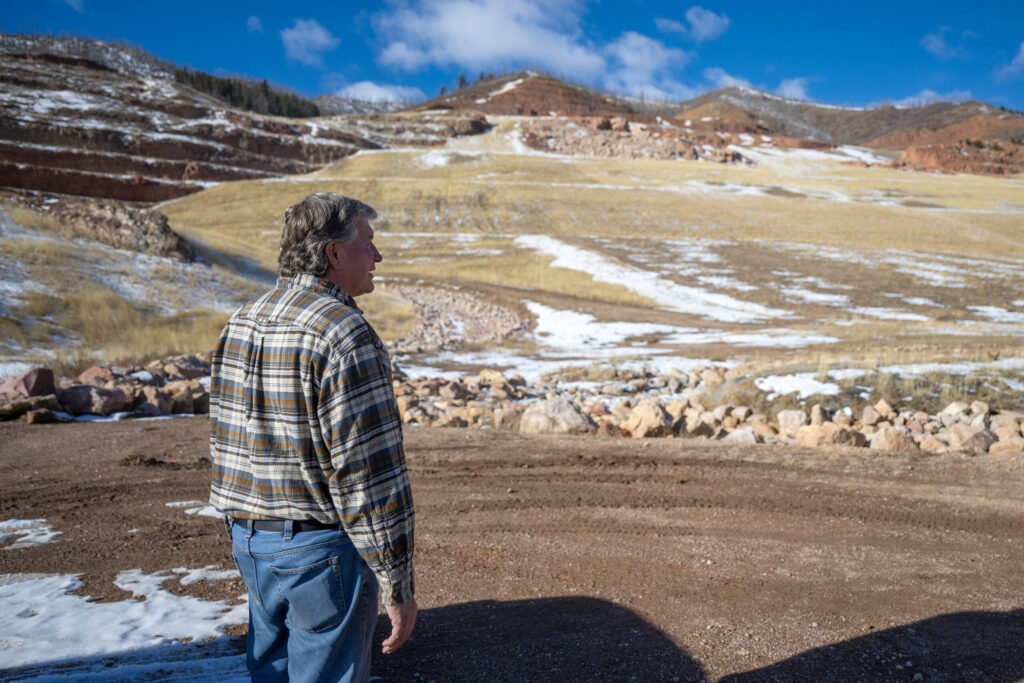
It began small, as some wounds begin ー something like a scratch on Colorado Springs’ northern mountainside. But over 100 years the people below watched it fester, that scratch becoming a scar that would grow and grow along with a...

Seth Boster
Reporter

Denver, Buffalo mayors place friendly wager on Broncos vs. Bills playoff game
Chase Rogers
chase.rogers@denvergazette.com
Updated 15 hours ago
As if the stakes could get any higher for the Broncos on Saturday. Denver Mayor Mike Johnston and Buffalo Mayor Sean Ryan are placing a friendly bet ahead of Saturday’s AFC divisional-round playoff matchup between the Broncos and the Bills....

Chase Rogers
Reporter

PHOTOS: The National Western Stock Show 4-H Day Pro Rodeo Tournament
Stephen Swofford
stephen-swofford@denvergazette.com
Updated 14 hours ago

Stephen Swofford
Reporter
Colorado appeals Trump’s rejection of federal disaster declarations for flooding, fires
The Denver Gazette
the-denver-gazette@denvergazette.com
Updated 15 hours ago
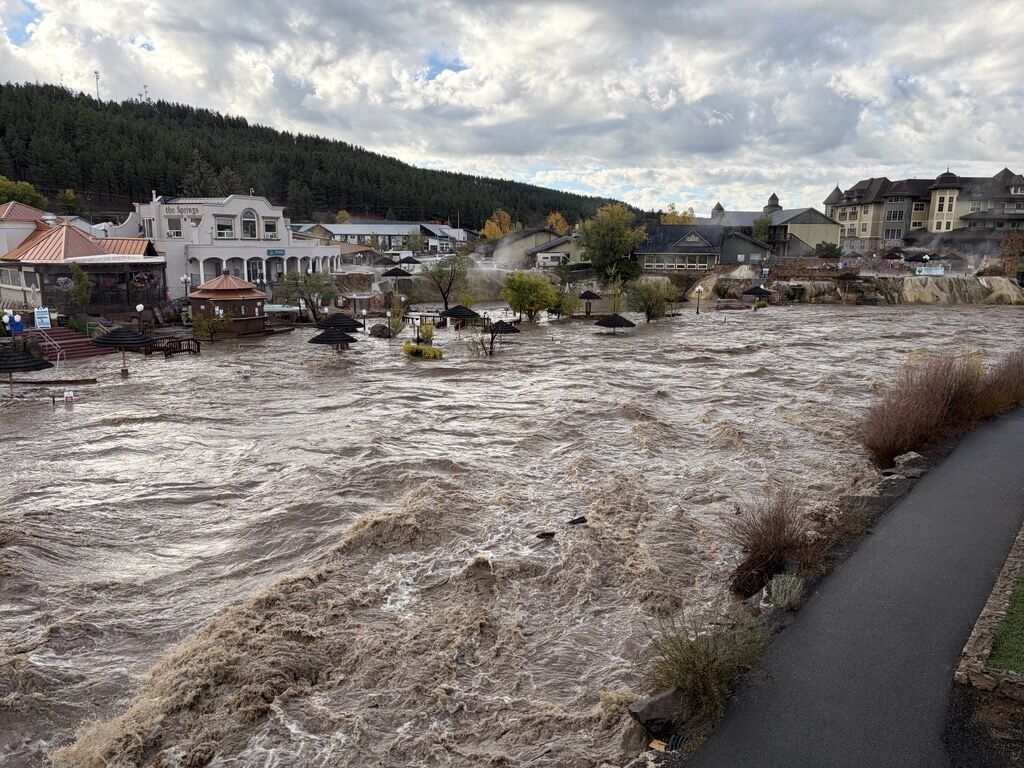
Colorado has formally appealed the Trump administration’s decision to deny requests for federal disaster declarations tied to two wildfires and flooding last year. Gov. Jared Polis said the state asked the federal government to reconsider its denials for the Elk...

The Denver Gazette
Reporter

Denver City Council meeting set for Tuesday, light agenda expected
Deborah Grigsby
deborah.smith@denvergazette.com
Updated 17 hours ago
The Denver City Council will meet on Tuesday as most city offices will be closed on Monday in observance of Martin Luther King Jr. Day. Council members will have a relatively light agenda with no proclamations being issued and no...

Deborah Grigsby
Reporter

With home field advantage, Broncos playoffs could bring Denver economy millions
Bernadette Berdychowski
bernadette.berdychowski@denvergazette.com
Updated 18 hours ago
This weekend, there will be plenty of bills coming out of the wallets of both Denver Broncos and Buffalo Bills fans for the divisional round playoff game. The first playoff game played at Empower Field at Mile High on Saturday...

Bernadette Berdychowski
Reporter

Denver names director of community empowerment
Deborah Grigsby
deborah.smith@denvergazette.com
Updated 18 hours ago
Almost a year after its creation, the city’s Division of Community Empowerment has named its first director, Stephanie Laing, a longtime captain with the Denver Sheriff’s Department, according to a statement from the Office of Human Rights and Community Partnership,...
Deborah Grigsby
Reporter
Colorado city demands action, transparency from Xcel Energy on power shutoffs
Sage Kelly
sage.kelley@denvergazette.com
Updated 17 hours ago
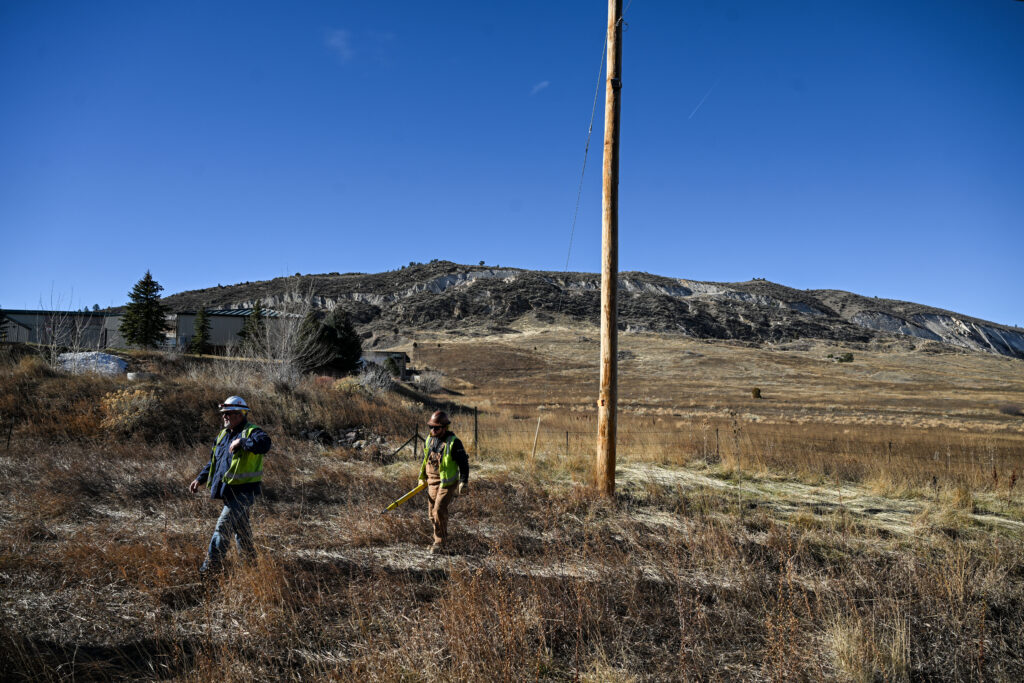
The City of Golden demanded action from Xcel Energy, saying the latter’s power shutoffs caused grief throughout the community, including “financial shocks” and a “disproportionate” impact on one of Colorado’s major tourism destinations. In a letter, city officials said the...

Sage Kelly
Reporter
Colorado pond hockey tournament canceled due to thin ice
Daniel Boniface
dan.boniface@denvergazette.com
Updated 17 hours ago
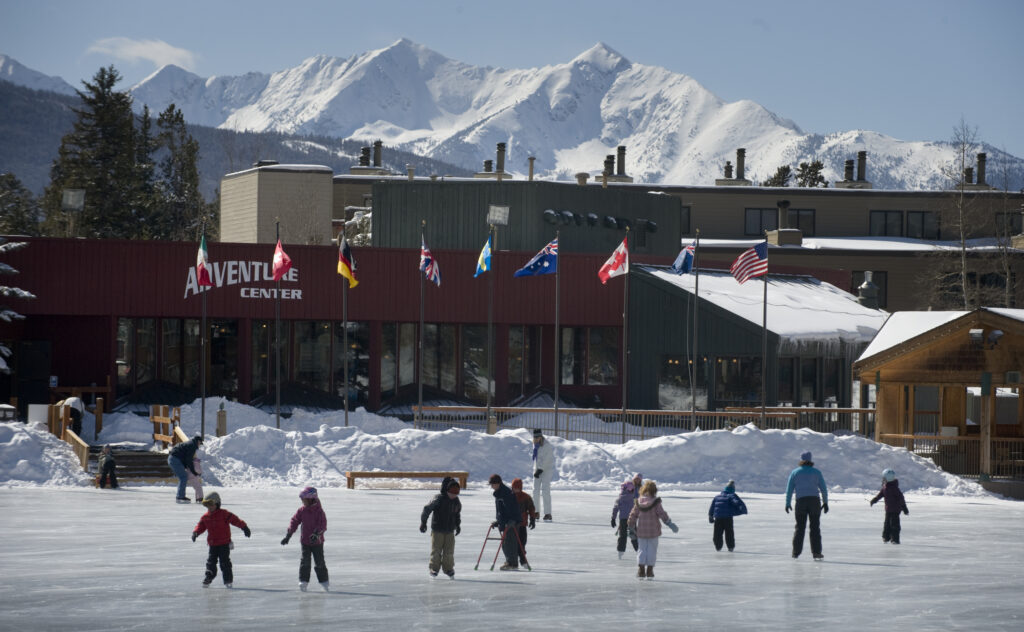
Unseasonably warm conditions in Colorado’s high country this winter forced organizers this week to cancel an annual pond hockey tournament at Keystone Lake. “We are beyond sad to announce that the 2026 – 9280 Pond Hockey Tournament has officially been...

Daniel Boniface
Reporter
PREV
PREVIOUS

7 Buffalo wing spots to try for the Broncos vs. Bills game
Denver brings the heat for the first playoff game of the season, here’s seven places to get some Buffalo wings for game day There is no better way to eat on game day than with traditional bar food, such as wings, fries, and pizza. In the spirit of Denver being the No. 1 seed in the AFC and entering […]
‘Now we’re moving to action:’ $2.5 million grant set to advance recreation goals on Pikes Peak
Local and state officials have big ideas for Pikes Peak recreation and conservation. Now there’s money to support those ideas. Many were outlined in a 491-page “vision plan” last year by nonprofit Pikes Peak Outdoor Recreation Alliance (PPORA), which over the previous decade has convened land managers, advocates and business leaders for regular talks about […]