







Cleo Parker Robinson Dance studio shines in Denver’s Five Points neighborhood
When people walk by the new Cleo Parker Robinson Dance Center for the Healing Arts expansion building, they’ll pass colorful dots they might not realize are instructions of how to dance Parker Robinson’s “Mary Don’t You Weep” — a tribute to Martin Luther King Jr.
The choreography for the dance is written out much like sheet music, using Rudolf Laban’s dance notation called Labanotaion, which maps out every jump, twirl, toss and movement.
Just in time for the civil rights leader’s holiday, this weekend marked the debut of the stunning new building in Denver’s Five Points neighborhood and adjacent to the historic Shorter AME Church, 119 Park Avenue West.
The architects and construction company had to do a delicate dance to complete the 25,000-square-foot, four-level building on just a 6,000-square-foot triangular plot of land next to the church.

Famed Denver-based architect Curt Fentress, known worldwide for his airport designs, including work on Denver International Airport, brought all his team’s problem-solving skills to this one.

Fentress saw a Cleo Parker Robinson performance in the early 1980s, where audiences assembled on the gym floor, and loved the performance and the work Parker Robinson does for the Five Points neighborhood and Denver.
Fentress Studios, a Populous Company, did much of the work pro bono.
“It’s kind of payback, you know,” Fentress told The Denver Gazette, noting he grew up during the civil rights movement, living close to Greensboro, N.C.
CPRD President and CEO Malik Robinson, son of Cleo Parker Robinson and the late Tom Robinson, called Fentress for help.
READ MORE: CLEO PARKER ROBINSON DANCE CENTER GRAND-OPENING COVERAGE
“I went over, looked at it with him, and then I got depressed — because it’s a triangle and it was very tight and right next to a historic building,” Fentress said.
Not to mention all the rectangular rooms required for dance studios, practice rooms and sub-ground floor performance theater with a retractable 240 seating area.
“The city and the setbacks and requirements like that, the historical society that had some purview over what happens near the church or a historical structure,” Fentress said. “And so we very lightly touch the historical structure, but we didn’t attach in any way or manner.
“I call it the kiss.”

Mortensen Contruction handled the building.
“The Cleo Parker Robinson Dance Center for the Healing Arts is where creativity strengthens community and opportunity grows. Mortenson is proud to have partnered with Fentress Studios, a Populous company, Cleo Parker Robinson Dance, and a broad coalition of trade partners to honor Five Points’ history while delivering a modern, sustainable home for dance, learning, and wellness,” said Brian Fitzpatrick, vice president and general manager for Mortenson Construction. “From acoustic engineering and integrated soundproofing to innovative photovoltaic cladding and a sub-grade flex theatre, every choice was made to serve the neighborhood. Together, we created a place where creativity, healing, and opportunity thrive.”
READ MORE: CLEO PARKER ROBINSON’S 2025 TRUE WEST AWARD
Lead designer for the project, Fentress’ Principal Kahyun Lee, described the meticulous process for putting in just the right flooring — floating concrete. CPRD officials actually visited a dance studio in Dallas to test several flooring options, which needed to be suitable for tap, ballet, African Caribbean and others.
There are several levels of concrete, soft flooring, membranes, a topping slab and another spring boot sprung floor, she said.
“If they dance on concrete, they’re going to have a shorter life than the dancer,” Fentress said. “But if they dance on a sprung floor, that’s resilient, so it has a little bounce to it for all the lifts and the jumps and the things that they do in the part as a part of the performance. This will allow their body to recover from all the punishment that they put on it while they’re rehearsing things and performing things.”
Each room is soundproof and the floors are independent, to there’s no unwanted vibrations in other rooms.
“Everything is very unique and thoughtfully designed,” Lee said.
The $25 million project was funded entirely by donations — so it’s paid off.
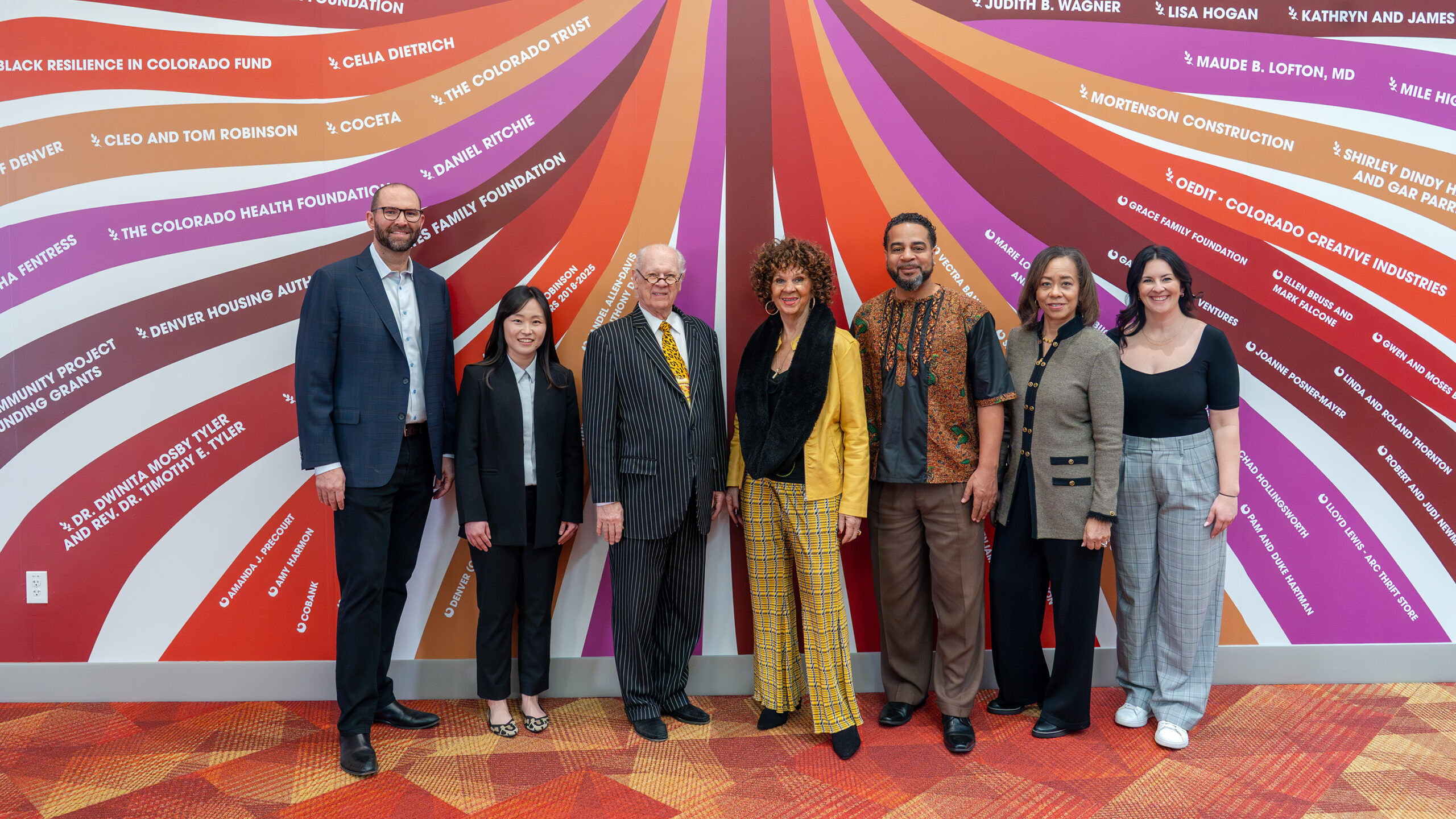
To recognize the major donors, Denver Art Museum’s Jenn Goodrich designed a “Junkanoo Queen” with a colorful, floating dress. It’s based on Afro Caribbean Junkanoo King, who has a skirt made of men’s cravat, but brings the feminine energy to the building and thanks the community that helped build it.
There are gems everywhere to be discovered. The stained glass in one of them includes 55 colors, to match the 55 years CPRD has been in the community — based out of the church. The exterior glass walls are actually solar panels, Lee said.
“We think it’s the first technology installation of street-level solar panels in the United States,” Lee said.

“You know what’s really cool,” Fentress added. “Kahyun worked with the people who supply this and got the price down to where it could be affordable. That’s in addition to designing.”
Parker Robinson’s history is inextricably tied to the historic Five Points neighborhood. And now they have the room to grow and teach even more people to dance.
According to History Denver, she was “born and raised in Five Points. Robinson’s passion for dance started at an early age, and after graduating from Colorado Women’s College and a brief stint in New York, she returned to Denver. After collaborating with Schyleen Qualls, the two began Cleo Parker Robinson Dance in 1970. The company has performed in over 30 countries and welcomes people of all ages, race, gender, and ethnicity.”
