







How video coach Brett Heimlich became unsung hero of Colorado Avalanche coaching staff
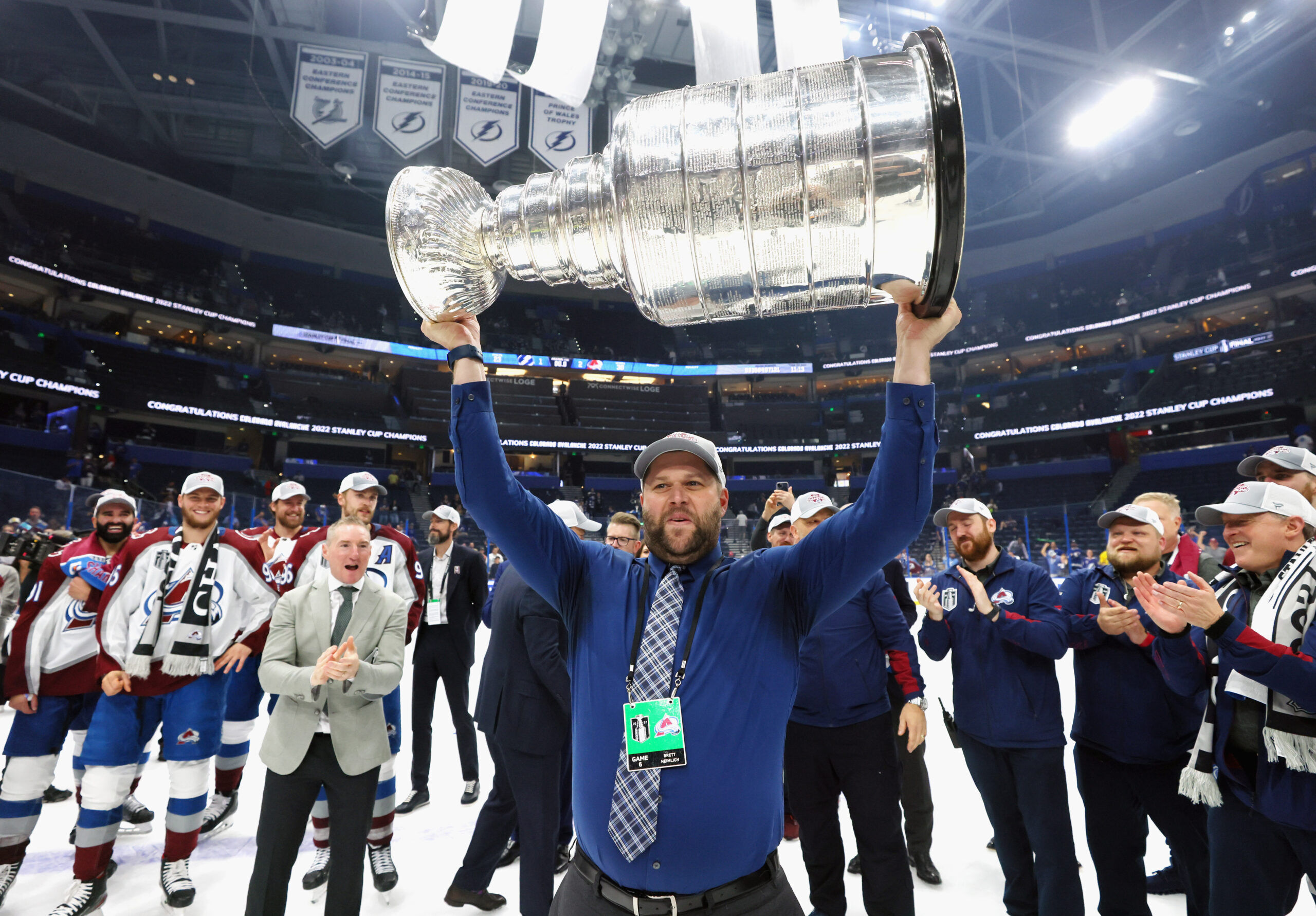
TORONTO — You know Brett Heimlich. You just don’t know what he looks like.
Yet the longest-tenured member of the Colorado Avalanche coaching staff is perhaps its most valuable.
“We wouldn’t be able to operate without him,” coach Jared Bednar told The Denver Gazette.
Heimlich joined the Avalanche one year prior to Bednar’s arrival for the 2015-16 campaign. He does not stand behind the bench with his fellow coaches or the equipment and training managers. Instead, he’s in his office watching the games in real time with his two screens.
Most fans know of Heimlich due to the NHL’s challenge system. He communicates throughout games with Avalanche assistant Dave Hakstol on what he sees that can help the staff make adjustments — and if he thinks there’s something worthy of a challenge from Colorado’s point of view.
His job is so much more than that, though.
“He does all the prep for all the coaches. He gets everything ready for them to sort through,” Bednar said. “He gets ready and digs in on the things he knows I want to see. Same for power play, same for penalty kill. He preps it all and does a great job of it, so we’re not digging through mountains of information and clips to try and figure out what we need to know. He’s dialed right in.
“Most teams have two or three Bretts. He does it all by himself.”

The Avalanche, along with Vegas, are the only teams in the NHL that have just one Brett. How he even got into the business is a story in and of itself.
***
Heimlich was working for the San Jose Sharks as a soon-to-be 21-year-old, but not in any sort of coaching capacity.
“It’s called ‘Tank Patrol,’ so I threw T-shirts in the crowd, kind of like what ‘Ski Patrol’ does (for the Avalanche),” Heimlich told The Denver Gazette.
At a family barbecue, Sharks assistant coach Tim Hunter approached Heimlich. The Sharks did not have a video guy, like a lot of teams in the league at the time. Hunter approached Heimlich with an offer.
Want a shot at being our video coach?
“I had no idea what it was,” Heimlich said.
He agreed and showed up to development camp in July. When he arrived, he was handed a binder with information about the video system, a computer to mess around with and the objective to figure it out.
Which he did.
It began with filming the Sharks’ on-ice testing and putting it into the video system. From there it evolved to working game nights, where Heimlich would start computers and mark faceoff chances, something simple for the staff to break down. They liked that, so it evolved even more to him coming on the next day, finding players’ shifts and burning them onto DVDs for the staff.
That worked out so well for him that he traveled with the team in the postseason and was brought back again the following year. After his second season working with the Sharks the coaching staff was fired, but Heimlich was retained by new head coach Todd McClellan. That’s when he really started to dive into the operations of a video coach at the time.
“By, I want to say Thanksgiving, I was traveling full time,” Heimlich said. “That allowed Jay (Woodcroft) to move up to be more of a full-time assistant coach on the bench, but it was doing a lot of those little projects that get overlooked. It started really evolving (into) what I kind of do now.”
It’s easy these days for Heimlich to get the video he needs. Within five minutes of a period ending, he can download an entire period of hockey and get to work. That wasn’t the case when he started.
Back then, they were still working with DVDs and not every game was televised, even locally. He recalled one time going to a sports bar in Dallas and asking them if they had the hockey package and the Outdoor Network, the NHL’s former television home. They did, so he went to work.
“You bring a computer, bring a capture device, go in their back room, actually start it, start the computer to be able to capture on it,” Heimlich said. “Then you came back and actually had to break it down for the pre-scout.”
And if he wasn’t able to capture video in the back room of a sports bar in another city, he’d call and ask other teams for copies of their games.
“Let’s say you’re going to Toronto. (But) two nights before, Chicago’s in town. You can call Chicago’s video coach and say, ‘Hey, can I get a copy of your game?'” Heimlich said. “He’d be like, ‘Yeah, no problem. I’ll put it above the clock, the ceiling tile to the left.’ You literally would go there in the evening, reach around and grab it. Then you go back to your room and you’d have a rolling cart with a DVD player on it, and you have to live capture the game.”
It’s a good thing technology has come a long way, because the job of the video coach includes some very long days.

***
It’s a Tuesday in January in the dog days of a long season where the schedule is relentless. Heimlich arrives at Family Sports Center bright and early, as always.
“It’s quiet, I kind of do my own thing,” he says.
Less than 24 hours prior, the Avalanche had beaten the Washington Capitals in a matinee at Ball Arena. He’s always working a game ahead. Before the Capitals game had taken place, he had already watched the last two games of Colorado’s next opponent, the Anaheim Ducks. By the time the Avalanche staff had hit the ice for practice that day, Heimlich has the pre-scout ready for their next opponent.
Heimlich has worked with Bednar and assistant coach Nolan Pratt for a decade, so he knows exactly what they’re looking for.
“We’re one of the smallest staffs in the league,” Heimlich said. “We can do that because Jared knows, ‘This is done (and) that’s done. Nolan’s got this, Dave’s got that.’ That’s how we can operate. (I) pretty much know what Jared wants, what Nolan needs, all that.”
Each pre-scout includes roughly 100 clips of the opposing team’s 5-on-5 play, covering everything from faceoffs to zone entries to defensive zone coverage. Bednar then drops clips here and there and presents everything to the team. With a mix of the eye test and the analytics the Avalanche have available to them, they come up with a game plan. Heimlich does the same stuff for special teams and gets those to the assistants.
He’s not done yet.
Beyond the game-plan content, Heimlich gathers clips for the goaltenders and other miscellaneous items, including clips the coaches want for individual meetings with their players. On game days, he gets to the rink early, begins work on the next opponent, finalizes the pre-scout at their morning meetings and watches the morning skate of their opponents to see if they have any lineup changes.
He’s able to sneak away in the afternoon before returning for a special-teams meeting. Then, it’s game time, and he must be just as locked in as anyone.
“I’ll break it down systematically so between periods, we can watch certain things,” Heimlich said. “We can go right to it, narrow it down, even narrow down player shifts and watch just that, try and make the correction between periods.”
That’s not all.
“Obviously, (I’m) in charge of coach’s challenge,” Heimlich said.
If you’re an Avalanche fan who knows who Brett Heimlich is, it’s probably because of the coach’s challenge, which became a thing when he arrived in Denver in 2015. There are many who wish it had never become a thing.
“I have no clue what it is still to this day,” Bednar said of goaltender interference after the win over Washington.
In that game, the Avalanche had a third-period goal taken away after the Capitals challenged for goaltender interference. Washington felt Martin Necas interfered with Charlie Lindgren’s ability to make the save. Given Necas wasn’t in the crease and he didn’t seem to have any impact on Lindgren’s ability to move, it looked like the goal would count. It did not, adding to even more confusion as to what is considered goaltender interference in 2026.
“Like (Bednar) says, they’re never right. The coaches are never right,” Nathan MacKinnon said of goalie interference. “No, ‘Bedsy’ says that. They have no idea what counts. Nobody does.”

Which can be tough to hear when it’s a big part of your job.
“Has (coach’s challenge) made my job harder? Absolutely,” Heimlich said. “You get it wrong, or you provide wrong information, you’ve got the 20 players on the ice that are mad. Then you’ve got management, got coaches, you’ve got the whole world. When you get it right, you’re the king. When it’s wrong, it’s bad.”
Heimlich, like all the video coaches around the league, reviews every challenge that takes place in the NHL. This year, the entire staff started to sit in and watch them so that they’re all prepared.
With goaltender interference being so subjective, they have to.
“It is frustrating (with) goaltender interference, and I’m not the only one,” Heimlich said. “You talk to a lot of my counterparts around the league, and ultimately, I get it. The league doesn’t want challenges. That’s what they’re trying to do. You’ve got to play through previous examples you’ve seen, what your beliefs are, your team, time (and) score, so it’s frustrating.”
But when you get a challenge right, boy, does it feel good.
“Your phone blows up like crazy,” he said. “It’s neat. You’ll get a text message from everyone. It feels good to be a little part of that game. … It’s fun to get that adrenaline rush. I still get nervous as hell. I know for sure it’s offsides, and I get so nervous.”
***
There was an adrenaline rush in early January when a smart challenge turned the momentum of a game back in Colorado’s favor.
After racing out to a 3-0 lead against Ottawa, the Avalanche took their proverbial foot off the gas, giving up two quick goals to the Senators in the second period. That made it a one-goal game. The ice was suddenly tilted and Ottawa looked like it was about to make a comeback.
Not so fast.

Heimlich, who checks every zone entry into Colorado’s end, immediately knew that the Ottawa player had entered the zone prior to the puck. Before he could be sure it was offside, he had to rewind and confirm it was an Ottawa player who sent the puck into the zone and that no one tagged up. After a quick review, he tells Hakstol it’s a play they need to challenge, giving him additional information as to why the refs might have missed this one.
They got this one right, like they do on most offside challenges. When Heimlich says it’s time to challenge for offside, Bednar listens. Goaltender interference? That requires more of a discussion due to its subjective nature.
“On offsides, it’s pretty much nonnegotiable,” Heimlich said. “Goaltender interference, he’s more conservative than I am. I’m probably like ‘let’s go!’ (and) he’ll listen every single time: ‘Hey, this is my argument (and) this is what I see.’ Goaltender interference, we talk a little more over it.”
The hours are long, as are the days. But it’s all worth it for Heimlich. When he gets time in the afternoon he sneaks away to help his wife and pick up their two kids from school. During the Olympics break, he’ll get some time away before getting back to the grind. And in the summers, he tries to work as little as possible. He’s certainly hoping this summer is shorter than the last few.
“We got to lift the Cup (in 2022), which was awesome,” he said. “It makes it worth it.”
Think coaches aren’t competitive? You haven’t met Brett Heimlich. He’s friendly with the other video coaches around the NHL — but not too friendly.
Why?
“I want to win every night,” he said.