







Aurora needs adults, not symbolism | Michael Hancock
Aurora is not short on real problems. We have a public-safety imperative: keep crime trending down and keep it down. We have a humanitarian imperative: move the homeless off sidewalks and into services that restore people to stability, treatment and work — something resembling normal life. We have an economic imperative: expand attainable housing — single-family and multi-family — fast enough to keep Aurora from pricing out ordinary families. We have an infrastructure imperative: rejuvenate aging public infrastructure and expand where growth demands. And we must stop punishing seniors with runaway property-tax increases, period. Now.
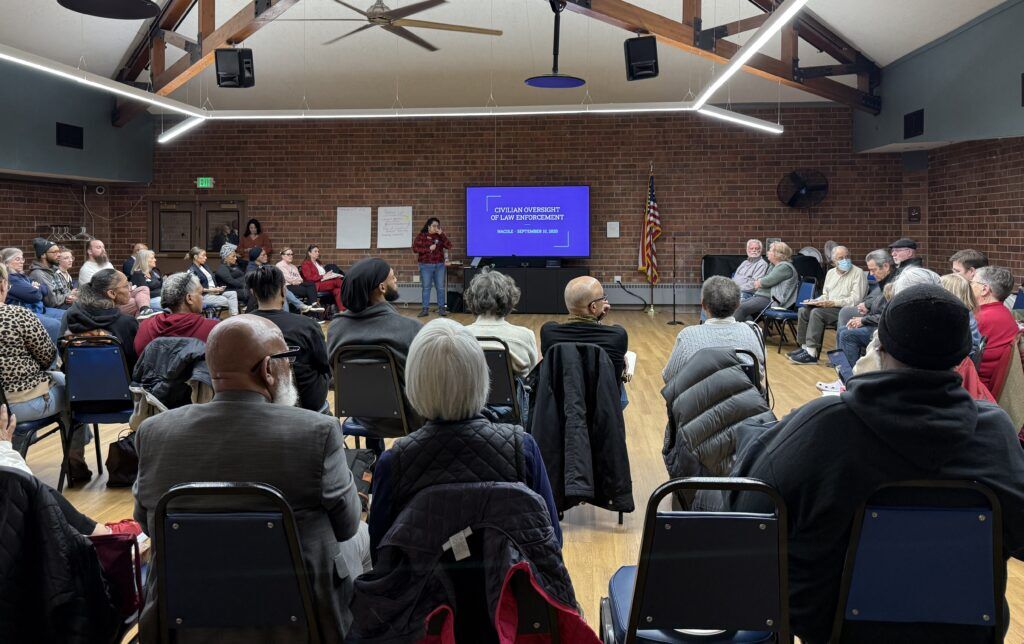
Aurora Councilmember Gianina Horton speaks to a crowd at a listening session about police oversight on Jan. 13, 2025.
That is the stage. That is the script Aurora needs. And yet, the new progressive leadership on City Council has chosen to rehearse a different play.
Not governance. Performance. Not accountability. Deflection.
The problem isn’t that they hold progressive views. Aurora can handle debate. The problem is that, confronted with concrete issues demanding focused competence, they have chosen the soft intoxication of virtue — cheap, theatrical, and functionally useless — while treating an integrity breach in their own ranks as a non-event.
Start with the toothless resolution urging the city to stand as comrades alongside protesters interfering with ICE’s lawful actions in Minnesota.
Minnesota. Not Aurora.
A city council is supposed to govern the city it represents. That is not narrow-minded; it is the definition of the job. When a council spends finite time issuing moral endorsements aimed at events in another state — endorsements that effectively cheer interference with lawful enforcement — what they are really saying is they prefer gestures to responsibilities. It’s the civic equivalent of watching the roof leak and hosting a workshop on the ethics of umbrellas in Wisconsin.
Then there’s council member Ali Jackson’s social-media moment: a video describing how “triggered” she became when Aurora police arrived at an illegal homeless encampment she happened to be visiting — followed by indignation that the officers didn’t allow her title to freeze their actions on the spot.
This matters because it reveals something deeper than one incident: the habit of treating official authority as a moral override switch. “I’m on council” becomes not a statement of duty, but a demand for deference — an expectation that normal procedure should pause until the elected official is soothed.
But police work doesn’t run on vibes. It runs on policy, process and public safety. Officers responding to an illegal encampment aren’t there to host a feelings circle. They are there because a law is being violated, public health is at risk, surrounding residents are impacted, and the city has obligations. When an elected official sees enforcement as offensive simply because it is enforcement, the message to police is clear: do your job — unless it conflicts with my narrative.
A city cannot be governed by narrative.
Which brings us to the push for an “independent citizen police oversight monitor,” framed as empowerment but too often functioning as activist control. Hosting forums is not scandalous. Citizen input can be healthy. Oversight can be healthy. Transparency can be healthy.
But the fine print matters: insinuations that “citizens” — in practice, a narrow band of anti-police activists — should decide who the chief is, and should hold power to punish officers in use-of-force incidents.
That is not oversight. That is politicized prosecution.
If any function must be insulated from political fashion and crowd psychology, it is the monitoring of public safety. You do not improve policing by making it hostage to the loudest microphone. You do not build trust by creating a system where outcomes are determined by who can mobilize the angriest meeting turnout. And you do not reduce crime by teaching officers that the real supervisor is not law and policy, but the mood of the month.
Finally, we arrive at the part they would prefer you not to notice: Council member Rob Andrews’ DUI, and the progressive council’s posture that it is basically a non-issue.
A DUI is not a minor clerical error. It is a breach of judgment that puts lives at risk. And when the person involved chairs the Public Safety Committee, the conflict isn’t merely optics — it is institutional credibility.
Yet when asked whether Andrews should resign or face consequences, Amy Wiles’ response — “I don’t know much; let the legal system play out” — is the language of evasion, not leadership. Ruben Medina’s pivot to Trump as an explanation for inaction is worse: the reflex to turn a local accountability question into a national partisan rant, as if pointing at a distant villain absolves you of immediate duties.
This is how institutional decay begins: not with dramatic corruption, but with the steady normalization of things that should trigger alarms. If the council treats a DUI by the chair of public safety as shrug-worthy, what is the standard for integrity in Aurora government now? And who is supposed to take the council seriously when it lectures anyone else about safety, responsibility, or ethics?
Michael A. Hancock is a retired high-tech business executive and a Coloradan since 1973. Originally from Texas, he is a musician, composer, software engineer and U.S. Air Force veteran whose wide-ranging interests — from science and religion to politics, the arts and philosophy — shape his perspective on culture, innovation and what it means to be a Coloradan.