







Colorado has no need for nationalized elections | Jimmy Sengenberger

When President Donald Trump embraces an approach long pushed by Colorado Secretary of State Jena Griswold, it’s a sign that something is deeply wrong.
On Tuesday, the president declared he wanted a federal takeover of elections, suggesting doing so “in at least 15 places.”
“The Republicans ought to nationalize voting,” Trump said plainly.
He doubled down on Wednesday. “I want to see elections be honest, and if a state can’t run an election, I think the people behind me should do something about it,” he said, referring to the Republican lawmakers flanking him.
“The federal government should get involved,” Trump added, pointing to Detroit, Philadelphia and Atlanta. “These are agents of the federal government to count the vote. If they can’t count the vote legally and honestly, then somebody else should take over.”
Should the federal government actually take over elections? Only if you want to play with fire.
States and municipalities are not “agents of the federal government.” The U.S. Constitution establishes that elections for senators and representatives are the purview of state legislatures.
Since our founding 250 years ago, the United States has empowered states to run their elections. Congress has provided oversight and set certain state standards. But those are limited in scope — and for good reason.
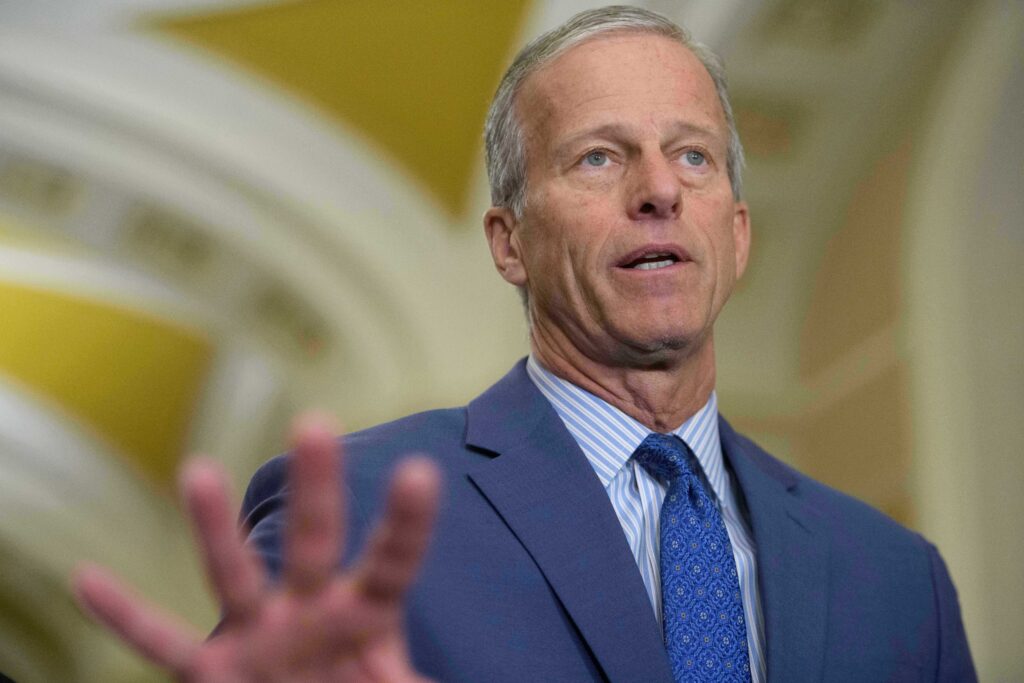
Senate Majority Leader John Thune, R-S.D., speaks during a news conference.
“I’m a big believer in decentralized and distributed power,” Senate Majority Leader John Thune said Tuesday, breaking with Trump. “And I think it’s harder to hack 50 election systems than it is to hack one. In my view, at least, that’s always a system that has worked pretty well.”
Thune is right. The Framers were wise to promote a federal system and, with it, the power for states to control their own election processes.
Most elections aren’t even federal. We elect state, county, municipal, and special district officials, alongside ballot initiatives. The idea that an overzealous federal government should enforce one-size-fits-all elections is antithetical to our federalist system.
And Colorado proves the point.
Colorado has run universal mail elections for nearly 15 years. When we made the switch in 2013, more than 70% of voters were already signed up for automatic, no-excuse absentee ballots — meaning voters themselves chose to receive them. These days, Colorado voters expect it. More than two-thirds vote by drop boxes, not postal mail.
The state has made significant improvements over the years — learning from mistakes and generating best practices, like the statewide risk-limiting audit pioneered here.
Not everything is perfect. Until 2013, county clerks would move voters to inactive status for returned mail or failing to vote, then remove them if they missed two more general elections with no contact. Now, only returned mail triggers the process.
Colorado should restore the previous standard to ensure clean voter rolls. We also need a photo ID requirement and toughened laws against ballot harvesting.
But therein lies the point: These are state-level debates, and states are nimble in a way the feds aren’t. Colorado has been able to tinker and improve because states have that flexibility. A federal takeover would undercut that ability.
Thune offered wise nuance: “I’m supportive of only citizens voting and showing ID at polling places. I think that makes sense. But I’m not in favor of federalizing elections, no. I think that’s a constitutional issue.”
In 2021, Democrats introduced their own election nationalization scheme under the guise of “protecting voting rights.” HR1 would have imposed a one-size-fits-all system for elections across the country, micromanaging everything from voter registration and early voting to vote-by-mail and deadlines.
The bill’s election provisions would have codified some existing Colorado policies into federal law, but it would also have undermined several of the state’s key election security measures.
At the time, Griswold was rising to national fame as a left-wing folk hero against the “Big Lie.” Yet she — the purported champion of Colorado’s “gold standard” elections — called HR1 “urgent” to “fortify democracy.”
Irony, thy name is Jena Griswold: insisting a federal takeover was necessary to evade a supposed existential crisis, even at Colorado’s expense. She was willing to sacrifice our state’s election independence for partisan gain.
HR1 would have upended the table, handing control to Washington — and in doing so, made it far easier for Trump and a Republican Congress to make sweeping, nationwide changes now.
Here’s the rub: If Trump successfully nationalizes elections his way, Democrats will impose their own vision when they return to power. Back and forth we’ll go. Election rules rewritten nationwide with every pendulum swing. States caught in the crossfire. Voters left confused.
What remains to be seen is how Griswold and Colorado’s congressional Democrats react. Griswold will surely protest, conveniently forgetting she championed this same approach five years ago. Sens. Michael Bennet and John Hickenlooper and U.S. Reps. Jason Crow and Joe Neguse all voted for HR1 — to tie Colorado’s hands and limit our ability to continue improving elections. Watch how they all oppose Trump now.
The president should steer clear of this path. Nationalizing elections is a dangerous idea no matter who’s pushing it — be it Jena Griswold or Donald Trump.
The answer isn’t a right-wing version of the Left’s federal takeover. It’s allowing states to keep the freedom to do what they’ve always done: run their own elections.
Jimmy Sengenberger is an investigative journalist, public speaker, and longtime local talk-radio host. Reach Jimmy online at Jimmysengenberger.com or on X (formerly Twitter) @SengCenter.